CIA Reading Room cia-rdp75-00149r000200590012-6: CIA IN MARKET FOR 'WIGGLE SEAT' CHAIRS
 75
75

CIA Reading Room cia-rdp75-00149r000200590012-6: CIA IN MARKET FOR 'WIGGLE SEAT' CHAIRS



Celeste Moreau (Divination & Symbolism Reviewer) — Within this declassified artifact lies an unexpected resonance with ancient divinatory practices. The CIA's pursuit of a 'wiggle seat' chair, a device designed to illicit truth through physiological cues, echoes the shaman's drum or the seer's trance – methods of accessing hidden knowledge. The document, though couched in bureaucratic language, reveals a profound, albeit secular, interest in the subtle energies of the human body. It prompts contemplation on how external stimuli can unlock internal truths, a core tenet in many mystical traditions. This is a fascinating, if unsettling, exploration for those who study the confluence of technology, psychology, and the esoteric.
📝 Description
75
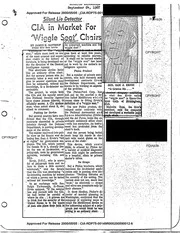
A 1975 CIA document details a 'wiggle seat' chair intended for consciousness interrogation.
This declassified CIA document, designated cia-rdp75-00149r000200590012-6, concerns the potential application of a 'wiggle seat' chair. The text outlines a concept for a chair designed to subtly detect physiological changes, suggesting its use as a tool for probing an individual's truthfulness or mental state. It moves beyond a simple furniture description to frame the chair as an instrument for observing subtle human reactions. The document appears to be an internal assessment or proposal, examining how such a device could serve governmental purposes related to understanding and potentially influencing perception.
It frames the chair as a means to access deeper truths through physiological responses, likening it to an oracle for discerning deception. The document touches upon the convergence of technology, psychology, and methods for perceiving the unapparent. It is presented for readers interested in the covert mechanisms of influence and the subtler aspects of awareness, offering a look at operations that may affect our understanding of reality.
While presented as a government document, the concept of the 'wiggle seat' taps into traditions concerned with the subtle body and its relationship to consciousness. Esoteric thought often explores how physical states can reveal or influence mental and spiritual conditions. This document, though utilitarian in its origin, echoes inquiries found in psychophysical research and certain occult traditions that seek to understand the unseen connections between the material and the immaterial, aiming to discern hidden truths through observable phenomena.
💡 Why Read This Book?
For seekers of hidden knowledge, this document offers a unique lens into the historical development of interrogation techniques that border on the esoteric. Scholars of intelligence history, parapsychology, and symbolic systems will find fertile ground for analysis. Practitioners exploring consciousness manipulation and subtle energy detection will find a compelling case study.
⭐ Reader Reviews
Honest opinions from readers who have explored this book.
❓ Frequently Asked Questions
What is the primary function of the 'wiggle seat' chair?
The 'wiggle seat' chair was conceived as an advanced polygraph, designed to detect deception by monitoring subtle physiological responses of the occupant without their explicit awareness, effectively acting as a silent lie detector.
What makes this document relevant to esoteric studies?
Its relevance lies in the underlying principle of using subtle, often unconscious, physiological cues to access hidden information, a concept mirrored in various esoteric practices focused on mind-body connection and intuition.
Who was the intended recipient or audience for this information?
The document was an internal CIA communication, intended for agency personnel involved in research, development, and operational planning related to interrogation and information gathering.
Does the document provide technical specifications of the chair?
While it describes the concept and its intended function, the document does not offer detailed technical schematics or engineering blueprints for the 'wiggle seat' chair.
Is this document available for public viewing?
Yes, this document is a declassified file from the CIA Reading Room, made available to the public under specific declassification protocols, allowing for study and analysis.
🔮 Key Themes & Symbolism
The Unseen Architecture of Truth
This document probes the very essence of truth-seeking, moving beyond overt questioning to explore the subtle, involuntary expressions of the human form. It suggests a hidden architecture within our physiology that betrays our deepest thoughts. The 'wiggle seat' chair, in this context, becomes a symbolic key, unlocking doors to subconscious revelations. It challenges us to consider how external technologies can be designed to interface with our internal landscapes, mirroring ancient practices of physiognomy and intuition, but through a decidedly modern, and perhaps unsettling, technological lens.
The Esotericism of Surveillance
Beyond its practical implications for intelligence gathering, the concept of the 'wiggle seat' chair speaks to a broader esoteric interest in surveillance – not just of actions, but of internal states. It highlights a desire to perceive what is normally hidden, to bypass conscious defenses and access a more primal, unfiltered self. This aligns with esoteric quests for ultimate knowledge and the desire to see beyond illusion. The chair, in its silent operation, embodies the hidden 'eye' that perceives the unseen, a theme resonant in mystical traditions concerned with omniscience and the unveiling of mysteries.
The Body as a Divination Tool
The document implicitly treats the human body as a sophisticated divination tool. The subtle 'wiggles' and shifts are not mere random movements but coded messages, a language of the subconscious waiting to be deciphered. This elevates the mundane physical form to a status of profound significance, akin to the sacred texts or celestial alignments consulted by mystics. It encourages a re-evaluation of our own physicality, recognizing it as a constant source of information, a subtle oracle that speaks volumes if only we are attuned to its whispers.
💬 Memorable Quotes
Direct passages from the work, attributed to the author.
“Silent Lie Detector”
— This phrase captures the core concept: a device that bypasses verbal communication to extract truth, hinting at a more profound, almost telepathic, form of interrogation.
“unwary person who in- nocently takes a seat”
— This highlights the subtle, almost deceptive, nature of the technology, preying on unsuspecting individuals and their unconscious responses.
“subjected, without his knowledge”
— This emphasizes the clandestine and intrusive aspect of the technology, operating on a subconscious level without the subject's consent or awareness.
“most unusual and expen- sive chairs”
— This suggests the significant investment and innovative design required for such a specialized and technologically advanced apparatus.
“electronic device looks 'like an ordinary office chair”
— This points to the art of camouflage and deception, where powerful tools are disguised as mundane objects to facilitate their operation.
🌙 Esoteric Significance
Tradition
While not directly tied to a specific esoteric tradition, the concept of the 'wiggle seat' chair appeals to Hermeticism's emphasis on 'as above, so below,' suggesting that macrocosmic principles can be observed in micro-level physiological phenomena. It also touches upon Gnostic ideas of hidden knowledge and the unveiling of illusion, where the chair acts as a tool to discern the 'true' state of being.
Symbolism
The chair itself symbolizes a throne of judgment or a seat of power from which truth is extracted. The 'wiggle' represents the subtle vibrations or energies that betray inner states, akin to the tremors of an earth spirit or the subtle shifts in a scrying mirror. The 'silent' nature of the detection symbolizes the hidden, unseen forces at play in human interaction and consciousness.
Modern Relevance
In an age of ubiquitous surveillance and data collection, this historical document serves as a precursor, highlighting the enduring human desire to understand and potentially control the inner workings of others. It prompts reflection on the ethical implications of using technology to bypass conscious consent, a debate amplified by modern AI and biometric surveillance.
👥 Who Should Read This Book
This declassified document is a compelling read for a diverse audience. **Beginners** in esoteric studies will find it an accessible entry point into the intersection of technology, psychology, and the unseen. **Scholars** of intelligence history, Cold War studies, and the history of science will appreciate its unique historical context and implications. **Seekers** of hidden knowledge and unconventional truths will be intrigued by the concept of a 'silent lie detector' and its symbolic resonance. **Practitioners** in fields related to consciousness studies, behavioral analysis, and even those interested in the philosophy of mind will find it a thought-provoking case study.
📜 Historical Context
The latter half of the 20th century, particularly the Cold War era, was a period of intense technological innovation driven by intelligence and counter-intelligence imperatives. This document, dated September 21, 1967, emerges from a time when the CIA was actively exploring unconventional methods for information gathering and interrogation. The burgeoning field of psychology and early advancements in biofeedback and physiological monitoring technologies intersected with state security concerns. This era saw a fascination with mind control, parapsychology, and the potential to exploit human vulnerabilities for strategic advantage. The development of such 'unusual' devices reflects a broader cultural and governmental interest in pushing the boundaries of what was scientifically and ethically permissible in the pursuit of perceived national security. This context provides a backdrop for understanding the motivations behind exploring technologies like the 'wiggle seat' chair.
📔 Journal Prompts
How might the 'wiggle seat' chair symbolize the unconscious desire to know another's truth?
Reflect on a time you felt your body betrayed your true feelings. What were the subtle cues?
In what ways does modern technology continue the legacy of seeking hidden truths about individuals?
Consider the ethical boundaries when technology is used to extract information without explicit consent.
If the 'wiggle seat' chair were a metaphor for a spiritual practice, what would that practice be?
🗂️ Glossary
Polygraph
A device used for detecting lies by measuring physiological responses such as heart rate, blood pressure, and respiration, often referred to as a 'lie detector'.
Declassified Document
A government record that was previously classified for security reasons but has been released for public access under specific regulations.
Physiological Responses
Involuntary bodily reactions to stimuli, such as changes in breathing, pulse, or skin conductivity, which can indicate emotional or mental states.
Consciousness Interrogation
The act of probing or questioning an individual's awareness, thoughts, or mental state, often employing subtle or unconventional methods.
Esoteric
Intended for or likely to be understood by only a small number of people with a specialized knowledge or interest; mystical or secret.
This book appears in 7 collections
🔮 Readers Also Liked
Browse all →









More by CIA Reading Room
All books →




From the “Transcendental Meditation” Collection
View all →









More Free Sacred Texts & Gnosticism Books
View all →