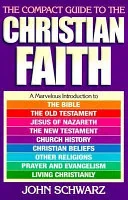
The Compact Guide to the Christian Faith
 78
78

The Compact Guide to the Christian Faith
John Schwarz's *The Compact Guide to the Christian Faith* attempts a broad sweep, covering biblical studies, church history, and comparative religion. Its strength lies in its clear, if sometimes overly simplified, explanations of complex theological ideas. The section on evangelism, for instance, offers practical advice that avoids jargon. However, the book's brevity means that nuanced debates within Christianity or significant challenges from other belief systems are often glossed over. The treatment of non-Christian religions, while present, feels more like a cursory mention than a deep engagement, a missed opportunity given the 'other religious belief systems' mentioned in its blurb. While Schwarz presents the Bible as a foundational text, the work could benefit from more critical engagement with its historical context and diverse interpretations. It serves as a basic roadmap, but readers seeking a critical or deeply interpretive analysis will need to look elsewhere.
📝 Description
78
John Schwarz published The Compact Guide to the Christian Faith in 1999.
This book offers a clear introduction to the core beliefs and historical progression of Christianity. It covers fundamental biblical accounts, the development of church organization, and comparisons with other faiths. The guide also touches on practical elements like evangelism and prayer, aiming to give readers a wide grasp of Christian thought.
It is written for people new to Christian theology or those wanting a brief overview. Students of religion, individuals looking into different beliefs, and church members needing a review will find it useful. Anyone interested in dialogue between faiths or the historical path of major religions can also benefit.
While categorized as esoteric, this guide focuses on mainstream Christian tenets rather than fringe interpretations. Its 'esoteric' nature likely stems from its intent to present complex theological ideas in a structured, accessible format for those seeking deeper understanding beyond superficial knowledge. It addresses the foundational doctrines that inform various spiritual paths within Christianity, positioning them as distinct yet connected elements of a larger whole.
💡 Why Read This Book?
• Gain a foundational understanding of the Trinity, a core Christian doctrine, as explained by Schwarz, allowing for informed personal reflection or comparative study. • Learn about the historical development of the Church, including key events like the Council of Nicaea (325 AD), offering specific historical anchors for understanding Christian evolution. • Understand practical aspects of Christian practice, such as evangelism, as presented by Schwarz, providing actionable insights for personal faith expression.
⭐ Reader Reviews
Honest opinions from readers who have explored this book.
❓ Frequently Asked Questions
What is the primary audience for 'The Compact Guide to the Christian Faith'?
This guide is primarily for individuals new to Christian theology or seeking a concise overview. It's suitable for students of religion, those exploring belief systems, and Christians wanting a refresher on historical and theological points.
When was 'The Compact Guide to the Christian Faith' first published?
The book was first published in 1999, placing it within the context of late 20th-century religious scholarship and apologetics.
Does the book cover non-Christian religions?
Yes, the book includes introductions to other religious belief systems as part of its comparative approach, aiming to provide context for Christian tenets.
What practical aspects of faith does the guide address?
Beyond theological concepts, the guide addresses practical elements of Christian life, including methodologies for evangelism and the practice of prayer.
How does the book approach the Bible?
The guide introduces readers to the Bible, likely covering its significance as a foundational text and perhaps offering basic interpretative frameworks.
Is 'The Compact Guide to the Christian Faith' suitable for academic study?
While it provides a good introduction, its 'compact' nature suggests it is more of a primer than an exhaustive academic text. It offers foundational knowledge useful for further study.
🔮 Key Themes & Symbolism
Biblical Foundations
The work systematically introduces the Bible, presenting its narrative structure and theological significance. It likely covers key figures and events from both the Old and New Testaments, framing them within a coherent theological perspective. The esoteric angle might lie in exploring the Bible not just as historical text but as a repository of spiritual truths and archetypal patterns relevant to inner transformation, hinting at deeper allegorical meanings beyond the literal.
Church History Trajectory
Schwarz outlines the historical progression of Christianity, from its early apostolic roots through major doctrinal developments and institutional formations. This includes key councils and figures that shaped orthodox doctrine. Esoterically, this historical arc can be viewed as the external manifestation of an evolving spiritual impulse, with certain periods or movements representing moments of deeper esoteric insight or its suppression by exoteric structures.
Comparative Religious Systems
A significant component involves contrasting Christian beliefs with those of other major world religions. This section aims to situate Christianity within a broader spiritual landscape. From an esoteric perspective, this comparison highlights common spiritual principles or archetypal themes that recur across different traditions, suggesting a universal underlying truth or a shared human quest for the divine that transcends specific doctrines.
Spiritual Practice
The guide addresses practical applications of faith, specifically prayer and evangelism. It likely offers guidance on cultivating a personal relationship with the divine through prayer and methods for sharing one's faith. Esoterically, these practices are not merely devotional acts but are seen as direct energetic interactions with higher realms and as expressions of spiritual realization, vital for personal growth and outward testimony.
💬 Memorable Quotes
Direct passages from the work, attributed to the author.
“The Bible serves as the primary source for understanding Christian doctrine.”
— This highlights the foundational role of scripture in Christian theology and practice, emphasizing its authority and indispensability for believers seeking knowledge of God's will.
“Understanding church history reveals the evolution of Christian thought and practice.”
— This suggests that the historical context is crucial for comprehending the development of Christian beliefs and institutions, offering a lens through which to view contemporary faith.
“Prayer is a direct communication with God.”
— This emphasizes the personal and relational aspect of prayer, portraying it as a dynamic dialogue between the individual believer and the divine.
“Evangelism is the act of sharing the Christian message.”
— This defines evangelism as a core mission of Christianity, focused on the proclamation and dissemination of its central tenets to others.
“Christianity shares common ground with other world religions.”
— This points to an underlying unity or shared human spiritual impulses across different faith traditions, suggesting potential for interfaith understanding.
🌙 Esoteric Significance
Tradition
While not explicitly aligned with a single esoteric lineage, the guide's focus on foundational Christian texts and history positions it within the broader study of Western esotericism, particularly traditions that engage with Christian symbolism and theology. It can be seen as a gateway text for those exploring the esoteric dimensions of Christianity, such as Gnostic or Hermetic interpretations, by providing the exoteric framework upon which such interpretations are often built.
Symbolism
The book likely touches upon core Christian symbols such as the Cross, representing sacrifice and redemption, and the Dove, symbolizing the Holy Spirit. Esoterically, the Cross can be viewed as a symbol of cosmic balance and the union of divine and human, while the Dove signifies divine inspiration and spiritual awakening, aspects often explored in mystical traditions seeking direct experience of the divine.
Modern Relevance
This guide remains relevant for contemporary thinkers and practitioners interested in the historical and theological underpinnings of Christian mysticism and esoteric traditions. It provides a solid reference point for individuals exploring the integration of Christian faith with practices found in New Age spirituality, comparative mythology, or modern occult studies that draw heavily on Christian archetypes.
👥 Who Should Read This Book
• Beginning students of comparative religion seeking a clear introduction to Christian beliefs and history to contextualize their studies. • Individuals exploring personal spirituality who are interested in understanding the core tenets of Christianity before studying more esoteric interpretations. • Church educators or lay leaders looking for a straightforward resource to explain foundational Christian concepts to new members or study groups.
📜 Historical Context
John Schwarz's *The Compact Guide to the Christian Faith*, first published in 1999, arrived at a time when religious studies were increasingly interdisciplinary. The late 20th century saw the rise of postmodern thought, which challenged grand narratives and universal truth claims, influencing how theological texts were approached. Simultaneously, a resurgence of interest in traditional Christian apologetics sought to provide reasoned defenses of faith. Schwarz's work can be seen as an accessible entry point into Christian thought, distinct from the more academically rigorous theological scholarship of figures like N.T. Wright or the emerging critiques from scholars like Karen Armstrong, who focused on comparative religious history. The book aimed to provide a clear, foundational understanding of Christianity, perhaps as a counterpoint to the fragmentation and skepticism prevalent in the era.
📔 Journal Prompts
The Bible's role as a foundational source for Christian doctrine.
Key events in church history shaping Christian thought.
The concept of prayer as divine communication.
Comparing Christian tenets with other religious belief systems.
The practice of evangelism as sharing a message.
🗂️ Glossary
Trinity
The Christian doctrine stating that God is one being who exists eternally as three co-equal persons: the Father, the Son (Jesus Christ), and the Holy Spirit.
Incarnation
The belief that God the Son became human in the person of Jesus Christ, taking on flesh and human nature while remaining fully divine.
Resurrection
The belief that Jesus Christ physically rose from the dead on the third day after his crucifixion, a central event in Christian theology.
Evangelism
The practice of spreading the Christian message, often through preaching, teaching, and personal testimony, with the aim of conversion.
Apostolic
Relating to the apostles, the primary disciples of Jesus Christ, or the early church founded by them. Often implies continuity of doctrine or authority.
Doctrine
A belief or set of beliefs held and taught by a church, religious, or political organization.
Council of Nicaea
An ecumenical council of Christian bishops convened in Nicaea in 325 AD by the Roman Emperor Constantine I. It produced the first uniform Christian doctrine, the Nicene Creed.
This book appears in 1 collection
🔮 Readers Also Liked
Browse all →









From the “Soul Travel” Collection
View all →









More Free Sacred Texts & Gnosticism Books
View all →