Alchemy & Hermeticism: Core Texts and Study Guides

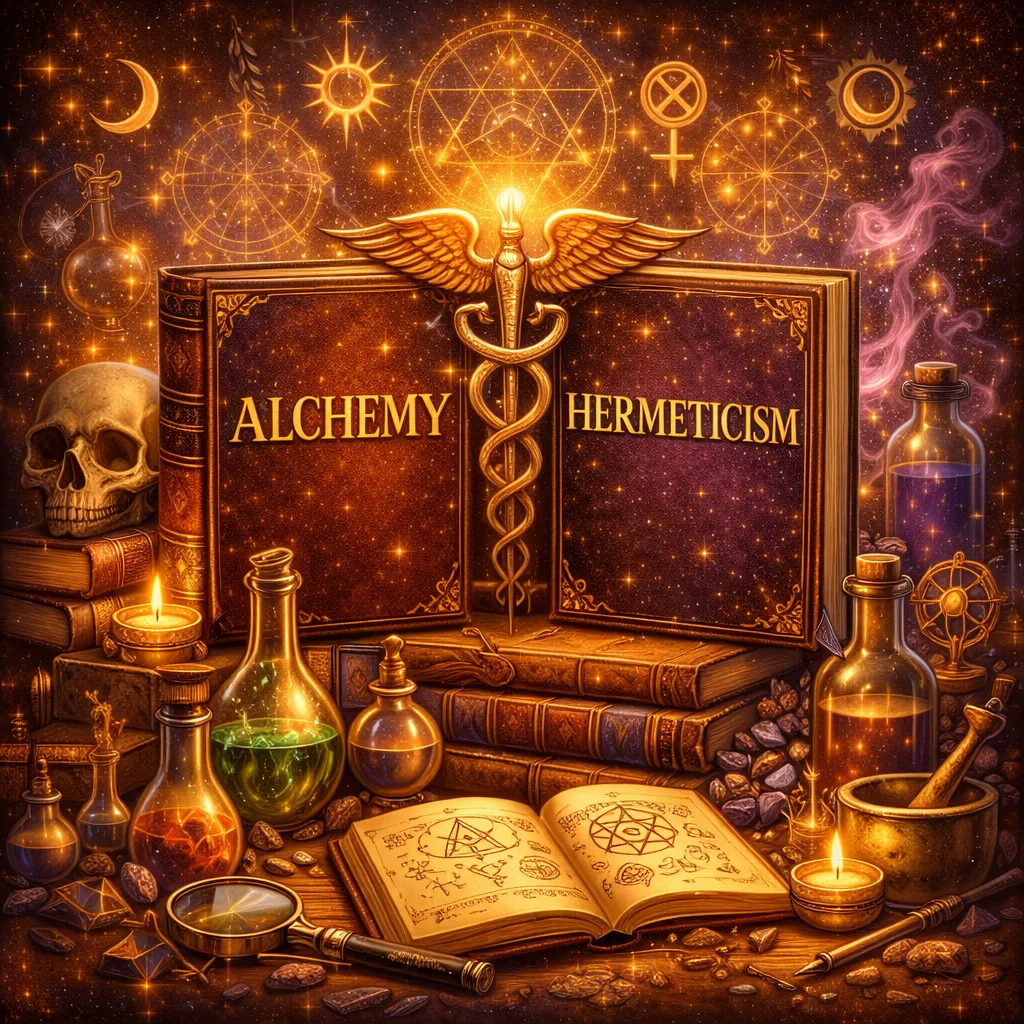

Ancient transmutation arts, Hermetic philosophy, Emerald Tablet, and the Great Work
Texts on Alchemy and Hermeticism trace a philosophical and spiritual lineage from ancient Egypt and Greece to modern interpretations. Works such as The Corpus Hermeticum and The Kybalion provide foundational concepts, while authors like A. E. Waite and Joscelyn Godwin offer scholarly and practical explorations. This curated selection aids students in understanding the principles, symbols, and historical development of these interconnected esoteric traditions. Below, find key texts, author profiles, and a structured reading plan.
















































Reading Order
Three paths · pick by your level
🌱
Beginner
- Provides a clear, concise overview of the core Seven Principles of Hermeticism.
- Introduces the essential visual language and common symbols used in alchemical texts.
- Offers a modern perspective on a specific, often misunderstood, branch of alchemical practice.
- A general introduction that covers historical context and basic concepts.
- Explores the symbolic meanings behind alchemical imagery and practices.
🌿
Intermediate
- A foundational text of Hermetic philosophy, essential for understanding its origins.
- Compares and contrasts Western alchemy with its Taoist counterpart, broadening understanding.
- Details the history and teachings of a significant esoteric organization influenced by Hermeticism.
- A deep dive into alchemical symbolism, particularly within French architectural traditions.
🌳
Advanced
- Direct access to the complex theories and writings of a key figure in Renaissance alchemy.
- A psychological interpretation of alchemical symbolism, linking it to the process of individuation.
- Explores the deep connections between ancient Egyptian cosmology and Hermetic principles.
Why Each Book Matters
What is Alchemy & Hermeticism?
Alchemy is a proto-scientific and philosophical tradition focused on the transmutation of matter, often symbolizing spiritual purification and enlightenment. Hermeticism, rooted in texts attributed to Hermes Trismegistus, outlines a cosmology and spiritual philosophy emphasizing divine knowledge, the interconnectedness of all things, and the potential for human ascent. These traditions frequently overlap, with alchemical practices seen as a material manifestation of Hermetic principles. Key concepts include the Emerald Tablet's aphorisms and the correspondence between macrocosm and microcosm.
Best Books for Complete Beginners
For those new to the subject, starting with accessible overviews is crucial. The Kybalion [A Study Of The Hermetic Philosophy Of Ancient Egypt And Greece] (2014) offers a concise summary of core Hermetic principles. Donald Tyson's Sexual Alchemy provides a modern lens on a specific alchemical practice. A. E. Waite's Pictorial Symbols of Alchemy serves as an excellent visual introduction to common alchemical imagery, aiding comprehension of later, more complex texts. These books lay a foundation for understanding the symbolic language and core ideas.
Intermediate Reading
Moving beyond introductory concepts, intermediate texts delve deeper into specific traditions and historical contexts. Joscelyn Godwin's The Hermetic Brotherhood Of Luxor examines a significant esoteric order. Fulcanelli's Dwellings Of The Philosophers is a seminal work on French alchemical symbolism, though dense. The Way Of The Golden Elixir - An Introduction To Taoist Alchemy (Neidan) bridges Western and Eastern alchemical thought, offering comparative perspectives. These works build upon foundational knowledge with more detailed analysis and historical accounts.
Classical / Advanced Texts
Serious students will engage with primary source material and complex analyses. The Corpus Hermeticum (2014) is a cornerstone text, presenting dialogues attributed to Hermes Trismegistus. A. E Waite's The Hermetic And Alchemical Writings Of Paracelsus Vol II (1894) provides access to the works of a pivotal alchemist. C.G. Jung's Volume 13 Alchemical Studies offers a psychological interpretation of alchemical symbolism, connecting it to the individuation process. These texts require dedicated study and often benefit from accompanying commentaries.
Reading Order — Step by Step
Begin with foundational Hermetic philosophy and accessible alchemical symbolism. Weeks 1-2: Read The Kybalion for core principles and A. E. Waite's Pictorial Symbols of Alchemy for visual vocabulary. Month 2: Explore The Corpus Hermeticum, perhaps alongside a modern commentary, and delve into Donald Tyson's Sexual Alchemy for a specific practice. Month 3: Engage with intermediate texts like Joscelyn Godwin's The Hermetic Brotherhood Of Luxor or The Way Of The Golden Elixir. Advanced study can then proceed to Paracelsus or Jung, with Fulcanelli as a challenging but rewarding goal.
Other categories
Alchemy & Hermeticism
3093
Astrology & Cosmology
2043
Divination & Tarot
2212
Kabbalah & Jewish Mysticism
126
Magic & Ritual
149
Mysticism & Contemplation
610
Occult Philosophy
891
Theosophy & Anthroposophy
597
Witchcraft & Paganism
1183
Freemasonry & Secret Societies
1914
Spiritualism & Afterlife
77
Sacred Texts & Gnosticism
276
Supernatural & Occult Fiction
22
Spiritual Development
50
Esoteric History & Biography
33

Browse Esoteric Library
📚 All 52,000+ Books
🜍 Alchemy & Hermeticism
🔮 Magic & Ritual
🌙 Witchcraft & Paganism
⭐ Astrology & Cosmology
🃏 Divination & Tarot
📜 Occult Philosophy
✡️ Kabbalah & Jewish Mysticism
🕉️ Mysticism & Contemplation
🕊️ Theosophy & Anthroposophy
🏛️ Freemasonry & Secret Societies
👻 Spiritualism & Afterlife
📖 Sacred Texts & Gnosticism
👁️ Supernatural & Occult Fiction
🧘 Spiritual Development
📚 Esoteric History & Biography