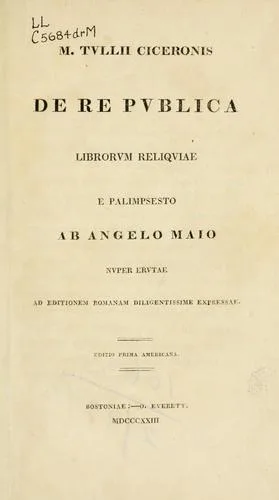
De republica
 66
66

De republica



Silas Hawthorne (Hermetic Studies Editor) — Cicero's 'De re publica' remains a cornerstone for understanding the esoteric underpinnings of Western political thought. Beyond its historical significance, the work offers profound insights into the Platonic ideal of the soul mirrored in the state, and the 'Dream of Scipio' serves as a potent allegorical map of the afterlife and cosmic justice. Its exploration of the mixed constitution can be seen as an early attempt to harmonize seemingly opposing forces for societal equilibrium, a principle echoed in various hermetic traditions. This volume is essential for scholars of ancient philosophy and practitioners seeking to draw wisdom from the deep wells of classical spiritual and political theory. Its enduring relevance lies in its timeless contemplation of order, virtue, and the pursuit of the good.
📝 Description
66
Cicero wrote 'De re publica' around 54 BCE, a dialogue that examines the ideal state.
Cicero's 'De re publica' presents a dialogue that considers the ideal form of government. It includes the most complete ancient description of the mixed constitution, a governmental model proposed for Rome. The text also recounts the early history of Rome. Beyond its political ideas, the work touches on the nature of the soul and its relation to the state. The final section, the 'Dream of Scipio,' describes a vision of the afterlife and the cosmos.
This work blends Roman practicality with Greek philosophy, particularly Plato's ideas. Cicero reflects on an idealized past Rome and how it absorbed Greek thought. It addresses civic virtue, the order of the universe, and the pursuit of a just society. The book uses sophisticated language fitting its time.
For readers interested in the roots of Western political thought and ideas about societal structure, 'De re publica' offers significant insights.
While primarily a political text, 'De re publica' contains elements that resonate with esoteric traditions. The 'Dream of Scipio' section, in particular, offers a Neoplatonic vision of the soul's journey and its place within a divinely ordered cosmos. This contemplation of celestial harmony and the afterlife connects it to philosophical currents that sought deeper, hidden meanings behind the material world, suggesting a connection between individual virtue and universal order.
💡 Why Read This Book?
Uncover the ancient blueprint for balanced governance and the spiritual architecture of a just society. 'De re publica' offers a profound meditation on the afterlife, cosmic order, and the intertwined destinies of the individual and the state. Essential for seekers of hidden wisdom, scholars of classical thought, and practitioners interested in the philosophical roots of ethical leadership and societal harmony.
⭐ Reader Reviews
Honest opinions from readers who have explored this book.
❓ Frequently Asked Questions
What is the 'Dream of Scipio' and its esoteric significance?
The 'Dream of Scipio' is a powerful allegorical vision of the afterlife, featuring Scipio Aemilianus's ascent to the celestial spheres. Esoterically, it represents a journey of the soul towards divine knowledge, cosmic order, and the understanding of eternal truths beyond mortal existence.
How does 'De re publica' relate to Platonic philosophy?
The work is structured as a Platonic dialogue, exploring concepts like the ideal state, justice, and the philosopher-king. Cicero adapts these Platonic ideals to a Roman context, examining Roman virtue and its relationship with Greek intellectual traditions.
What is the theory of the mixed constitution discussed in the book?
Cicero presents the theory of the mixed constitution as a balanced form of government, drawing elements from monarchy, aristocracy, and democracy. This blend aims to prevent the excesses of any single form and promote stability and justice.
Is this book relevant to modern political science?
Absolutely. The principles of balanced governance, the critique of political corruption, and the emphasis on civic virtue discussed by Cicero remain highly relevant to understanding contemporary political challenges and aspirations.
What kind of manuscript is being referenced in the subjects?
The subjects mention 'Latin Manuscripts' and 'Facsimiles,' indicating that this edition or its source material likely includes reproductions or transcriptions of ancient Latin manuscripts, preserving the original textual heritage.
🔮 Key Themes & Symbolism
The Celestial City and the Earthly State
Cicero intricately combines the celestial order, as revealed in the 'Dream of Scipio,' with the earthly area of governance. This theme explores the divine blueprint for justice and harmony, suggesting that a well-ordered state should mirror the cosmic arrangement of the universe. It posits that true leadership derives its legitimacy and wisdom from an understanding of eternal principles, guiding citizens towards virtue and a flourishing existence, thereby connecting the mundane practice of politics with profound spiritual realities and the ultimate destiny of the soul.
The Ideal Republic and Roman Virtue
This work serves as a profound examination of the ideal Roman Republic, not merely as a political entity, but as a repository of virtue and moral rectitude. Cicero nostalgically evokes an earlier, purer Rome, contrasting it with contemporary societal decay. The dialogue looks at the cardinal virtues—wisdom, justice, courage, and temperance—as the indispensable foundation for both individual character and collective well-being, presenting them as the esoteric keys to maintaining a stable and enduring state against the tides of corruption and decline.
The Soul's Journey and the Afterlife
The 'Dream of Scipio' stands as a breathtaking vision of the afterlife, offering a glimpse into the spiritual cosmos and the ultimate fate of virtuous souls. This section transcends political philosophy to touch upon profound metaphysical questions concerning immortality, divine justice, and the rewards of a life lived in accordance with cosmic law. It presents a deeply spiritual perspective on existence, suggesting that true understanding and fulfillment lie not only in earthly achievements but in the soul's ascent towards higher areas of knowledge and eternal peace.
💬 Memorable Quotes
Direct passages from the work, attributed to the author.
“The commonwealth is the people's affair.”
— This aphorism underscores the fundamental principle that legitimate governance serves the collective good of its citizens, placing the populace at the heart of the state's purpose and operation.
“The most important duty of a soldier is to obey.”
— While seemingly military, this highlights the virtue of discipline and adherence to rightful authority, a principle crucial for the functioning of any structured society, reflecting an inner discipline necessary for societal harmony.
“And the greatest reward of virtue is immortality.”
— This profound statement links earthly merit with eternal consequence, suggesting that the pursuit of virtue leads not only to earthly renown but to a lasting, spiritual legacy beyond the mortal coil.
💡 Key Ideas
Editorial paraphrase of the work's core concepts — not direct quotes.
For nothing is more pleasing to God who rules the universe than a well-ordered assembly of men.
This quote reveals the divine sanction for just governance, suggesting that societal order and virtuous leadership are not merely human endeavors but are divinely ordained and pleasing to the cosmic powers.
The soul, when it has left the body, is immortal.
A direct affirmation of belief in the soul's eternal nature, this quote offers comfort and a framework for understanding the 'Dream of Scipio,' grounding the vision of the afterlife in a core metaphysical doctrine.
🌙 Esoteric Significance
Tradition
While not explicitly tied to a single esoteric school, 'De re publica' resonates deeply with Neoplatonic and Hermetic traditions. Its emphasis on cosmic order, the soul's journey, divine justice, and the mirroring of celestial principles in earthly governance aligns with the core tenets of these mystical philosophies. The 'Dream of Scipio' itself can be interpreted as an allegorical Neoplatonic ascent, seeking union with the One through understanding the divine Intellect and its emanations.
Symbolism
The dialogue is rich in symbolism: the 'State' itself represents a microcosm of cosmic order, with its various classes and functions mirroring celestial bodies and their movements. The 'mixed constitution' symbolizes the harmonious interplay of opposing forces, a common theme in esoteric thought seeking balance and equilibrium. The 'Dream of Scipio' is a potent symbol of spiritual awakening, the journey of the soul through the spheres, and the ultimate attainment of divine wisdom and immortality.
Modern Relevance
In an age often characterized by political polarization and societal fragmentation, Cicero's exploration of balanced governance and civic virtue offers a timeless prescription for stability and well-being. His insights into the interconnectedness of individual morality and statecraft, and his contemplation of the soul's eternal destiny, provide a spiritual anchor for contemporary seekers grappling with the complexities of modern life. The work encourages a deeper understanding of leadership, justice, and the enduring human quest for meaning beyond the material realm.
👥 Who Should Read This Book
This profound work is a treasure for a diverse audience. For the **seeker of hidden knowledge**, it offers a glimpse into ancient spiritual cosmology and the philosophical underpinnings of a just society. **Scholars of classical antiquity and political philosophy** will find its detailed analysis of the mixed constitution and its historical context invaluable. **Practitioners of esoteric traditions** will recognize familiar themes of cosmic order, the soul's journey, and the divine blueprint for human affairs. Even **beginners** to philosophical inquiry will be captivated by Cicero's eloquent prose and his timeless reflections on virtue, leadership, and the enduring pursuit of the good life.
📜 Historical Context
Composed around 105-100 BC, Cicero's 'De re publica' emerged during the tumultuous late Roman Republic, a period marked by intense political strife, social upheaval, and the erosion of traditional civic virtues. This era witnessed ambitious individuals vying for power, leading to widespread corruption and instability. Cicero, a statesman and philosopher deeply invested in the Republic's survival, sought to articulate an ideal vision of governance, drawing inspiration from both Roman traditions and Greek philosophical thought, particularly Plato. The work reflects a profound concern for the moral and political health of Rome, offering a nostalgic look at its past while proposing a theoretical framework for a more just and stable future, a framework that profoundly influenced subsequent Western political and philosophical thought, especially during the Renaissance and Enlightenment.
📔 Journal Prompts
Reflect on the concept of the 'people's affair' in your own community or nation. How is this principle upheld or neglected?
Meditate on the 'Dream of Scipio.' What celestial order do you perceive guiding your own life and the world around you?
Consider the virtues of wisdom, justice, courage, and temperance. How can these be cultivated more deeply in your personal and public life?
If the state is a reflection of its citizens, what does the current state of your society reveal about its people?
Explore the idea of 'immortality' as a reward for virtue. How does this concept influence your understanding of legacy and purpose?
🗂️ Glossary
Mixed Constitution
A form of government that blends elements from monarchy, aristocracy, and democracy, aiming for balance and stability by preventing the dominance of any single power structure.
Platonic Dialogue
A literary form, pioneered by Plato, where philosophical ideas are explored through conversations between characters, often led by a central figure like Socrates.
Afterlife
The existence of the soul or consciousness after the physical death of the body, a concept explored in various religious and philosophical traditions.
Civic Virtue
The moral qualities or traits that are considered necessary for the maintenance of a healthy or efficient society or state, such as patriotism, self-sacrifice, and public spirit.
Hellenic Culture
Refers to the culture, art, and thought of ancient Greece, which had a profound influence on Roman civilization and Western culture as a whole.
This book appears in 3 collections
🔮 Readers Also Liked
Browse all →






More by Cicero
All books →




From the “Tarot” Collection
View all →









More Free Divination & Tarot Books
View all →