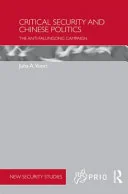
Critical Security and Chinese Politics
 84
84

Critical Security and Chinese Politics
Juha A. Vuori's "Critical Security and Chinese Politics" offers a rigorous, if sometimes dense, application of European critical security theory to a pressing geopolitical issue. The book's central strength lies in its sophisticated dissection of the anti-Falungong campaign through the analytical tools of securitization and the politics of insecurity. Vuori adeptly demonstrates how these concepts, often debated in Western academic circles, provide a potent framework for understanding state-sponsored repression in China. A notable limitation, however, is the book's academic prose, which may present a barrier to readers less familiar with critical security studies jargon. The detailed examination of how the PRC government framed Falungong as an existential threat in the late 1990s, for instance, is particularly illuminating, showcasing the performative nature of security discourse. Ultimately, this is an important scholarly contribution for those seeking to understand state power through a critical theoretical lens.
📝 Description
84
In 2014, Juha A. Vuori applied European critical security studies to China's campaign against Falungong.
This book examines how European critical security theory sheds light on the People's Republic of China's actions against the Falungong movement. Vuori analyzes how established theoretical frameworks, particularly those from European academic discourse, can explain state control and societal anxieties within the Chinese political system. The work scrutinizes these dynamics using specific concepts that challenge traditional security perspectives.
The author's analysis centers on key concepts such as 'securitization,' the framing of issues as existential threats, and 'the politics of insecurity,' which concerns the construction and manipulation of threats for political ends. Vuori also considers 'emancipation,' the possibility of liberation from oppressive systems. These theoretical lenses are used to dissect the PRC's campaign against Falungong, aiming for a deeper understanding than simple descriptions allow.
Published in 2014, this work emerged when critical approaches to security were gaining traction, moving beyond state-centric and militaristic definitions. It engages directly with concepts like securitization and emancipation, ideas prominent in European security debates following the Copenhagen School's influence. The book's focus on the Falungong campaign serves as a concrete case study for these theoretical discussions, demonstrating their application outside Western contexts.
💡 Why Read This Book?
• Learn how securitization theory, as developed in European discourse, can be applied to analyze state repression, specifically the PRC's campaign against Falungong starting in the late 1990s. • Understand the concept of 'the politics of insecurity' and how states construct threats to legitimize political actions, a key focus within the book's analysis of Chinese security policy. • Gain insight into the emancipatory potential within critical security studies by examining how theoretical frameworks can offer alternative perspectives on state-society relations in China.
⭐ Reader Reviews
Honest opinions from readers who have explored this book.
❓ Frequently Asked Questions
What is the primary theoretical framework used in Critical Security and Chinese Politics?
The book primarily employs critical security studies concepts, notably securitization theory, the politics of insecurity, and emancipation, as developed in European academic discourse.
What specific Chinese political issue does Juha A. Vuori examine?
Juha A. Vuori examines the People's Republic of China's campaign against the Falungong movement, analyzing it through critical security lenses.
When was Critical Security and Chinese Politics first published?
Critical Security and Chinese Politics was first published in 2014.
Who is the author of Critical Security and Chinese Politics?
The author of Critical Security and Chinese Politics is Juha A. Vuori.
How does the book connect European security theory to Chinese politics?
It applies European critical security frameworks, such as securitization, to investigate and understand specific Chinese security issues like the anti-Falungong campaign.
What is the significance of the Falungong case in the book?
The Falungong campaign serves as a concrete case study to test and illustrate the applicability of critical security concepts to understanding state actions and societal control in China.
🔮 Key Themes & Symbolism
Securitization in Chinese Context
The work interrogates how the concept of securitization, typically applied to Western security discourse, functions within the People's Republic of China. It explores how the state frames specific issues, such as the Falungong spiritual movement, as existential threats requiring extraordinary measures. This process, analyzed through the lens of the Copenhagen School, reveals the performative aspects of security policy and state legitimacy construction within a non-Western authoritarian framework.
The Politics of Insecurity
This theme explores how insecurity is not merely a reaction to objective threats but is actively constructed and manipulated for political ends. Vuori investigates how the Chinese state's portrayal of Falungong as a dangerous entity served to consolidate power, suppress dissent, and shape public perception. It highlights the role of discourse in manufacturing consent and justifying repressive policies.
Emancipatory Potential of Theory
The book considers the emancipatory dimension of critical security studies, exploring whether these theoretical frameworks can offer pathways towards liberation from oppressive structures. By applying these concepts to the PRC's actions, Vuori implicitly questions the possibility of challenging dominant security narratives and state control, even within a highly restrictive political environment.
State-Society Dynamics
Central to the analysis is the examination of the complex relationship between the Chinese state and its society, particularly concerning movements like Falungong. The work probes how state power is exerted through security apparatuses and how societal groups are subjected to, or resist, securitization efforts, offering a critical perspective on governance and control mechanisms.
💬 Memorable Quotes
Direct passages from the work, attributed to the author.
“European critical security approaches offer potent analytical tools for understanding Chinese security issues.”
— This statement underscores the book's core argument: that theoretical frameworks developed in one geopolitical context can be effectively adapted to illuminate phenomena in vastly different political systems, challenging Eurocentric assumptions.
“The anti-Falungong campaign provides a concrete case for examining securitization dynamics.”
— This highlights the specific empirical focus of the work, positioning the state's actions against Falungong not just as a political event, but as a practical demonstration of theoretical concepts in action.
“Securitization involves framing an issue as an existential threat.”
— A concise definition of a key concept, emphasizing the extreme nature of threats that trigger securitizing moves and justify exceptional measures by the state.
“Insecurity can be a politically constructed phenomenon.”
— This interpretation points to the deliberate manipulation of fear and threat perception by political actors to achieve specific policy goals or maintain power.
“Applying abstract theories to specific political cases tests their validity.”
— This reflects the methodological approach of the book, suggesting that the real-world application of theories like securitization is crucial for refining and validating them.
🌙 Esoteric Significance
Tradition
While not overtly mystical, the book touches upon esoteric themes through its examination of belief systems and state control. The Falungong movement itself is rooted in Buddhist and Taoist principles, representing a form of spiritual practice that the state sought to suppress. The work can be seen as indirectly engaging with the esoteric via the analysis of how state power intersects with and attempts to neutralize non-mainstream spiritual or philosophical movements, a recurring theme in historical and contemporary esoteric thought.
Symbolism
The Falungong movement itself, with its emphasis on the Falun (Dharma Wheel) symbol and its associated spiritual cosmology, represents a potent symbol of alternative belief systems clashing with secular state power. The state's campaign against it can be viewed symbolically as an attempt to eradicate spiritual or metaphysical concepts that challenge the materialist, political ideology of the ruling party. The book implicitly explores the state's reaction to symbols and ideas it deems threatening to its control.
Modern Relevance
Contemporary thinkers and practitioners in fields concerned with state surveillance, digital authoritarianism, and the control of information flows may find this work relevant. It speaks to modern concerns about how states manage populations and dissent, particularly in the digital age. Scholars examining the intersection of technology, belief systems, and political power, as well as those interested in the state's response to organized spiritual or philosophical movements, continue to draw upon such critical analyses.
👥 Who Should Read This Book
• Scholars of International Relations and Political Science seeking to apply critical security theory to non-Western contexts, particularly China. • Students of Chinese Politics interested in understanding state-society relations and the mechanisms of political control beyond conventional analyses. • Researchers focused on human rights, religious freedom, and the persecution of minority or spiritual movements by authoritarian regimes.
📜 Historical Context
Published in 2014, Juha A. Vuori's "Critical Security and Chinese Politics" arrived during a period of intense academic debate surrounding the expansion and application of critical security studies beyond their Western origins. The work directly engages with the legacy of the Copenhagen School, particularly its theories of securitization, which had gained significant traction in International Relations scholarship since the 1990s. Simultaneously, scholars were increasingly turning critical attention towards China's political system and its approach to security, often contrasting it with Western liberal democratic norms. Vuori's choice to analyze the PRC's campaign against the Falungong movement, a highly visible and controversial issue, provided a potent empirical anchor for these theoretical discussions. This approach moved against more traditional, state-centric analyses prevalent in earlier China scholarship, offering a theoretically informed critique of state power and societal control. The book's reception within the field would have situated it alongside emerging scholarship that sought to de-Westernize security studies while also critically engaging with authoritarian regimes.
📔 Journal Prompts
The securitization of Falungong as an existential threat.
Constructing insecurity: how the PRC state framed its campaign.
Applying European critical security theory to Chinese political realities.
The state's suppression of spiritual movements and emancipatory potential.
Analyzing state-society dynamics through the lens of security policy.
🗂️ Glossary
Securitization
A theoretical concept where an issue is framed as an existential threat, justifying extraordinary measures beyond normal political procedures to address it.
Politics of Insecurity
The study of how political actors construct, manipulate, and benefit from the perception of threats and insecurities to achieve political objectives.
Emancipation
In critical theory, the process of liberation from oppressive structures, constraints, or forms of domination.
Falungong
A spiritual practice involving meditation and qigong exercises, combining Buddhist and Taoist elements, which was banned and suppressed by the Chinese government in 1999.
Copenhagen School
A school of thought in security studies, influential in developing the concept of securitization, which emphasizes the social construction of security threats.
Critical Security Studies
An interdisciplinary field that challenges traditional, state-centric approaches to security, focusing instead on broader issues like human security, emancipation, and societal security.
Existential Threat
A danger or risk that threatens the fundamental existence or survival of a state, society, or identity.
This book appears in 1 collection
🔮 Readers Also Liked
Browse all →









From the “Qi Gong” Collection
View all →








More Free Esoteric History & Biography Books
View all →