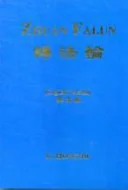
Zhuan Falun
 81
81

Zhuan Falun
The primary strength of Zhuan Falun lies in its accessible yet comprehensive approach to spiritual cultivation. Hongzhi Li's prose, particularly when discussing the cultivation of Zhen-Shan-Ren, offers a clear ethical compass for self-improvement. The book's explanation of karma and its effects on human life provides a framework for understanding personal struggles. However, the text's occasional forays into cosmology and the nature of advanced beings can sometimes feel speculative rather than grounded, potentially posing a challenge for readers accustomed to more empirical philosophical systems. A notable section, Chapter 3, addresses the concept of 'Attachments' (ren), offering practical guidance on identifying and releasing desires that hinder spiritual progress. While the book offers a coherent system, its claims regarding the universe's fundamental nature might require significant interpretative effort from newcomers. Ultimately, Zhuan Falun presents a potent, if sometimes esoteric, path for those seeking moral and spiritual refinement.
📝 Description
81
Zhuan Falun, first published in 2002, systematizes the teachings of Falun Dafa.
Zhuan Falun is a collection of lectures given by Hongzhi Li in the early 1990s, published in 2002. The book guides practitioners in cultivating their minds and bodies based on the principles of Zhen-Shan-Ren, which translates to Truthfulness, Compassion, and Forbearance. It examines the nature of the universe, human existence, and the origins of illness and suffering, providing a path for spiritual development and moral betterment.
This text is for those seeking a spiritual practice focused on personal growth through high moral conduct. It will interest individuals familiar with Chinese qigong but seeking a more philosophical and ethical approach. Readers drawn to meditation, spiritual cultivation, and understanding fundamental realities will find its lessons applicable. It particularly suits those who connect with Buddhist and Taoist ideas but want a contemporary integration of these concepts.
Emerging in the 1990s amidst a resurgence of interest in traditional Chinese culture, Zhuan Falun became central to Falun Gong, founded by Hongzhi Li in 1992. While drawing on elements of Buddhist and Taoist thought, it presents a distinct system of belief and practice focused on moral cultivation and spiritual transformation. The movement's rapid growth and subsequent suppression by the Chinese state after 1999 highlight its significance as a modern spiritual phenomenon that engaged with traditional Chinese philosophical underpinnings.
💡 Why Read This Book?
• Gain insight into the cultivation of Zhen-Shan-Ren, a core ethical framework for self-improvement, as detailed in Zhuan Falun's teachings. • Understand the concept of karma and 'de' (virtue) as presented in the text, offering a lens through which to view personal challenges and spiritual growth. • Explore the esoteric principles of cultivation and the nature of the universe as described in Zhuan Falun, first published in 2002, for a unique spiritual perspective.
⭐ Reader Reviews
Honest opinions from readers who have explored this book.
❓ Frequently Asked Questions
What is the original language of Zhuan Falun?
Zhuan Falun was originally written in Chinese. It was first published in 2002 and has since been translated into numerous languages, making its teachings accessible globally.
Who is the author of Zhuan Falun?
The author is Hongzhi Li, the founder of Falun Dafa (also known as Falun Gong). He began publicly teaching the practice in 1992.
Is Zhuan Falun a religious text?
While Zhuan Falun contains spiritual teachings and draws from Buddhist and Taoist philosophies, its practitioners often describe it as a spiritual cultivation system rather than a religion. It emphasizes personal moral conduct and inner transformation.
What are the core principles taught in Zhuan Falun?
The core principles are Zhen (Truthfulness), Shan (Compassion), and Ren (Forbearance). These are presented as the fundamental characteristics of the universe and the basis for spiritual cultivation.
Can Zhuan Falun be read online for free?
Yes, Zhuan Falun is widely available online for free in multiple languages, reflecting the movement's intent for broad accessibility.
What is 'xinxing' cultivation as discussed in Zhuan Falun?
'Xinxing' cultivation refers to the process of improving one's moral character and mental disposition by adhering to the principles of Truthfulness, Compassion, and Forbearance, as elaborated in the book's lectures.
🔮 Key Themes & Symbolism
Moral Cultivation
The central theme is the cultivation of 'xinxing' (mind nature) through the practice of Zhen-Shan-Ren (Truthfulness-Compassion-Forbearance). The book posits these principles as the fundamental characteristics of the universe and the pathway to spiritual elevation. It details how adhering to these tenets in daily life helps practitioners purify their minds, eliminate attachments, and improve their moral character, leading to a transformation of their spiritual selves and a deeper understanding of existence.
Karma and Rebirth
Zhuan Falun extensively discusses the concept of karma ('ye') and its pervasive influence on human life, including the causes of illness and misfortune. It explains that negative actions create negative karma, while good deeds generate 'de' (virtue), which can be used to offset karma. The text suggests that understanding this cosmic balance is crucial for spiritual progress and that practitioners aim to reduce their karma through diligent cultivation and moral conduct.
Cosmic Principles
The book offers an esoteric view of the universe, describing its fundamental nature through the concepts of 'yours' and 'ours' – the inherent characteristics of existence. It suggests that the universe operates on multiple levels and dimensions, and that human beings are microcosms reflecting this larger cosmic order. This perspective provides a framework for understanding phenomena beyond the scope of conventional science and encourages practitioners to align themselves with these universal laws.
The Nature of Illness
Zhuan Falun presents a unique perspective on illness, attributing it not only to physical causes but also to karmic retribution and imbalances in one's energy system. It suggests that through spiritual cultivation and the practice of Zhen-Shan-Ren, practitioners can purify their bodies and minds, thereby alleviating or resolving ailments. This approach links physical well-being directly to spiritual progress and moral rectitude.
💬 Memorable Quotes
Direct passages from the work, attributed to the author.
“The universe has its principles of operation.”
— This statement highlights the book's assertion that existence is governed by fundamental laws, which practitioners are encouraged to understand and align with for spiritual growth.
“Where there is the appearance of a person, there is the appearance of a Buddha.”
— This interpretation suggests that the potential for enlightenment and Buddhahood exists within every individual, emphasizing the inherent spiritual capacity of humans.
“Goodness and evil are distinguished by a single thought.”
— This concept underscores the critical role of intention and thought in moral and spiritual development, indicating that choices made at the mental level have significant karmic consequences.
“When you find yourself unable to let go of something, that is an attachment.”
— This definition of attachment is practical, encouraging self-reflection on desires, fears, or mental states that hinder spiritual progress and adherence to the principles.
“What is a human being? A human being is a being that has xinxing.”
— This defines humanity through its capacity for moral cultivation ('xinxing'), differentiating humans from other beings and emphasizing the importance of spiritual development.
🌙 Esoteric Significance
Tradition
Zhuan Falun draws heavily from Taoist and Buddhist philosophical traditions, synthesizing concepts like karma, reincarnation, and the cultivation of inner virtue. It presents a modern interpretation of ancient Chinese spiritual practices, particularly qigong, emphasizing moral cultivation ('xinxing') through the principles of Zhen-Shan-Ren. While referencing familiar themes, it offers a unique cosmology and a structured path for practitioners seeking spiritual attainment and purification.
Symbolism
Key symbols include the Falun, a complex mandala-like emblem representing the universe and incorporating Buddhist and Taoist symbols like the swastika and yin-yang. It signifies the practitioner's connection to universal principles and the energy field cultivated through practice. The concept of 'de' (virtue) and 'ye' (karma) functions symbolically, representing the fundamental forces of spiritual merit and karmic consequence that govern existence and personal transformation.
Modern Relevance
Contemporary thinkers and spiritual seekers interested in mind-body practices, Eastern philosophies, and ethical self-improvement often engage with Zhuan Falun. Its emphasis on Truthfulness, Compassion, and Forbearance provides a moral framework relevant to modern societal challenges. Various online communities and practitioners continue to study and apply its teachings, demonstrating its enduring influence on individuals seeking spiritual guidance outside of mainstream religious institutions.
👥 Who Should Read This Book
• Individuals seeking a spiritual path focused on moral self-improvement and ethical living, particularly those interested in Eastern philosophies and meditation. • Students of comparative religion and esoteric traditions looking to understand modern spiritual movements originating from China and their philosophical underpinnings. • Practitioners of qigong or similar mind-body disciplines who wish to explore a system that integrates physical exercises with a profound emphasis on cultivating character.
📜 Historical Context
Zhuan Falun emerged from the burgeoning qigong boom in China during the 1990s, a period marked by a revival of traditional Chinese culture and practices following decades of suppression. Founded by Hongzhi Li in 1992, Falun Gong quickly gained millions of adherents, attracted by its purported health benefits and profound spiritual teachings rooted in Buddhist and Taoist principles. The book, a compilation of Li's lectures, became the central text for practitioners. This rapid growth and visibility, however, led to state suspicion and eventual persecution. By 1999, the Chinese Communist Party initiated a campaign to eradicate Falun Gong, labeling it an 'evil cult'. This political climate profoundly shaped the reception and dissemination of Zhuan Falun, turning it into a text associated with both spiritual awakening for its followers and political contention within China.
📔 Journal Prompts
The concept of 'xinxing' cultivation and its application to daily challenges.
Reflections on personal attachments and their impact, as described in Zhuan Falun.
How the principles of Zhen-Shan-Ren can inform decision-making.
Understanding the connection between one's actions and karmic outcomes.
Exploring the idea of 'de' (virtue) as a spiritual resource.
🗂️ Glossary
Zhen-Shan-Ren
The core principles of Truthfulness (Zhen), Compassion (Shan), and Forbearance (Ren), presented as the fundamental characteristics of the universe and the guide for spiritual cultivation.
Xinxing
Literally 'mind nature' or 'heart-mind'. It refers to one's moral character, disposition, and state of mind, which practitioners aim to improve through cultivation.
Karma (Ye)
A fundamental concept of cause and effect, where actions generate consequences. Negative actions create negative karma, while good deeds generate virtue ('de').
De
Virtue or merit, often considered a substance or energy that is accumulated through good deeds and moral conduct, and can be used to offset karma.
Falun
A central symbol in Falun Dafa, often described as a spinning wheel containing various symbols, representing the universe and the practitioner's connection to its principles.
Qigong
A Chinese system of coordinated body posture and movement, breathing, and meditation used for health, spirituality, and martial arts training.
Attachment
An excessive desire, emotional dependency, or fixation on worldly things, people, or ideas that hinders spiritual progress and spiritual purity.
This book appears in 1 collection
🔮 Readers Also Liked
Browse all →








From the “Qi Gong” Collection
View all →








More Free Occult Philosophy Books
View all →