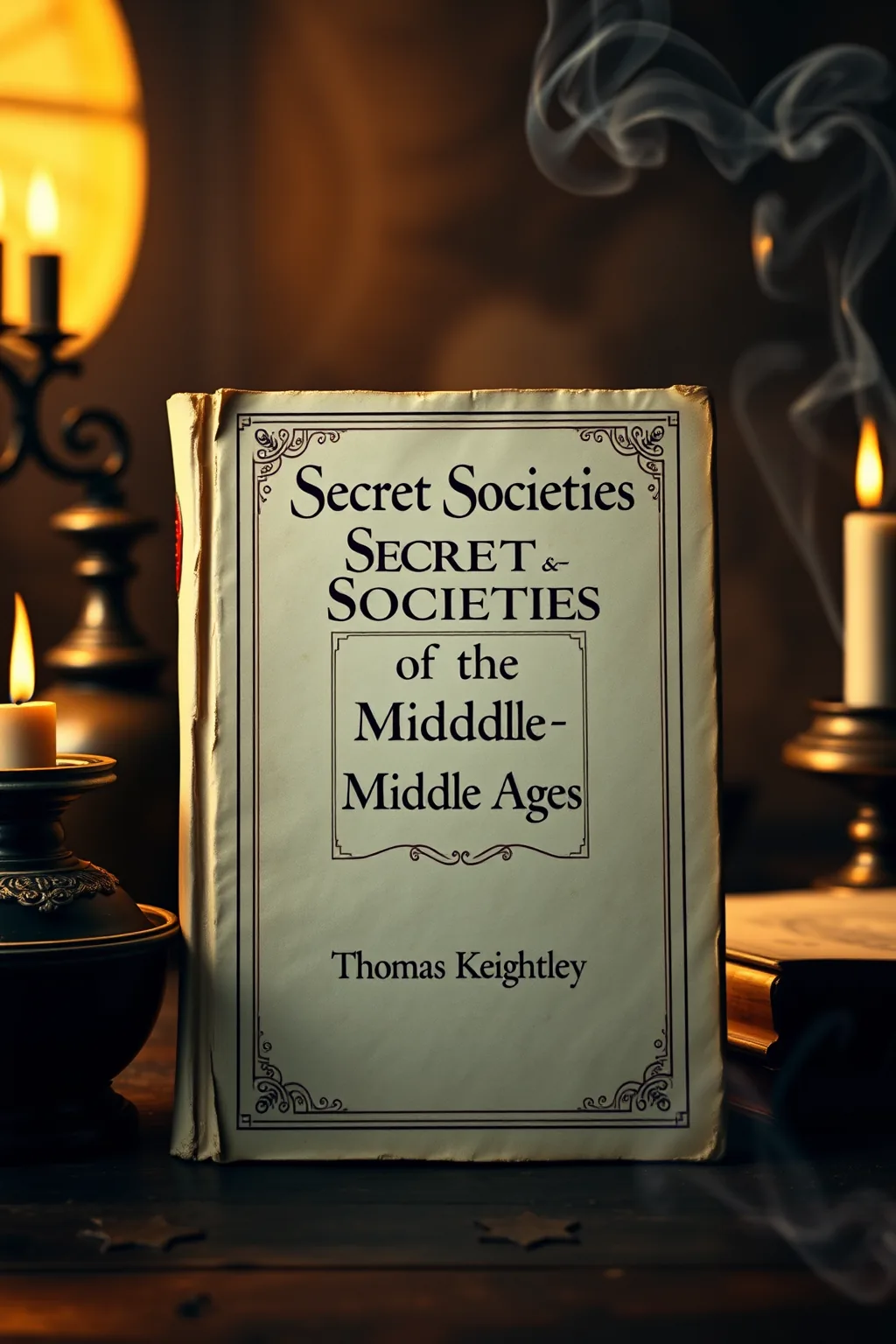
Secret Societies of the Middle Ages
 78
78

Secret Societies of the Middle Ages
Thomas Keightley's "Secret Societies of the Middle Ages" presents a sober, fact-driven inquiry into groups often obscured by legend. The strength of this work lies in its methodical approach, particularly in separating the historical reality of the Knights Templar from the sensational narratives that followed their dissolution in 1312. Keightley grounds his analysis in available documentation, a crucial step when dealing with subjects prone to mythologizing. However, the book occasionally suffers from its own adherence to a strictly historical framework, sometimes downplaying the symbolic and spiritual dimensions that continue to draw individuals to these orders. A notable passage concerns the early Nizari Ismailis, where Keightley details their distinct theological roots and their eventual transformation into a formidable political force, a transformation often reduced in popular lore to mere assassination. The work’s limitation is its dated perspective; while historically valuable, it predates much modern scholarship on comparative mysticism and occult traditions. Still, for its meticulous dissection of historical records, it remains a foundational text. Keightley offers a necessary corrective to romanticized notions of medieval secret orders.
📝 Description
78
Thomas Keightley's 1838 study examines the medieval origins of clandestine groups like the Assassins and Knights Templar.
Thomas Keightley's 1838 study offers a historical examination of clandestine organizations that influenced medieval and early modern history. The book details the origins and development of three prominent groups: the Nizari Ismailis, known as the Assassins; the Knights Templar; and the Rosicrucians. Keightley's research probes the historical milieu from which these societies emerged, tracing their evolution from religious sects and military orders into entities shrouded in mystery and influence.
The core of Keightley's work dissects the historical trajectories of these organizations, analyzing their doctrines, rituals where known, and their impact on contemporary power structures. The book acknowledges the difficulty in separating verifiable historical accounts from later embellishments or speculative theories, particularly concerning the later periods of the Templars and the initial appearances of the Rosicrucians. Readers interested in the roots of modern secret societies, the political and religious contexts of the medieval period, and the legends surrounding these groups will find substantial material here.
Published in 1838, Keightley's work engages with the burgeoning interest in secret societies and hidden histories during the 19th century. It approaches groups often viewed through a romantic or conspiratorial lens with a focus on historical documentation, distinguishing known facts from later mythologizing. This approach places it within a tradition of scholarship that sought to understand esoteric currents not purely as superstition but as phenomena with historical roots and societal impact.
💡 Why Read This Book?
• Learn the historical evolution of the Nizari Ismailis, understanding how a religious sect became synonymous with political assassination, a concept detailed in Keightley's examination of their origins. • Grasp the documented rise and fall of the Knights Templar, moving beyond myth to understand their role as protectors and crusaders, a narrative explored through their establishment in the early 12th century. • Discover the historical basis and early reception of the Rosicrucians, distinguishing the documented facts of their initial appearance from later esoteric interpretations.
⭐ Reader Reviews
Honest opinions from readers who have explored this book.
❓ Frequently Asked Questions
What historical period does "Secret Societies of the Middle Ages" primarily cover?
The book primarily covers the medieval period, focusing on the origins and development of groups like the Assassins and the Knights Templar from roughly the 11th to the 14th centuries, with later discussions extending into the appearance of the Rosicrucians.
Does the book discuss the Knights Templar's alleged magical practices?
Keightley's work focuses on the documented historical facts and evolution of the Knights Templar, rather than delving into unsubstantiated legends about their alleged magical practices or esoteric rituals.
How does Keightley differentiate between fact and legend regarding the Assassins?
Keightley distinguishes fact from legend by tracing the historical lineage of the Assassins from their roots in Islamic Isma'ilism and examining their known military and political activities, separating these from later, more sensationalized accounts.
Is "Secret Societies of the Middle Ages" suitable for beginners in esoteric studies?
While the book is factual and historical, its dense research and focus on documented history make it more suited for readers with a serious interest in historical investigation rather than absolute beginners seeking introductory esoteric concepts.
What is the original publication date of Thomas Keightley's "Secret Societies of the Middle Ages"?
The original publication date for Thomas Keightley's "Secret Societies of the Middle Ages" is April 3, 2005, although Keightley himself was an earlier 19th-century historian.
Does the book provide a comprehensive history of all medieval secret societies?
No, the book specifically focuses on three prominent organizations: the Assassins, the Templars, and the Rosicrucians, examining their individual historical trajectories rather than attempting a comprehensive survey of all such groups.
🔮 Key Themes & Symbolism
Evolution of Religious Sects
The work traces how groups initially founded on distinct religious doctrines, such as the Nizari Ismailis stemming from Isma'ilism, could transform into powerful socio-political entities. Keightley details their historical trajectory, moving from theological foundations to becoming influential, often feared, organizations during the medieval period. This transformation highlights the dynamic interplay between faith, power, and historical circumstance that shaped the medieval world.
The Knights Templar's Dual Nature
Keightley examines the Knights Templar's transition from a pious order dedicated to protecting pilgrims and fighting in the Crusades to a wealthy and influential institution. The book dissects their military prowess, economic power, and eventual downfall, distinguishing historical accounts from the myths that later enveloped them, particularly after their suppression in the early 14th century.
The Enigma of the Rosicrucians
The book addresses the historical emergence of the Rosicrucian movement in the early 17th century, analyzing the initial manifestos and the subsequent impact they had on European thought. Keightley attempts to situate the Rosicrucian claims within their historical context, acknowledging the difficulty in verifying their origins and the speculative nature of much subsequent commentary.
Fact vs. Legend in Esoteric History
A central theme is the critical examination of historical sources to separate verifiable facts from popular legend and later embellishment. Keightley applies a scholarly lens to differentiate between the documented history of groups like the Assassins and the sensationalized narratives that have long surrounded them, emphasizing the importance of primary evidence.
💬 Memorable Quotes
Direct passages from the work, attributed to the author.
“The name of the Assassins became the word for political murder.”
— This highlights the profound and lasting impact of the Nizari Ismailis on language and perception, demonstrating how their historical actions became synonymous with a specific type of clandestine killing.
“From a pious group of protectors and dedicated crusaders to their...”
— This fragmented phrase points to the dramatic transformation and eventual corruption or downfall of the Knights Templar, suggesting a narrative arc from noble beginnings to a more complex, perhaps compromised, latter state.
“The historical reality of the Knights Templar is often obscured by legend.”
— This statement underscores Keightley's central objective: to cut through the myth and speculation surrounding the Templars to present a grounded, historical account based on evidence.
“The Rosicrucian manifestos appeared in the early 17th century.”
— This anchors the discussion of the Rosicrucians to a specific historical timeframe, indicating the starting point for Keightley's investigation into their origins and influence.
“Separating fact from the embellished accounts of these societies is crucial.”
— This emphasizes the critical methodology employed by Keightley, stressing the importance of rigorous historical analysis when studying groups often shrouded in mystery and folklore.
🌙 Esoteric Significance
Tradition
While Keightley's work is primarily historical and critical, it engages with traditions that later became foundational to modern esoteric movements. By meticulously dissecting the historical reality of groups like the Templars and Rosicrucians, he provides source material for later esoteric thinkers who sought to reinterpret these orders within Hermetic, Gnostic, or Rosicrucian frameworks, often adding layers of symbolic meaning absent in Keightley's factual accounts.
Symbolism
Although Keightley focuses on historical facts, the symbols associated with these groups are implicitly present. The cross of the Templars, the rose and cross of the Rosicrucians, and the specific iconography of the Nizari Ismailis are visual anchors. Keightley's work, by detailing their historical context, implicitly invites deeper symbolic interpretation of these emblems within esoteric traditions, even if he does not provide it directly.
Modern Relevance
Contemporary esoteric practitioners and scholars of Western Esotericism frequently reference Keightley's research as a baseline historical account. Thinkers exploring the lineage of Freemasonry, Rosicrucianism, or Templarism often cite his work to establish the historical context before applying their own symbolic or philosophical interpretations to these figures and movements.
👥 Who Should Read This Book
• Students of medieval history seeking factual accounts of influential organizations like the Knights Templar and the Assassins. • Researchers of comparative religion interested in the historical development and socio-political impact of Islamic sects and Christian military orders. • Enthusiasts of esoteric traditions looking for a grounded, evidence-based perspective on the historical origins of groups often shrouded in myth and legend.
📜 Historical Context
Published in 2005, Thomas Keightley's "Secret Societies of the Middle Ages" engages with a long-standing academic and popular fascination with clandestine groups. The work emerged in an era where historical revisionism and a renewed interest in medieval history were prevalent. Keightley's approach, rooted in 19th-century historical scholarship, predates much of the postmodern critique that would further complicate understandings of historical truth and narrative. His careful distinction between the historical Nizari Ismailis, the Knights Templar (whose suppression occurred in 1312), and the Rosicrucians (whose manifestos appeared in the early 17th century) places him in dialogue with earlier antiquarians and historians. Unlike contemporaries who might lean towards speculative or occult interpretations, Keightley prioritizes documented evidence, a stance that implicitly contrasts with the more romanticized views prevalent in some esoteric circles of the time. His reception within academic history is one of a foundational, albeit dated, source on these specific organizations.
📔 Journal Prompts
The historical trajectory of the Nizari Ismailis from religious sect to feared political entity.
The documented rise and suppression of the Knights Templar in the 14th century.
The early Rosicrucian manifestos and their historical impact.
The challenge of distinguishing verifiable fact from later embellishment regarding medieval secret societies.
The evolving perception of the Assassins' name and its connection to political killings.
🗂️ Glossary
Nizari Ismailis
A branch of Shia Islam that emerged in the 11th century, known historically for their militant activities and the associated order often referred to as the Assassins.
Assassins
A Western designation for members of the Nizari Ismailis, particularly those active as fedayeen (devoted ones) during the medieval period, known for targeted political killings.
Knights Templar
A Catholic military order founded in the early 12th century, prominent during the Crusades, known for protecting pilgrims and their eventual wealth and suppression.
Rosicrucians
Members of a secret society, first appearing in early 17th-century Germany through published manifestos, associated with esoteric and mystical traditions.
Crusades
A series of religious wars sanctioned by the Latin Church during the medieval period, primarily aimed at recovering the Holy Land from Islamic rule.
Fedayeen
A term, often translated as 'devoted ones,' used for individuals within certain Islamic movements who undertake missions, including martyrdom operations.
Manifestos
Public declarations or statements of policy or intention, such as the early 17th-century Rosicrucian documents that announced the existence of their fraternity.