Das Lächeln des Parmenides
 78
78

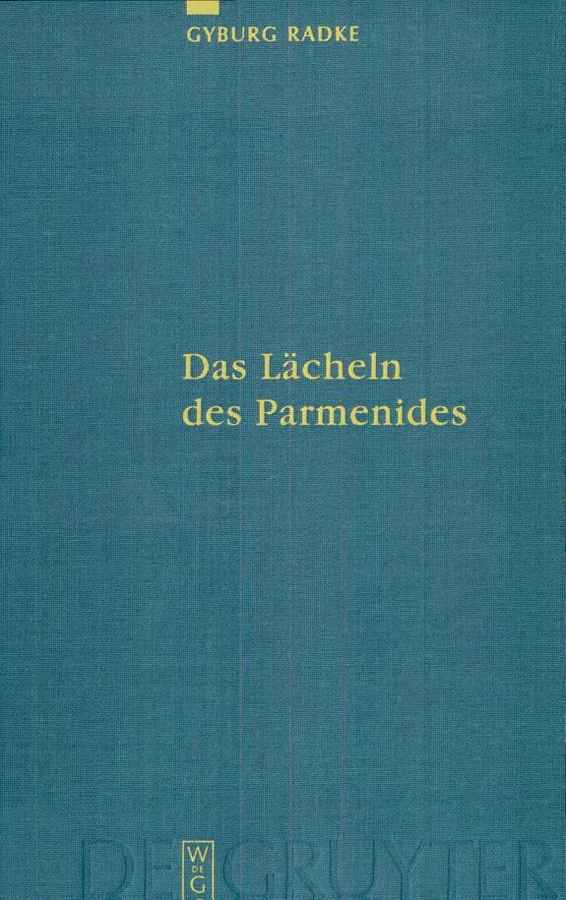
Das Lächeln des Parmenides
Gyburg Uhlmann and Gyburg Radke's "Das Lächeln des Parmenides" dissects the late 20th and early 21st-century shift in Platonic studies towards a "literary turn." The authors meticulously detail how this movement, by foregrounding dialogue form, critiques earlier Neoplatonic readings that sought systematic, dogmatic content. A key strength lies in its precise articulation of this methodological schism, particularly its engagement with the idea that "the literary form is the true content of the Platonic dialogues." However, the book occasionally leans into academic jargon, which might present a barrier for those not deeply immersed in the specific scholarly debates it addresses. The discussion of how ancient commentators, such as Porphyry, established a dogmatic reading is particularly illuminating. This work effectively argues for a re-evaluation of Plato through his stylistic and dramatic presentation, offering a valuable counterpoint to purely metaphysical interpretations.
📝 Description
78
Published in 2006, Das Lächeln des Parmenides examines the shift in Plato studies toward literary interpretation.
This 2006 work by Gyburg Uhlmann and Gyburg Radke critiques a trend in contemporary Platonic scholarship. The "literary turn" emphasizes Plato's dialogical form, moving away from traditional, systematic interpretations. The authors question how this approach challenges the Neoplatonic view of Plato as a philosopher who presented fixed doctrines.
The book argues that Plato's "literary form" is actually his philosophical content. This perspective highlights the performative and dialogical aspects of his method, contrasting with readings that sought dogmatic conclusions. The authors consider the consequences of this interpretative shift for understanding Plato's overall philosophical aims. It is written for academics and advanced students of ancient Greek philosophy, as well as those interested in how philosophical texts are read and how critical methods change.
While not strictly an esoteric text itself, this book engages with the history of interpreting Plato, a figure central to many esoteric traditions. Neoplatonism, with its systematic approach to Plato's dialogues, formed a significant basis for later esoteric philosophical systems. Uhlmann and Radke's examination of the "literary turn" thus touches upon how the foundational texts of Western esoteric thought are understood and reinterpreted through changing critical lenses.
💡 Why Read This Book?
• Understand the "literary turn" in Platonic studies and how it reinterprets Plato's work, moving beyond dogmatic readings established since Neoplatonism. • Grasp the critical distinction between a philosophical text viewed as a repository of doctrines versus one understood through its dialogical and literary structure. • Engage with the scholarly debate that emerged around the year 2006, which emphasizes the form of Plato's dialogues as their essential philosophical content.
⭐ Reader Reviews
Honest opinions from readers who have explored this book.
❓ Frequently Asked Questions
What is the main argument of "Das Lächeln des Parmenides"?
The book's central argument is that the literary form of Plato's dialogues represents their true philosophical content, challenging the traditional Neoplatonic approach that sought systematic doctrines.
When was "Das Lächeln des Parmenides" first published?
The work was first published in 2006.
Who are the authors of "Das Lächeln des Parmenides"?
The authors are Gyburg Uhlmann and Gyburg Radke.
What philosophical tradition does the book critique?
The book critiques the traditional Neoplatonic interpretation of Plato, which has historically been dogmatic and has neglected the dialogical form of his works.
What does the "literary turn" in Platonic studies emphasize?
The "literary turn" emphasizes the dialogical, dramatic, and stylistic elements of Plato's writings as crucial to understanding their philosophical meaning, rather than viewing them as systematic philosophical treatises.
What is the significance of the title "Das Lächeln des Parmenides"?
The title alludes to the enigmatic smile often associated with philosophical figures and suggests a deeper, perhaps ironic or subtle, understanding of Parmenides' philosophy conveyed through Platonic dialogue.
🔮 Key Themes & Symbolism
Form as Content
The core of the work asserts that the very structure and literary presentation of Plato's dialogues are not mere vessels for ideas but are the essential philosophical content. This perspective challenges centuries of interpretation, particularly the Neoplatonic tradition, which tended to extract systematic doctrines. The authors argue that understanding Plato requires attending to the dramatic context, the characters' interactions, and the dialogical process itself, rather than seeking a singular, fixed meaning.
Critique of Neoplatonism
This theme focuses on dismantling the long-standing practice of reading Plato through a Neoplatonic lens. The book details how ancient commentators, beginning with figures like Porphyry, established a method of interpreting Plato as a systematic philosopher, often ignoring or downplaying the nuances of his literary style. Uhlmann and Radke argue that this dogmatic approach has obscured the true philosophical import of Plato's dialogues, which lies in their dynamic, open-ended form.
The "Literary Turn"
The book examines the emergence and implications of the "literary turn" in Platonic scholarship, particularly prominent in Anglo-American academia since the late 20th century. This approach champions a re-reading of Plato that prioritizes his dramatic and stylistic elements. It posits that the dialogues function more like philosophical performances or explorations than treatises, demanding an interpretive method sensitive to literary art and rhetorical strategy.
Hermeneutics of Plato
This theme studies the philosophical problem of interpretation itself, using Plato as a case study. It questions how we arrive at understanding philosophical texts and how interpretive traditions, like Neoplatonism, shape our perception. The work implicitly asks whether Plato's philosophy is best accessed through direct engagement with his dialogical form or through the accumulated commentary of centuries.
💬 Memorable Quotes
Direct passages from the work, attributed to the author.
“The literary form is the true content of the Platonic dialogues.”
— This central thesis suggests that the way Plato crafts his dialogues—through character, setting, and conversational flow—is not secondary to his ideas but is the very medium and substance of his philosophical inquiry.
“The modern thesis challenges the traditional Platonic interpretation, which has been dogmatic since ancient Neoplatonism.”
— This highlights the book's critical stance, contrasting a new wave of scholarship with historical methods, particularly those stemming from the 3rd century CE onwards, which prioritized systematic philosophical doctrines over textual form.
“Interpretation of Plato's philosophy has neglected its form.”
— This points to a perceived deficiency in past scholarship, arguing that the focus on Plato's doctrines has led to a disregard for the artistic and structural elements that are crucial for a complete philosophical understanding.
“A new direction in Anglo-American Platonism.”
— This identifies the intellectual movement that the book analyzes, positioning it as a significant and potentially revolutionary shift in how Plato's work is studied and understood within contemporary academic circles.
“The claim of a revolutionary turning point.”
— This refers to the ambitious nature of the "literary turn," suggesting that its proponents believe it fundamentally alters the field of Platonic scholarship, moving it away from established paradigms.
🌙 Esoteric Significance
Tradition
While primarily a work of academic philosophy, "Das Lächeln des Parmenides" engages with traditions that have often been considered esoteric, notably Neoplatonism. By dissecting the interpretive methods that emerged from this lineage, the book indirectly touches upon how philosophical ideas are transmitted and potentially veiled or revealed through layered interpretations. Its focus on form over dogma can be seen as aligning with certain esoteric practices that emphasize experiential understanding and direct apprehension over doctrinal adherence.
Symbolism
The title itself, "The Smile of Parmenides," evokes a sense of enigmatic wisdom, reminiscent of how esoteric traditions often imbue figures and concepts with symbolic depth. Parmenides, a pre-Socratic philosopher whose work famously presented a stark dichotomy between Being and Becoming, becomes a symbol here for the challenges of philosophical interpretation. The "smile" suggests an underlying truth or a subtle irony accessible only through a deeper, perhaps unconventional, understanding of his (and by extension, Plato's) thought.
Modern Relevance
Contemporary philosophical inquiry, particularly in hermeneutics and literary theory applied to philosophy, continues to grapple with the questions raised by the "literary turn." Thinkers interested in the performative aspects of philosophy, the role of rhetoric in shaping thought, and the critique of systematic dogma find resonance in Uhlmann and Radke's work. It informs ongoing debates about how to approach ancient texts in a way that respects their historical context while remaining intellectually vital.
👥 Who Should Read This Book
• Advanced students of ancient Greek philosophy and the history of interpretation, seeking to understand the methodological debates surrounding Plato. • Scholars of comparative literature and philosophy, interested in how literary theory impacts the reading of philosophical texts. • Readers of Plato who are curious about the evolution of Platonic scholarship and the arguments for prioritizing dialogical form over doctrinal content.
📜 Historical Context
The publication of "Das Lächeln des Parmenides" in 2006 occurred within a vibrant and often contentious field of Platonic studies. The "literary turn," which the book critically examines, had gained considerable traction, championed by scholars like Seth Benardete and later influential figures such as Eva Brann. This movement offered a counterpoint to the more traditional, philological, and metaphysical approaches that had dominated since the antiquarian studies of the 19th century and the systematic readings of the Neoplatonists. While not a direct engagement, the work implicitly debates with scholars who, like Werner Jaeger in his "Paideia" series (published mid-20th century), sought to reconstruct Plato's educational philosophy through his dialogues. Uhlmann and Radke's text specifically grappled with the reception and implications of this interpretive shift, questioning its claims to revolutionary status and analyzing its departure from the historically entrenched Neoplatonic dogma.
📔 Journal Prompts
The concept of "literary form as true content" in Plato's dialogues.
The Neoplatonic tradition's influence on Platonic interpretation.
The "literary turn" and its challenge to dogmatic readings.
Parmenides' philosophical legacy as presented through Platonic dialogue.
The critical evaluation of a "revolutionary turn" in academic scholarship.
🗂️ Glossary
Neoplatonism
A philosophical system originating in the 3rd century CE with Plotinus, which interpreted Plato's works as a unified, systematic philosophy, often with mystical and metaphysical dimensions, influencing centuries of Western thought.
Literary Turn
A critical movement in Platonic studies, gaining prominence in the late 20th century, that emphasizes the dramatic, stylistic, and dialogical aspects of Plato's writings as integral to their philosophical meaning.
Dogmatic Interpretation
An approach to philosophical texts that seeks to extract fixed doctrines, beliefs, or systematic teachings, often treating the text as a source of authoritative pronouncements rather than an open inquiry.
Dialogical Form
The characteristic structure of Plato's philosophical writings, presented as conversations between characters, emphasizing process, interaction, and the exploration of ideas through dialectic rather than direct exposition.
Hermeneutics
The theory and methodology of interpretation, especially the interpretation of literary texts, philosophical works, and religious texts.
Platonic Scholarship
The academic study and critical analysis of the works attributed to the ancient Greek philosopher Plato, encompassing philology, philosophy, and history of ideas.
Parmenides
An ancient Greek philosopher whose work, particularly his poem "On Nature," presented a radical ontological system distinguishing between the unchanging reality of Being and the illusory world of Becoming.
This book appears in 1 collection
🔮 Readers Also Liked
Browse all →







From the “Neoplatonism” Collection
View all →






More Free Esoteric History & Biography Books
View all →