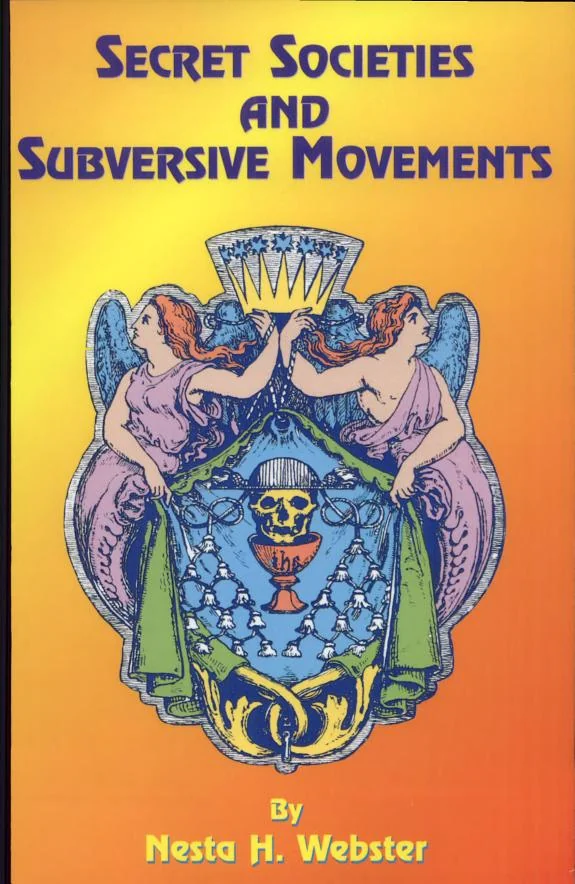
Secret Societies and Subversive Movements
 75
75

Secret Societies and Subversive Movements
Nesta H. Webster’s "Secret Societies and Subversive Movements" offers a comprehensive, if polemical, account of alleged conspiratorial influence on history. Her strength lies in the sheer breadth of her research, connecting threads from the French Revolution to early 20th-century Bolshevism with impressive detail. She meticulously reconstructs the perceived machinations of groups like the Bavarian Illuminati, presenting a compelling narrative of hidden hands guiding world events. However, Webster's work is undeniably biased. Her conviction that a singular, malevolent agenda drives all subversive movements colors her interpretation, often leading to the dismissal of organic social forces or genuine ideological dissent. While her analysis of the French Revolution's origins, referencing figures like Sylvain Maréchal, is detailed, it is presented through a pre-determined lens. The book’s limitation is its lack of critical distance; it reads as an urgent warning rather than a balanced historical inquiry. Webster’s examination of how symbols are allegedly used by these groups is particularly insightful, though the interpretation is always framed within her conspiratorial thesis. It is a document of its time, reflecting post-WWI anxieties about global stability, offering a challenging perspective for modern readers.
📝 Description
75
Nesta H. Webster argued in 1924 that secret societies directed world events.
Published in 1924, Nesta H. Webster's "Secret Societies and Subversive Movements" examines the alleged role of clandestine organizations in shaping history. Webster connects groups like the Bavarian Illuminati and Freemasonry to various revolutionary periods, positing a unified agenda behind widespread political changes. She traces historical threads across centuries, suggesting a consistent, organized force orchestrating global transformation. The book argues that these movements employ specific doctrines and symbolic language to achieve their aims. Webster's research was informed by post-World War I anxieties and the rise of Bolshevism, building on themes from her earlier work, "World Revolution." It presents a dense, evidence-based analysis for readers interested in historical frameworks for power structures. Webster's work demands careful consideration of historical narratives and the alleged continuity of aims and methods across diverse organizations.
Webster's work fits within a tradition of historical analysis that scrutinizes hidden influences on society, often associated with early 20th-century concerns about revolutionary movements and secret organizations. It engages with ideas about pervasive, directed change rather than purely organic historical development. Her approach aligns with those who seek to uncover underlying structures and motivations behind public events, connecting disparate historical occurrences through a lens of organized, often subversive, intent.
💡 Why Read This Book?
• Gain a historical perspective on the alleged linkages between secret societies, like the Bavarian Illuminati, and major political upheavals, understanding Webster's thesis on their persistent agenda. • Explore Webster's specific analysis of revolutionary movements, such as the French Revolution, and the historical evidence she presents to support her claims about clandestine influence. • Understand the intellectual climate of the early 20th century, particularly the anxieties surrounding Bolshevism and social unrest, as reflected in Webster's urgent tone and focus on subversive elements.
⭐ Reader Reviews
Honest opinions from readers who have explored this book.
❓ Frequently Asked Questions
When was Nesta H. Webster's "Secret Societies and Subversive Movements" first published?
Nesta H. Webster's "Secret Societies and Subversive Movements" was first published in 1924, reflecting concerns about revolutionary movements following World War I.
What historical events does Webster link to secret societies?
Webster links numerous historical events, most notably the French Revolution and the rise of Bolshevism, to the influence of secret societies and subversive movements.
Which specific secret societies are discussed in the book?
The book prominently discusses groups such as the Bavarian Illuminati and Freemasonry, detailing their alleged roles in shaping historical events.
What is Webster's central argument about these movements?
Webster's central argument is that a persistent, hidden agenda orchestrated by secret societies drives global revolutions and aims for a radical transformation of society.
Is this book considered neutral historical analysis?
No, Webster's work is highly polemical and reflects the anxieties of its time. It presents a strong, conspiratorial interpretation of history rather than neutral analysis.
What was Nesta H. Webster's background?
Nesta H. Webster was an English historian known for her works on the French Revolution and her investigations into revolutionary movements and secret societies.
🔮 Key Themes & Symbolism
The Illuminati Agenda
Webster dedicates significant attention to the Bavarian Illuminati, founded by Adam Weishaupt in 1776. She portrays them not as a historical curiosity but as a blueprint for modern revolutionary movements. The work meticulously details their alleged structure, initiation rites, and subversive doctrines, positing that their goals of overthrowing monarchies and religious institutions were later adopted and propagated by other clandestine groups, thereby continuing their agenda through successive historical periods.
Continuity of Revolution
A core theme is the perceived unbroken chain of revolutionary activity spanning centuries. Webster argues against viewing events like the French Revolution or the Russian Revolution as isolated incidents. Instead, she presents them as phases of a single, long-term conspiracy orchestrated by secret societies. This continuity is emphasized through tracing alleged networks, shared symbols, and consistent ideological aims across different organizations and eras, suggesting a deliberate, intelligent direction behind global unrest.
Symbolism and Subversion
The book examines the symbolic language and esoteric motifs allegedly employed by secret societies to communicate and advance their subversive aims. Webster interprets various symbols and rituals not merely as historical practices but as carriers of a hidden ideology designed to undermine established social and political orders. This focus on symbolism provides an esoteric lens through which to understand the perceived psychological and cultural warfare waged by these groups.
The Marxist Connection
Written after World War I and during the rise of Bolshevism, Webster explicitly links Marxist revolutionary movements to the historical patterns of secret societies. She posits that Marxism, in its revolutionary fervor and organizational structure, represents a modern manifestation of the age-old conspiracy. The work explores how socialist and communist movements, in her view, inherited and implemented the subversive strategies and ultimate goals attributed to earlier clandestine organizations.
💬 Memorable Quotes
Direct passages from the work, attributed to the author.
“The Illuminati sought to destroy all thrones and all altars.”
— This highlights the radical, anti-establishment aims attributed to the Bavarian Illuminati by Webster, framing their goals as the destruction of both political and religious authority.
“Subversive movements often employ symbols and secret codes to communicate and organize.”
— This reflects Webster's emphasis on the use of esoteric symbolism and clandestine communication as tools for organization and influence by secret societies.
“Marxism represents a modern iteration of an ancient conspiracy against established order.”
— This interpretation conveys Webster's view that Marxist revolutionary movements are not a new phenomenon but rather a contemporary manifestation of enduring subversive agendas.
💡 Key Ideas
Editorial paraphrase of the work's core concepts — not direct quotes.
The French Revolution was not an isolated event, but the outcome of a long and carefully prepared conspiracy.
This paraphrase captures Webster's central thesis that major historical upheavals are not spontaneous but are the product of deliberate, long-term planning by hidden forces, specifically secret societies.
The same methods and principles that guided the Illuminati are to be found in later revolutionary movements.
This paraphrased concept underscores Webster's argument for the continuity of revolutionary tactics and ideologies, suggesting a direct lineage from early secret societies to subsequent political upheavals.
🌙 Esoteric Significance
Tradition
Webster's work, while historical in presentation, taps into a long tradition of anti-Masonic and anti-Illuminati literature that emerged in the late 18th and 19th centuries. It aligns with a particular strand of conservative esotericism that views certain secret societies not as spiritual paths but as instruments of political and social subversion. It departs from more occult-focused traditions by centering its analysis on political action and societal control rather than spiritual evolution or metaphysical exploration.
Symbolism
Webster frequently points to symbols such as the eye within a triangle (often associated with the All-Seeing Eye of Providence or the Illuminati) and various Masonic emblems. She interprets these not as spiritual signifiers but as coded messages or markers of allegiance within a clandestine network. The number three, prevalent in Masonic symbolism, is often presented as a key element in their hierarchical structure and communication, representing a foundational principle of their alleged subversive order.
Modern Relevance
Contemporary thinkers interested in geopolitical analysis, critical examinations of power structures, and alternative historical narratives often reference Webster's work. While often critiqued for its bias, "Secret Societies and Subversive Movements" remains a foundational text for those exploring theories of deep state influence and historical continuity of clandestine organizations. It informs discussions within certain fringe political circles and academic studies of conspiracy theory as a cultural phenomenon.
👥 Who Should Read This Book
• Students of early 20th-century political thought and anxieties: Readers interested in understanding the historical context and fears surrounding revolutions like Bolshevism will find Webster's perspective informative. • Researchers of conspiracy theory origins: Those investigating the historical development and common tropes within conspiracy narratives, particularly concerning secret societies and their alleged global influence. • Critical historians and political scientists: Readers who wish to engage with a controversial but influential historical thesis, analyzing its arguments and biases against other historical accounts of revolutionary movements.
📜 Historical Context
Nesta H. Webster penned "Secret Societies and Subversive Movements" in 1924, a period deeply unsettled by the seismic shifts of World War I and the Bolshevik Revolution in Russia. The intellectual climate was charged with anxiety about radical ideologies, social disintegration, and the perceived threat of organized forces undermining national stability. Webster’s work emerged from this milieu, building upon her earlier book, "World Revolution" (1921), which also explored the roots of global unrest. Her research was influenced by contemporary fears of Bolshevism and its potential to spread internationally. She engaged with historical narratives of conspiracy, particularly those surrounding the French Revolution and the Enlightenment-era Bavarian Illuminati, as described by figures like Augustin Barruel. While some contemporaries like historian R.R. Palmer offered more nuanced interpretations of the French Revolution, Webster leaned into a conspiratorial framework, seeing a direct and unbroken line from groups like the Illuminati to the communist movements of her own time.
📔 Journal Prompts
The Bavarian Illuminati's alleged destruction of 'all thrones and all altars'—how does this aim compare to later revolutionary manifestos?
Webster's concept of 'continuity of revolution'—identify one historical event she links to a previous secret society and analyze the connection.
The role of symbolism in subversive movements, as described by Webster—what makes symbols potent tools for organization?
Webster's post-WWI anxieties regarding Bolshevism—how did contemporary events shape her interpretation of historical conspiracies?
Examining Webster's specific critique of Freemasonry—what aspects of its structure or tenets did she find most suspect?
🗂️ Glossary
Bavarian Illuminati
A secret society founded in Bavaria in 1776 by Adam Weishaupt. Webster argues it was a seminal organization whose subversive doctrines and revolutionary aims were inherited by subsequent clandestine groups.
World Revolution
Webster's term for a persistent, organized, and clandestine effort to overthrow established governments and social orders globally, orchestrated by secret societies throughout history.
Subversive Movements
Organizations and ideologies that actively seek to undermine or overthrow existing political, social, or religious structures, often through clandestine means, according to Webster's analysis.
French Revolution
The period of radical social and political upheaval in France from 1789 to 1799. Webster views this as a key event demonstrating the power and methods of secret societies.
Bolshevism
The faction of the Russian Social Democratic Labour Party led by Lenin, which seized power in the October Revolution of 1917. Webster saw it as a modern manifestation of ancient conspiratorial aims.
Adam Weishaupt
The founder of the Bavarian Illuminati. Webster extensively analyzes his writings and organizational principles as foundational to subsequent revolutionary conspiracies.
Freemasonry
A fraternal organization with a complex system of rituals and symbolism. Webster critically examines its role and alleged connections to other secret societies and revolutionary activities.
This book appears in 1 collection
🔮 Readers Also Liked
Browse all →









From the “Secret Societies” Collection
View all →








More Free Esoteric History & Biography Books
View all →