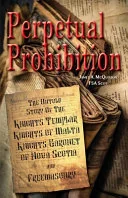
Perpetual Prohibition
 82
82

Perpetual Prohibition
James McQuiston Fsasct's *Perpetual Prohibition* attempts a bold feat: to definitively link the Knights Templar to Freemasonry using primary documents. The strength of the work lies in its diligent compilation of sourced evidence, which is indeed impressive. McQuiston presents a case built on family histories, specific events, and what he posits as absolute connections. However, the book's presentation, while aiming for accessibility, can sometimes feel dense, requiring careful reading to follow the intricate chains of reasoning. A particularly compelling section explores the alleged survival of Templar precepts through specific monastic lineages following the 1312 Council of Vienne. While the evidence presented is substantial, the interpretive leap required to connect these historical threads directly to the formative years of modern Freemasonry remains, for some, a point of continued discussion. Ultimately, *Perpetual Prohibition* offers a rigorously researched argument that will satisfy many, though perhaps not all, seekers of this particular historical nexus.
📝 Description
82
James McQuiston Fsasct's Perpetual Prohibition argues for a direct link between the Knights Templar and Freemasonry.
This book examines the historical connections between the Knights Templar and Freemasonry, aiming to establish concrete links between the two groups. McQuiston structures his research to be accessible, moving beyond purely academic language. He focuses on documented evidence rather than speculation.
The work addresses the historical debate about the Templars' origins and their relationship with Freemasonry. It seeks to fill a gap in literature that often relies on conjecture. The author synthesizes various historical elements into a unified account, tracing the potential transmission of knowledge and ritual from the Templars' dissolution in the early 14th century to the rise of Grand Lodges in the early 18th century. Specific concepts like continuous transmission of knowledge and the evolution of symbols, oaths, and organizational structures are central to this argument.
Perpetual Prohibition engages with the long-standing discussion within Western esoteric traditions concerning the survival and transformation of initiatory orders. It sits within a lineage of scholarship that investigates how medieval institutions, particularly the Knights Templar, might have influenced or directly contributed to the development of later fraternal and Masonic organizations. The book's focus on documented evidence and tangible connections distinguishes it from more speculative accounts often found in this field, grounding the inquiry in historical analysis.
💡 Why Read This Book?
• Gain a concrete understanding of the documented historical threads linking the Knights Templar to Freemasonry, as presented through primary sourced documents and family histories. • Explore the specific historical events and institutional trajectories McQuiston uses to demonstrate tangible connections, moving beyond mere speculation about the period after the Templars' suppression in 1312. • Understand the author's lifetime of research, including his correspondence with historical institutions, which underpins the assertion of absolute links between these two influential groups.
⭐ Reader Reviews
Honest opinions from readers who have explored this book.
❓ Frequently Asked Questions
What primary source documents are cited in Perpetual Prohibition?
The book references a variety of primary sources, including archival materials, family histories, and historical event records. McQuiston uses these to build a tangible, provable connection between the Knights Templar and Freemasonry.
How does Perpetual Prohibition differ from other books on Knights Templar and Freemasonry?
Unlike many speculative works, Perpetual Prohibition prioritizes primary sourced documents and historical events to establish direct links. It aims for a provable connection rather than relying on conjecture.
Who is James McQuiston Fsasct?
James McQuiston Fsasct is the author of Perpetual Prohibition. The book represents a culmination of his extensive research, travel, and correspondence with historians and institutions over many years.
When was Perpetual Prohibition first published?
Perpetual Prohibition was first published on January 24, 2024. This recent publication brings fresh analysis to a long-debated historical subject.
Is Perpetual Prohibition easy to read for beginners?
The book is presented in an 'easy to read presentation,' aiming to make complex historical connections accessible. However, the depth of research means it is best suited for those with a serious interest in the topic.
What historical period does Perpetual Prohibition focus on regarding the Templars and Freemasonry?
The work covers the period leading up to and following the suppression of the Knights Templar in the early 14th century, examining how their legacy might have transitioned into Freemasonry, particularly during the 17th and 18th centuries.
🔮 Key Themes & Symbolism
Templar-Masonic Continuity
This theme explores the author's central thesis: a direct, provable lineage connecting the Knights Templar to Freemasonry. McQuiston meticulously presents historical events, family histories, and primary sourced documents to argue for an unbroken chain of transmission. The work challenges the notion of a complete break following the Templars' suppression in 1312, suggesting a hidden continuity that later manifested within Masonic structures.
Primary Source Authentication
A significant focus is placed on the author's commitment to using primary sourced documents. The book emphasizes the importance of verifiable evidence over speculation in understanding the relationship between these two orders. McQuiston details his research methodology, including extensive travel and correspondence with historical institutions, to support his claims of tangible links.
Symbolic and Ritualistic Inheritance
Perpetual Prohibition studies how symbolic language and potentially ritualistic practices may have been passed down. It examines specific motifs and historical occurrences that, according to the author, indicate a clear inheritance from Templar traditions into early Freemasonry. The work seeks to identify absolute links through comparative analysis of historical records and esoteric symbolism.
The Esoteric Legacy
Beyond mere historical connections, the book touches upon the esoteric dimensions attributed to both the Knights Templar and Freemasonry. It explores how the perceived mysteries surrounding these groups might stem from a shared, continuous esoteric current. The author’s research aims to explain this legacy by grounding it in historical fact and traceable connections.
💬 Memorable Quotes
Direct passages from the work, attributed to the author.
“absolute links between these two famous, yet mysterious groups”
— This phrase captures the core ambition of the book: to move beyond speculation and establish concrete, verifiable connections between the Knights Templar and Freemasonry using historical evidence.
“culmination of a long lifetime of research”
— This highlights the author's dedication and the extensive nature of the work, suggesting a deep and prolonged engagement with the subject matter from multiple historical and geographical perspectives.
“tangible, provable way”
— This emphasizes the methodological approach of the book, focusing on evidence-based arguments and demonstrable connections rather than unsubstantiated theories or mystical interpretations alone.
“easy to read presentation”
— This points to the author's intention to make complex historical research accessible to a wider audience, ensuring that the findings are understandable without requiring specialized academic knowledge.
“many primary sourced documents”
— This underscores the evidentiary foundation of the book, indicating that the author relies heavily on original historical materials to support his conclusions about the Templar-Masonic relationship.
🌙 Esoteric Significance
Tradition
The work aligns with the Western Esoteric Tradition, specifically focusing on the lineage of chivalric orders and fraternal societies. It bridges historical inquiry with the esoteric interest in symbolic continuity, exploring how perceived spiritual or ritualistic legacies might pass through tangible historical structures. It departs from purely philosophical or mystical interpretations by grounding its claims in documentary evidence.
Symbolism
Key symbols likely explored include the Cross Pattée (associated with the Templars) and possibly Masonic symbols such as the Square and Compasses. The book would interpret these not just as abstract representations, but as potential markers of continuous organizational identity or shared symbolic language passed from Templarism to Freemasonry.
Modern Relevance
Contemporary researchers of Western Esotericism, particularly those interested in the historical development of Freemasonry and its perceived roots in ancient orders, find value in McQuiston's evidence-based approach. Thinkers seeking to reconcile historical fact with esoteric tradition may reference this work for its attempt to bridge a perceived gap in documented lineage.
👥 Who Should Read This Book
• Serious students of Western Esotericism seeking documented connections between historical orders. • Masonic researchers interested in the debated origins and historical influences on the Craft. • Historians of medieval military orders and early modern fraternal societies looking for primary source-based analysis.
📜 Historical Context
Published in 2024, *Perpetual Prohibition* enters a discourse on Templar-Masonic origins that has been active since at least the mid-18th century, when Masonic writers like Andrew Ramsay began explicitly linking the Craft to the Crusades. The book emerges in an era where historical revisionism and a demand for evidence-based scholarship are prevalent. McQuiston's work directly confronts the speculative nature of earlier theories, particularly those popular in the 19th century influenced by figures like Eliphas Lévi and Manly P. Hall, who often posited mystical or Gnostic connections. The book's publication follows decades of scholarly re-evaluation of Templar history post-dissolution, seeking to anchor connections to Freemasonry in documented events and genealogies rather than esoteric philosophy alone. While not explicitly engaging with a specific contemporary scholar in the blurb, the work implicitly challenges those who continue to favor unsubstantiated narratives.
📔 Journal Prompts
The author's assertion of 'absolute links' between the Knights Templar and Freemasonry.
How historical events cited in the book might have facilitated the transmission of Templar traditions.
The role of family histories in establishing the tangible connections McQuiston proposes.
Evaluating the evidence for continuity versus independent development in Masonic origins.
Reflecting on the significance of primary sourced documents in understanding esoteric history.
🗂️ Glossary
Knights Templar
A medieval Catholic military order founded around 1119, known for its role in the Crusades and its eventual suppression by Philip IV of France in the early 14th century.
Freemasonry
A fraternal organization that emerged in the late 16th to early 17th centuries, with origins in stonemason guilds, known for its use of symbolic ritual and hierarchical degrees.
Primary Sourced Documents
Original records and materials from the historical period being studied, such as letters, manuscripts, official decrees, or contemporary accounts, as opposed to later interpretations or secondary analyses.
Tangible Links
Connections between historical entities or traditions that can be demonstrated through concrete evidence, such as documented membership, shared property, or direct historical influence, rather than inferred or speculative relationships.
Council of Vienne
An ecumenical council convened by Pope Clement V in 1311-1312, which officially dissolved the Knights Templar and ordered the confiscation of their assets.
Family Histories
Records or narratives detailing the lineage, events, and associations of a particular family across generations, used in this context to trace potential lines of continuity between individuals or groups.
Esoteric
Relating to or denoting knowledge or a teaching that is meant only for a small number of people with a specialized interest or knowledge, often concerning spiritual or mystical matters.
This book appears in 1 collection
🔮 Readers Also Liked
Browse all →








From the “Templar Knights” Collection
View all →


![EBOOK COLLECTION ( PART 8) [ CSI][h 33t]](/img/thumb/ebook-collection-part-8-csi-h-33t.webp)


More Free Esoteric History & Biography Books
View all →