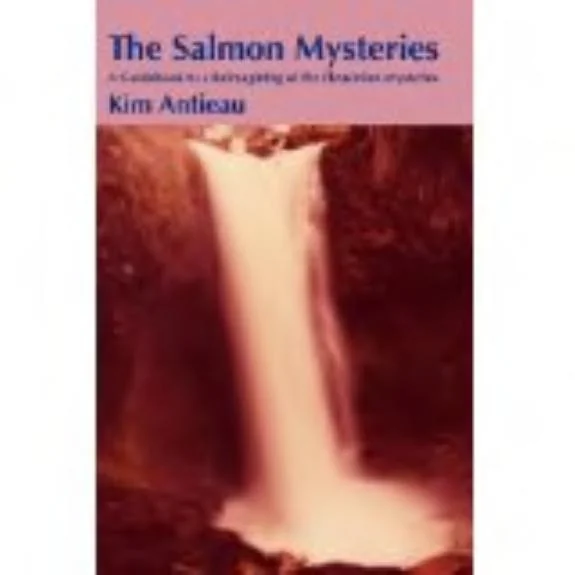
The Salmon Mysteries
 71
71

The Salmon Mysteries
Kim Antieau's *The Salmon Mysteries* daringly overlays the Eleusinian narrative onto the migratory life of the salmon. This is a bold move, and when it works, it’s inspired. The depiction of the salmon’s arduous journey upstream, its transformation, and its ultimate return to its birthplace provides a compelling, visceral analogue for Persephone's descent and Demeter's desperate search. Antieau’s prose often captures the primal, instinctual nature of the salmon’s existence, which is a significant strength. However, the novel occasionally struggles to fully integrate the human emotional arc of Demeter and Persephone with the biological imperative of the fish. The parallels sometimes feel strained, particularly in the more explicitly mythical sections. A passage detailing the salmon’s instinctual navigation of vast oceanic distances could have more deeply explored the concept of primal memory, but instead, it leans towards a straightforward naturalistic description. Despite these moments, the book offers a unique, if imperfect, perspective on ancient myth through the lens of natural cycles.
📝 Description
71
Kim Antieau's 2010 novel reimagines the Eleusinian Mysteries through the life cycle of the salmon.
Published in 2010, The Salmon Mysteries reinterprets the ancient Eleusinian Mysteries by drawing parallels between the salmon's life cycle and the myth of Demeter and Persephone. The novel uses the salmon, a creature that moves between fresh and saltwater and undergoes significant change, as a symbol for descent, transformation, and return. It addresses themes of loss and the cyclical nature of existence. The story connects the human experience to the natural world and its inherent cycles of death and rebirth.
The narrative engages with the Eleusinian Mysteries, a significant religious ritual from ancient Greece. These rites, centered on Persephone's abduction and Demeter's grief, promised initiates a better afterlife. Antieau's work recontextualizes this ancient drama in a contemporary setting, emphasizing natural cycles and the liminal spaces between different states of being. The salmon's journey between fresh and saltwater mirrors Persephone's descent into and return from the underworld.
This novel taps into the tradition of comparative mythology and esoteric interpretations of ancient Greek religion. The Eleusinian Mysteries were a major cult in antiquity, focused on agricultural cycles, death, and rebirth, with Demeter and Persephone at their center. Antieau uses the salmon's life cycle, its passage between fresh and saltwater and its metamorphosis, as a metaphor for the initiatory journey into the underworld and subsequent return. This approach echoes historical esoteric practices that sought spiritual understanding through allegory and the symbolism of natural phenomena.
💡 Why Read This Book?
• Gain a fresh perspective on the Eleusinian Mysteries, understanding how the salmon's life cycle, with its dual existence in fresh and salt water, mirrors Persephone's journey between worlds. • Explore the concept of liminality and transformation, learning how the salmon's metamorphosis and journey can symbolize spiritual passage and renewal. • Connect with ancient myth through a modern, ecological lens, appreciating how Antieau utilizes the specific behaviors and challenges of salmon migration, first documented scientifically in the 20th century, to reframe a foundational Western myth.
⭐ Reader Reviews
Honest opinions from readers who have explored this book.
❓ Frequently Asked Questions
What is the core mythological inspiration for *The Salmon Mysteries*?
The book draws its primary inspiration from the Eleusinian Mysteries, a significant ancient Greek religious ritual centered on the myth of Demeter and her daughter Persephone's abduction into the underworld.
How does the salmon symbolize Persephone and Demeter's story?
The salmon's life cycle—living in both fresh and salt water, undergoing metamorphosis, and undertaking a perilous journey to spawn—serves as a metaphor for Persephone's descent into the underworld and her eventual return, and Demeter's search and grief.
What esoteric concepts are explored in *The Salmon Mysteries*?
The novel explores themes of transformation, the cyclical nature of life, death, and rebirth, and the concept of liminality – the crossing of thresholds between different states of being or realms.
Is *The Salmon Mysteries* a retelling of the Persephone myth?
It is a radical reimagining, using the salmon's life cycle as a central, recurring motif to reinterpret the ancient myth of Demeter and Persephone for contemporary sensibilities, rather than a direct retelling.
When was *The Salmon Mysteries* first published?
The book was first published on September 5, 2010, offering a modern take on ancient mysteries.
What makes the salmon a unique symbol in this narrative?
The salmon's ability to live in two distinct worlds (fresh and saltwater) and its profound biological transformation make it a potent symbol for navigating liminal spaces and undergoing significant personal or spiritual change.
🔮 Key Themes & Symbolism
The Salmon as Avatar
The salmon's dual existence in fresh and saltwater environments is central, acting as a potent symbol for the liminal spaces and transitions inherent in both the Eleusinian myth and human spiritual journeys. Its arduous migration and biological metamorphosis are reinterpreted as a parallel to Persephone's descent into the underworld and subsequent return, highlighting themes of resilience, instinct, and the deep, often unconscious, drives that guide existence. The book uses this creature to embody the profound, often mysterious, forces at play in cycles of loss and renewal.
Reimagining the Eleusinian Mysteries
Antieau takes the foundational narrative of Demeter's search for her daughter Persephone, the inspiration for the ancient Eleusinian Mysteries, and refracts it through the lens of the salmon's life cycle. This approach moves beyond a simple retelling, instead using the biological realities of salmon migration and spawning to explore the psychological and spiritual dimensions of the myth. It offers a feminist perspective, emphasizing the enduring power of maternal bonds and the cyclical nature of life and death as experienced through a creature intimately connected to watery realms.
Duality and Transformation
The inherent duality of the salmon—its life in both rivers and oceans—serves as a powerful metaphor for navigating different states of consciousness and existence. This concept resonates deeply with the symbolic journey into the underworld and back, a core element of the Eleusinian tradition. The book explores how transformation is not just an end-state but an ongoing process, often fraught with peril and instinctual drives, mirroring the spiritual and psychological shifts individuals undergo when confronting loss and seeking rebirth.
Nature as Sacred Text
By centering the salmon, the novel elevates the natural world to a sacred text, revealing spiritual truths through ecological processes. The intricate biological imperatives of the salmon—its homing instinct, its struggle against currents, its ultimate sacrifice for procreation—are presented not merely as scientific phenomena but as archetypal expressions of cosmic cycles. This perspective encourages readers to find profound meaning and esoteric wisdom within the observable patterns of nature, connecting personal transformation to the larger rhythms of the planet.
💬 Memorable Quotes
Direct passages from the work, attributed to the author.
“Salmon live in two worlds: salt water and fresh water. They are shapeshifters, tran”
— This fragmented opening quote immediately establishes the central metaphor of the book. The salmon's ability to inhabit and traverse distinct realms—the ocean's immensity and the river's intimacy—serves as a potent symbol for the human soul's journey between the material and spiritual, the conscious and unconscious, life and death.
“Demeter's search for Persephone, her daughter lost in the underworld, inspired the Eleusinian Mysteries”
— This anchors the novel's ambitious project, directly linking the ancient Greek myth that underpins the Eleusinian rites to the contemporary narrative. It signals the book's intent to explore themes of maternal grief, loss, and the profound rituals that arise from such experiences.
“much of it remains a secret to this day”
— Referencing the veiled nature of the Eleusinian Mysteries highlights the book's exploration of hidden knowledge and initiatory experiences. It suggests that *The Salmon Mysteries* itself aims to uncover or reinterpret esoteric truths that remain elusive, inviting the reader into a process of discovery.
“Now, in a radical reimagining of this potent and ancient story, renowned novelist and mythologist Kim Antieau updates the tale for modern sensibilities”
— This statement positions the book as a contemporary intervention into ancient lore. It emphasizes Antieau's unique approach, blending literary skill with mythological scholarship to make the profound themes of the Eleusinian Mysteries accessible and relevant to a modern audience seeking deeper meaning.
“the life cycle of a most remarkable creature: the salmon.”
— This points directly to the novel's innovative central conceit. The salmon is not merely a backdrop but the primary symbolic vehicle through which the ancient myth is explored, suggesting a focus on natural cycles, instinct, and profound biological transformation as keys to understanding spiritual journeys.
🌙 Esoteric Significance
Tradition
The work draws heavily from the Hellenistic esoteric tradition, specifically the Eleusinian Mysteries, which were deeply tied to agricultural cycles, death, and rebirth. While not strictly Hermetic or Gnostic, it shares with these traditions a concern for initiatory journeys, hidden knowledge, and the transformative power of confronting primal forces. Antieau reinterprets these ancient rites through a lens that emphasizes natural processes and ecological interconnectedness, offering a contemporary, nature-based approach to themes traditionally explored through more anthropocentric mythologies.
Symbolism
The salmon is the primary symbol, representing the soul's journey between worlds (freshwater/saltwater, life/death, conscious/unconscious) and the process of transformation. Persephone's descent into the underworld symbolizes the confrontation with shadow aspects and the initiation into hidden truths. Demeter's grief embodies the profound sorrow that can catalyze spiritual awakening. The underworld itself is not merely a place of finality but a chasm of potential rebirth, echoing Gnostic ideas of descent and ascent.
Modern Relevance
In contemporary esoteric thought, *The Salmon Mysteries* speaks to the growing movement towards ecological spirituality and the search for meaning in natural cycles. Thinkers and practitioners exploring ecopsychology, deep ecology, and animism find resonance in Antieau's use of the salmon. It aligns with modern witchcraft traditions that emphasize lunar and seasonal cycles, and with contemporary mythopoetic approaches that seek to revitalize ancient stories for personal and collective healing in an era of environmental crisis.
👥 Who Should Read This Book
• Students of comparative mythology and ancient religions seeking new interpretations of foundational myths like the Eleusinian Mysteries. • Readers interested in ecofeminism and nature-based spirituality who wish to explore the connection between the natural world and esoteric concepts. • Individuals drawn to themes of transformation, loss, and rebirth, looking for a narrative that uses potent natural symbolism to explore profound psychological and spiritual journeys.
📜 Historical Context
Published in 2010, *The Salmon Mysteries* emerged during a period of renewed interest in mythology, ecocriticism, and feminist interpretations of ancient texts. The early 21st century saw scholars and authors like Karen Armstrong re-examining religious narratives for contemporary relevance, and writers such as Ursula K. Le Guin exploring nature and myth. Antieau's work fits within this intellectual current, particularly the trend of re-envisioning classical myths through non-traditional lenses. While the Eleusinian Mysteries themselves date back to at least the 2nd millennium BCE and were a central to ancient Greek religion, their esoteric nature has invited continuous interpretation. Antieau's approach, focusing on the biological cycles of a specific creature, contrasts with more purely theological or philosophical explorations of the Mysteries prevalent in the mid-20th century, such as those discussed by Walter Burkert. The novel's reception would have been influenced by ongoing debates about the role of nature in spirituality and the power of myth in shaping human consciousness.
📔 Journal Prompts
The salmon's dual existence in freshwater and saltwater.
Persephone's journey into the underworld.
Demeter's profound grief and search.
The cyclical nature of life, death, and rebirth.
Navigating liminal spaces and transformation.
🗂️ Glossary
Eleusinian Mysteries
Ancient Greek secret religious rites performed annually in honor of Demeter and Persephone, focused on themes of life, death, and rebirth, promising initiates a better afterlife.
Persephone
In Greek mythology, daughter of Demeter (goddess of agriculture) and Zeus. Abducted by Hades to be queen of the underworld, her myth explains the seasons and is central to the Eleusinian Mysteries.
Demeter
Greek goddess of the harvest and agriculture, mother of Persephone. Her grief over her daughter's abduction causes the earth to become barren, leading to the creation of the seasons.
Underworld
In mythology, the area of the dead, often depicted as a subterranean place ruled by deities like Hades. In this context, it also symbolizes a place of transformation and initiation.
Liminality
The quality of being in a transitional or initial stage of a process, or occupying an intermediate state. In esoteric contexts, it refers to thresholds between worlds or states of consciousness.
Metamorphosis
A profound change in form from one stage to the next in the life history of an organism, such as the changes from a larva to an adult insect or from a tadpole to a frog. Symbolically, it represents deep transformation.
Shapeshifter
A being with the ability to change its physical form at will. In *The Salmon Mysteries*, this term is applied metaphorically to the salmon's transformative life cycle and its ability to exist in different environments.
This book appears in 1 collection
🔮 Readers Also Liked
Browse all →







From the “Eleusinian Mysteries” Collection
View all →








More Free Esoteric History & Biography Books
View all →