Epistemologies and the Limitations of Philosophical Inquiry
 80
80

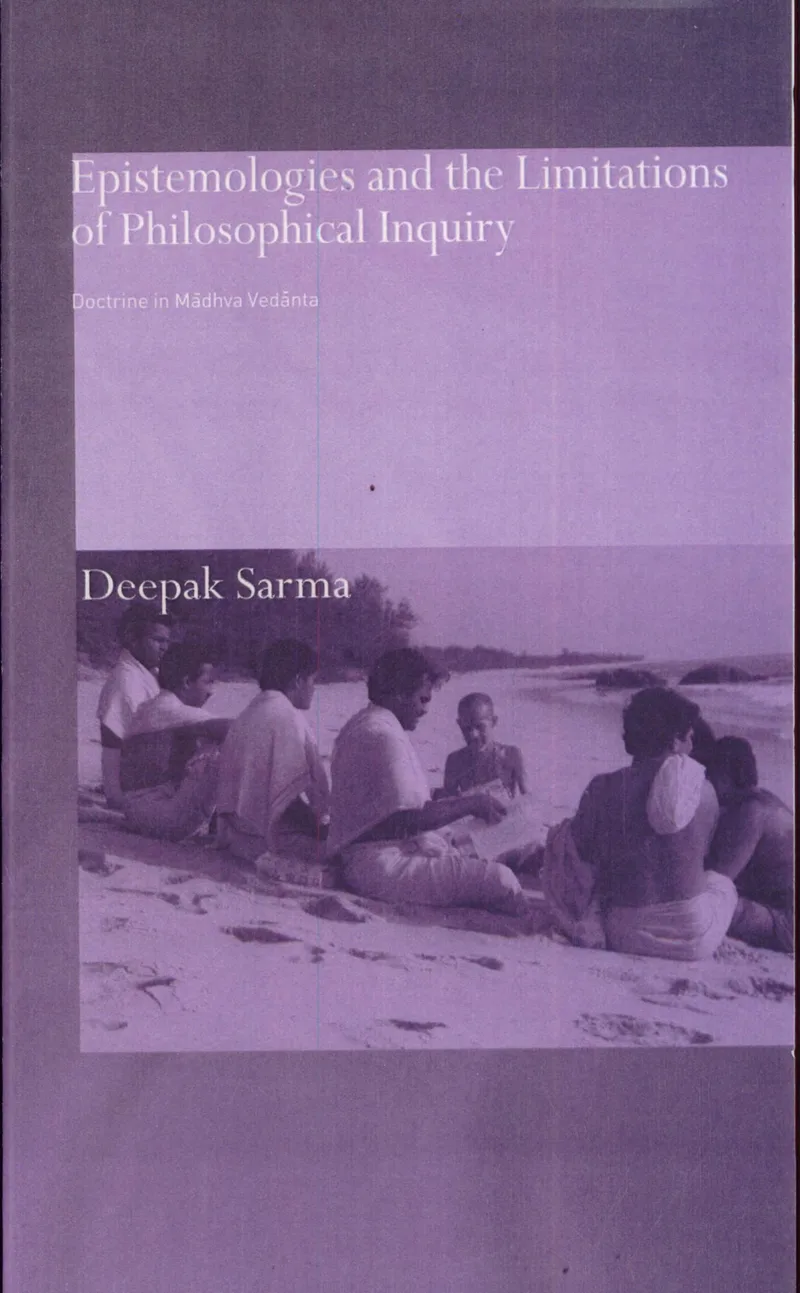
Epistemologies and the Limitations of Philosophical Inquiry
Sarma's "Epistemologies and the Limitations of Philosophical Inquiry" offers a sharp critique of how philosophical traditions, particularly the Madhva school of Vedanta, construct and guard their knowledge. The author's direct engagement with the 'insider epistemology' of the Madhva tradition is the work's most compelling aspect, demonstrating with precision how such systems resist external analysis. Sarma's examination of the potential for misinterpretation when outsiders attempt to decipher doctrines based on exclusive experiential validation is particularly incisive. While the book excels in its analytical rigor, its dense philosophical language might present a significant hurdle for readers not already conversant with advanced epistemological debates. A notable strength lies in the meticulous dissection of how the Madhva school's emphasis on direct, experiential knowing renders conventional philosophical dissection problematic. The work ultimately serves as a potent reminder of the inherent limitations in cross-doctrinal understanding. It is a vital, albeit challenging, contribution to the philosophy of religion.
📝 Description
80
Deepak Sarma's 2002 book analyzes the limits of philosophical inquiry into insider traditions.
In "Epistemologies and the Limitations of Philosophical Inquiry," Deepak Sarma examines the difficulties in understanding doctrinal traditions that rely on insider knowledge. The book focuses on the Madhva school of Vedanta, a philosophical system where internal experience rigorously defines its epistemology, making external interpretation a significant challenge. Sarma's 2002 work addresses the inherent problems in using Western philosophical frameworks to analyze traditions with distinct ways of knowing.
The book is for scholars of comparative philosophy, religious studies students, and advanced practitioners interested in how knowledge is acquired within closed systems. It questions the boundaries of interpretation and the authority given to outsiders when they engage with esoteric or specialized doctrines. Sarma highlights how the Madhva school's reliance on specific realizations and direct experience creates barriers for those not initiated into its methods of validation.
Sarma's work engages with the challenge of interpreting traditions like the Madhva school of Vedanta, which grounds knowledge in direct, realized experience. This approach often creates a gap between the initiated practitioner and the external observer. The book places itself within the academic study of Indian philosophy, a field that has grappled with how to analyze and understand systems of knowledge that diverge from Western epistemic norms. It acknowledges the ongoing scholarly discussion around these distinct modes of knowing.
💡 Why Read This Book?
• Learn how the concept of 'insider epistemology,' as exemplified by the Madhva school of Vedanta, creates unique barriers to external understanding, a challenge Sarma details. • Grasp the specific epistemological restrictions inherent in traditions that value direct experiential validation over discursive reasoning, as analyzed in the book's discussion of the Madhva doctrine. • Understand the intellectual hazards and ethical considerations of interpreting esoteric traditions from an outsider's perspective, a critical point raised by Sarma's 2002 publication.
⭐ Reader Reviews
Honest opinions from readers who have explored this book.
❓ Frequently Asked Questions
What is 'insider epistemology' as discussed in Deepak Sarma's book?
Insider epistemology refers to a system of knowledge validation that relies on the direct, often experiential, realization of truth by practitioners within a specific tradition, as examined in Sarma's analysis of the Madhva school.
Which school of Vedanta does Deepak Sarma focus on?
The book primarily focuses on the Madhva school of Vedanta, analyzing its unique epistemological framework and the challenges it presents to outside interpretation.
When was "Epistemologies and the Limitations of Philosophical Inquiry" first published?
This work by Deepak Sarma was first published on June 1, 2002.
What are the main challenges of studying traditions based on insider epistemology?
The main challenges involve the restrictive nature of the knowledge, the emphasis on direct experience over external verification, and the potential for misinterpretation by those not part of the tradition, as detailed in Sarma's work.
Is this book suitable for beginners in philosophy?
While it addresses fundamental questions about knowledge, the book's dense philosophical analysis and specific focus on the Madhva school make it more suitable for advanced students or those with prior knowledge of epistemology and Indian philosophy.
What is the core argument regarding outsiders interpreting doctrines?
Sarma argues that outsiders face significant limitations and potential pitfalls when trying to understand and interpret doctrines that are fundamentally based on exclusive insider epistemology, highlighting the risks of superficial or inaccurate conclusions.
🔮 Key Themes & Symbolism
Insider Epistemology
The central theme is the concept of 'insider epistemology,' where knowledge is validated through direct, often esoteric, personal experience unique to a tradition. Sarma uses the Madhva school of Vedanta as a prime example, detailing how its doctrines are understood and verified internally by practitioners. This contrasts sharply with external, objective philosophical analysis, raising questions about the accessibility and interpretability of such specialized knowledge for those outside the tradition.
Limitations of External Interpretation
This theme addresses the inherent difficulties and potential inaccuracies when individuals from outside a specific doctrinal framework attempt to interpret its tenets. Sarma emphasizes that the restrictive nature of insider epistemology can lead to superficial understanding or outright misrepresentation by outsiders, who lack the foundational experiential or doctrinal context necessary for true comprehension.
The Madhva School of Vedanta
The Madhva school serves as the primary case study for Sarma's epistemological inquiry. The book explores the specific doctrines and validation methods of this tradition, highlighting how its emphasis on direct realization and internal authority creates a complex epistemological landscape. Understanding the Madhva school's unique approach is crucial to grasping Sarma's broader arguments about knowledge systems.
Authority and Access to Knowledge
Sarma explores who holds the authority to interpret and disseminate knowledge within a tradition, particularly one with stringent insider epistemological requirements. The work questions the legitimacy and opportunity granted to outsiders to derive significant insights, suggesting that such endeavors are fraught with peril and may undermine the tradition's integrity.
💬 Memorable Quotes
Direct passages from the work, attributed to the author.
“The Madhva school is based on insider epistemology which is so restrictive that few can learn its intricate doctrines.”
— This statement captures the core problem Sarma addresses: how a tradition's internal methods of knowing can create insurmountable barriers for external scholars, making accurate comprehension a rare achievement.
“The degree to which outsiders can understand and interpret the doctrine of the Madhva school of Vedanta.”
— This phrase highlights the book's central investigative question, focusing on the boundaries and potential failures of external analysis when confronted with a system designed for internal comprehension.
“This book reveals the complexity of studying traditions based on insider epistemologies.”
— This interpretive summary points to the work's function as an exposé of the intricate difficulties scholars face when engaging with knowledge systems that prioritize internal validation and experience.
“The value and the hazards of granting any outsider the authority and opportunity to derive important insights into a tradition.”
— This concept underscores Sarma's critical examination of the ethical and intellectual implications of external engagement, weighing the potential benefits against the significant risks of misinterpretation and appropriation.
“Few can learn its intricate doctrines.”
— This concise observation emphasizes the high barrier to entry and the specialized nature of the Madhva school's teachings, illustrating why external understanding is so challenging.
🌙 Esoteric Significance
Tradition
While not strictly belonging to a single Western esoteric lineage like Hermeticism or Kabbalah, Sarma's work is highly relevant to esoteric studies by dissecting the very mechanisms by which esoteric knowledge is generated, validated, and guarded. It addresses traditions that, like many esoteric systems, often rely on direct experience, initiatory knowledge, and internal realization rather than empirical or rational proof accessible to the uninitiated.
Symbolism
The book's primary 'symbolism' lies in its exploration of abstract epistemological concepts rather than overt mystical symbols. The core 'motif' is the stark division between the 'insider' and the 'outsider,' representing the veil of exclusive knowledge. Another significant conceptual element is the 'restrictive doctrine,' which symbolizes the gatekeeping function of traditions that control access to their deepest truths, often through rigorous internal validation processes.
Modern Relevance
Contemporary thinkers in comparative philosophy of religion and consciousness studies, particularly those examining non-dual traditions or contemplative practices, find Sarma's work essential. It informs discussions on the limits of scientific or secular frameworks in understanding subjective experience and spiritual insight, resonating with modern practitioners and scholars seeking to bridge the gap between internal realization and external description.
👥 Who Should Read This Book
• Scholars of Comparative Philosophy and Religious Studies seeking to understand the epistemological challenges of interpreting non-Western traditions. • Advanced students of Indian philosophy, particularly Vedanta, who are interested in the meta-philosophical underpinnings of doctrinal knowledge. • Philosophers and researchers interested in the nature of knowledge, validation, and the boundaries of interpretative authority in specialized fields.
📜 Historical Context
Published in 2002, Deepak Sarma's "Epistemologies and the Limitations of Philosophical Inquiry" entered a scholarly landscape where the study of Indian philosophy was increasingly moving beyond purely textual exegesis to embrace nuanced discussions of epistemology and hermeneutics. The work engages with the ongoing academic conversation about understanding traditions like Vedanta, which often rely on experiential validation. At the time, scholars like Jonardon Ganeri were also exploring the philosophical traditions of India with a focus on their distinct conceptual frameworks. Sarma's book was significant for its direct confrontation with the concept of 'insider epistemology' as a fundamental barrier to comparative philosophy, rather than an obstacle to be easily overcome through standard analytical methods. It contributed to a growing awareness of the methodological challenges in cross-cultural philosophical dialogue.
📔 Journal Prompts
The restrictive nature of the Madhva school's insider epistemology.
The hazards of outsider interpretation versus the value of insider knowledge.
How does direct experiential validation differ from discursive philosophical argument?
Reflecting on the authority granted to interpreters of specialized doctrines.
The complexity of studying traditions with unique modes of knowing.
🗂️ Glossary
Insider Epistemology
A framework for validating knowledge that relies on the direct, personal, and often experiential realization of truth by practitioners within a specific tradition, as opposed to external, objective verification.
Madhva School of Vedanta
A prominent school of Hindu philosophy within the Vedanta tradition, founded by Madhvacarya, known for its dualistic theology and emphasis on devotional practice and direct realization.
Doctrine
A set of beliefs held and taught by a religious or political organization; in this context, the specific teachings and tenets of a philosophical or religious school.
Epistemology
The branch of philosophy concerned with the theory of knowledge, especially with its nature, scope, and the limits of its validity.
Interpretation
The action of explaining the meaning of something; in philosophy, the process of assigning meaning to texts, doctrines, or experiences.
Restrictive
Serving to limit or restrict; in this context, referring to epistemological systems that tightly control access to or validation of knowledge.
Outsider
A person who does not belong to a particular group, society, or organization; in this book, someone not initiated into or part of the specific tradition being studied.