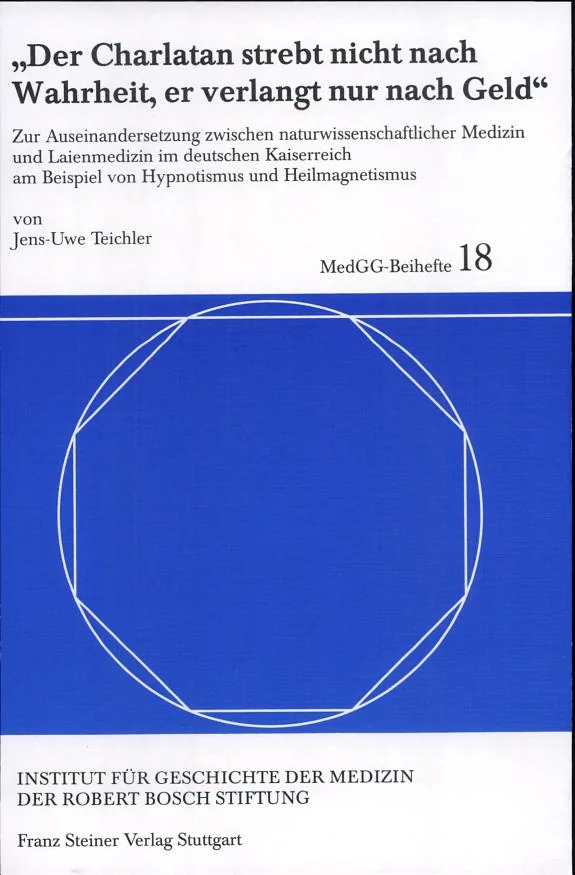
"Der Charlatan strebt nicht nach Wahrheit, er verlangt nur nach Geld"
 81
81

"Der Charlatan strebt nicht nach Wahrheit, er verlangt nur nach Geld"
Jens-Uwe Teichler’s "Der Charlatan strebt nicht nach Wahrheit, er verlangt nur nach Geld" offers a sharp historical lens on the perennial conflict between orthodox medicine and those practicing outside its established boundaries. The book’s strength lies in its granular examination of how concepts like hypnosis and Mesmeric healing became battlegrounds for professional identity and public trust in the late 19th and early 20th centuries. A particularly effective passage details the legal and ethical arguments deployed by physicians to discredit lay practitioners, often framing them as financial swindlers. While the narrative is meticulously researched, its academic focus can occasionally make the prose dense for a general audience. Nevertheless, Teichler provides a vital historical counterpoint to contemporary debates about alternative therapies. The work compellingly argues that financial motives, not solely therapeutic efficacy, have always fueled these disputes.
📝 Description
81
Jens-Uwe Teichler's 2021 book analyzes the historical conflict between conventional medicine and alternative healers.
This study investigates the historical disagreements between established medical professionals and alternative healers, using hypnosis and 'healing magnetism' as case studies. Teichler examines the late 19th and early 20th centuries, a time of significant scientific progress alongside growing interest in psychical phenomena and unconventional treatments. The debates over hypnosis, particularly influenced by Jean-Martin Charcot, and 'animal magnetism,' associated with Franz Mesmer, were key to the intellectual climate of this period. The book highlights concepts like 'Kulturschock'—cultural shock—when new healing methods emerged, and the continuous friction between lay healers ('Laienbehandler') and licensed physicians. It scrutinizes the economic and professional reasons behind these disputes.
This work is suitable for anyone interested in the historical origins of complementary and alternative medicine (CAM) and its societal integration. It will appeal to students of medical history, the sociology of science, and those curious about the long debates surrounding non-traditional healing practices. Teichler's analysis focuses on the economic and professional incentives that fueled these conflicts, offering a detailed look at a recurring tension in medical history.
While not strictly an esoteric text itself, the book examines historical movements that touched upon the esoteric, such as Mesmerism and early hypnosis. These practices often blurred the lines between scientific inquiry and what was then considered occult or spiritual healing. The period Teichler studies saw intense debate over the nature of the mind, consciousness, and healing forces, areas that continue to be explored in various esoteric traditions today. The work contextualizes these debates within a broader societal and scientific framework, showing how seemingly fringe ideas were once part of mainstream discourse.
💡 Why Read This Book?
• Gain a concrete understanding of the historical origins of the "charlatan" accusation against alternative healers, as explored through the specific debates surrounding hypnosis and Mesmerism in the late 19th century. • Discover the socio-economic factors that drove professional medical bodies to actively suppress competing healing practices, as detailed in the book's analysis of physician-lay healer conflicts. • Appreciate the nuanced historical perspective on "healing magnetism" and its practitioners, moving beyond simplistic dismissals to understand its place in medical history.
⭐ Reader Reviews
Honest opinions from readers who have explored this book.
❓ Frequently Asked Questions
When was "Der Charlatan strebt nicht nach Wahrheit, er verlangt nur nach Geld" first published?
The book "Der Charlatan strebt nicht nach Wahrheit, er verlangt nur nach Geld" was first published in 2002, offering a modern analysis of historical medical controversies.
What specific alternative therapies does the book focus on?
The book primarily examines the historical debates surrounding psychotherapeutic procedures like hypnosis and the practice of "healing magnetism" (Heilmagnetismus).
What is the main argument regarding the motivation of "charlatans"?
The book's central argument, reflected in its title, is that individuals labeled as "charlatans" in the context of healing are often driven by financial gain rather than a pursuit of genuine truth or therapeutic outcomes.
Who is the author of this historical analysis?
The author of "Der Charlatan strebt nicht nach Wahrheit, er verlangt nur nach Geld" is Jens-Uwe Teichler.
What historical period does the book cover in its examination of medical debates?
The work typically covers the late 19th and early 20th centuries, a period rife with discussions and conflicts concerning the integration of new and unconventional healing methods.
What does the book reveal about the relationship between doctors and lay healers?
It reveals a long-standing adversarial relationship, where established physicians often sought to discredit and marginalize lay healers, frequently citing economic motives as justification.
🔮 Key Themes & Symbolism
Professional Gatekeeping
The work meticulously details how medical guilds and individual physicians acted as gatekeepers, defining legitimate practice and often employing aggressive tactics to exclude or discredit those operating outside their purview. This theme is exemplified by the historical suppression of practices like Mesmerism, which threatened the established medical authority and economic interests of the time.
The Nature of "Truth" in Healing
Teichler questions the very definition of therapeutic truth, contrasting the scientific, evidence-based approach favored by orthodox medicine with the experiential, often intuitive methods of alternative practitioners. The book illustrates how "truth" itself becomes a contested concept when economic and social power dynamics are at play.
Financial Motivation in Medicine
The book directly confronts the financial underpinnings of medical practice, both historical and contemporary. By analyzing the accusations of charlatanry, Teichler highlights how the pursuit of money can influence the acceptance or rejection of healing modalities, often overshadowing considerations of efficacy or patient well-being.
Sociology of Alternative Therapies
This theme explores the social reception and marginalization of non-conventional therapies. The work examines the public discourse, professional rivalries, and regulatory efforts that shaped the landscape for practices like hypnosis and "healing magnetism," demonstrating how societal structures influenced the trajectory of these healing arts.
💬 Memorable Quotes
Direct passages from the work, attributed to the author.
“Hypnose und "Heilmagnetismus" were central to disputes between doctors and lay healers.”
— This statement highlights specific historical therapeutic modalities that became focal points for conflict, illustrating the broader tension between credentialed medical practitioners and those offering treatment outside traditional frameworks.
“Historical context is often overlooked in discussions of alternative medicine.”
— This interpretation points to a key deficiency the book aims to address: the lack of awareness regarding the deep historical roots and ongoing controversies surrounding non-traditional healing practices.
“The debate was less about scientific proof and more about professional control.”
— This concept suggests that the historical conflicts examined were driven by power struggles within the medical field, where professional identity and authority were prioritized over purely scientific validation of new therapies.
“The public's willingness to embrace new healing methods fueled opposition.”
— This interpretation implies that the popularity and acceptance of alternative practices among the populace created friction with the medical establishment, which felt threatened by these emerging trends.
💡 Key Ideas
Editorial paraphrase of the work's core concepts — not direct quotes.
The accusation of charlatanry is often a tool to protect financial interests.
This paraphrased concept suggests that labeling alternative practitioners as "charlatans" historically served not only to discredit their methods but also to safeguard the economic position of established medical professionals.
🌙 Esoteric Significance
Tradition
This work operates within the broader tradition of critical historical analysis of healing practices, touching upon lineages that explore the mind-body connection and subtle energies. While not strictly a manual of esoteric practice, it analyzes historical phenomena often associated with esoteric thought, such as "healing magnetism," placing them within a socio-historical context rather than a purely metaphysical one.
Symbolism
The primary symbolic tension explored is between "truth" and "money" as motivators in healing. "Truth" can be seen as representing genuine spiritual or therapeutic intent, while "money" symbolizes the corrupting influence of material gain and professional ambition. The specific practices of hypnosis and "healing magnetism" themselves become symbols of the unknown, the intuitive, and the potentially uncontrollable forces that orthodox science sought to either explain away or suppress.
Modern Relevance
Contemporary discussions surrounding energy healing, mindfulness-based therapies, and even aspects of psychotherapy that explore subconscious processes echo the historical debates detailed in Teichler's book. Thinkers and practitioners in fields like transpersonal psychology and integral medicine, who seek to bridge conventional science with broader human experience, find resonance in understanding these historical conflicts and the enduring tension between empirical validation and subjective experience in healing.
👥 Who Should Read This Book
• Students of medical history interested in the societal integration of alternative therapies, particularly those focusing on the late 19th and early 20th centuries. • Researchers of the sociology of science and professions seeking to understand how scientific legitimacy is constructed and contested, using the examples of hypnosis and "healing magnetism." • Practitioners and enthusiasts of esoteric or complementary medicine who wish to contextualize their fields within a historical framework of debate and professional challenge.
📜 Historical Context
Published in 2002, Jens-Uwe Teichler’s work emerged during a period of renewed public interest in complementary and alternative medicine (CAM), yet also amidst ongoing debates about its legitimacy. The book anchors its analysis in the late 19th and early 20th centuries, a fertile ground for intellectual ferment that saw figures like Sigmund Freud begin to explore the therapeutic potential of hypnosis, building on earlier work by Jean-Martin Charcot. This era was also defined by the lingering influence of Franz Mesmer's theories of "animal magnetism," which had already sparked significant controversy decades prior. Teichler situates these developments against a backdrop of burgeoning scientific rationalism clashing with enduring spiritual and esoteric beliefs. The work implicitly engages with the broader intellectual currents of positivism and vitalism, exploring how these philosophical underpinnings shaped medical discourse. Notably, the reception of such alternative therapies was often met with fierce resistance from established medical bodies, who saw them as threats to professional authority and economic stability, a dynamic Teichler meticulously documents.
📔 Journal Prompts
The historical conflict between "truth" and "money" in healing.
The professional strategies used to discredit "Laienbehandler."
The public reception of hypnosis and "Heilmagnetismus."
The concept of "Kulturschock" applied to new medical ideas.
Physicians' arguments against lay healers in the early 20th century.
🗂️ Glossary
Laienbehandler
German term for lay healers or practitioners who offer medical treatment or advice without formal medical qualifications recognized by the established medical profession.
Heilmagnetismus
Literally 'healing magnetism,' this refers to practices derived from Franz Mesmer's theories of animal magnetism, involving the manipulation of perceived subtle energies for therapeutic purposes.
Hypnose
The state of consciousness or awareness that can be induced through suggestion, involving a state of focused attention and reduced peripheral awareness, often used in therapeutic contexts.
Kulturschock
Cultural shock, referring to the disorientation experienced when encountering a new culture or way of life. In this context, it applies to the disruption caused by novel healing methods entering the established medical landscape.
Standespolitik
Professional politics or policy, referring to the internal affairs, regulations, and political maneuvering within a professional group, such as the medical establishment.
Alternativmedizin
Alternative medicine, encompassing a wide range of health care practices that are not typically part of standard medical care.
Komplementärmedizin
Complementary medicine, used together with conventional medicine.
This book appears in 1 collection
🔮 Readers Also Liked
Browse all →








From the “Hypnosis” Collection
View all →








More Free Esoteric History & Biography Books
View all →