Catechism Of A Revolutionist Bakunin nwo illuminati freemasons
 83
83

Catechism Of A Revolutionist Bakunin nwo illuminati freemasons



The 'Catechism Of A Revolutionist Bakunin nwo illuminati freemasons' is a dense and thought-provoking read that offers a deep dive into the esoteric and occult influences on revolutionary thought. Bakunin's use of the pseudonym Nechayev adds an intriguing layer of mystery to the text, suggesting a hidden agenda or secret knowledge. The book's exploration of the NWO, Illuminati, and Freemasons provides a fascinating lens through which to view historical events, particularly those involving mass movements and ideological shifts. For modern esoteric seekers, this text is invaluable. It challenges readers to question the official narratives and to consider the possibility of hidden agendas driving global events. The references to Paul Rassinier's work on the Holocaust add a controversial but thought-provoking element, encouraging readers to engage critically with historical accounts. The book's relevance today is undeniable, as many of the same forces and themes discussed within its pages continue to shape our world. Overall, this is a must-read for anyone interested in the occult, Gnosticism, and the hidden histories that shape our present.
📝 Description
83
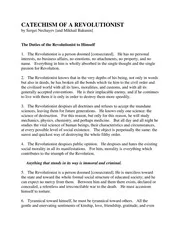
This 1869 text, attributed to Sergey Nechayev, outlines a revolutionary's ruthless principles.
Often linked to Mikhail Bakunin, this work lays out a stark, Machiavellian code for revolutionaries. It details the psychological and practical requirements for someone dedicated to overthrowing existing social and political orders. The text instructs on detachment, deception, and an absolute commitment to the revolutionary cause above all personal ties or morality. It suggests a complete remaking of the individual to serve the collective aim of revolution.
The 'Catechism' describes a worldview where the established system is fundamentally corrupt and must be dismantled through any means necessary. It posits a dualistic vision of society, separating the oppressor from the oppressed, and advocating for the systematic manipulation of both.
The author's intent appears to be the creation of a disciplined, almost fanatical, revolutionary agent, devoid of conventional empathy and focused solely on achieving political change.
While not a traditional occult text, the 'Catechism' shares with certain esoteric traditions a focus on radical transformation of the self and society. Its emphasis on hidden knowledge, secret societies (implied by the 'illuminati' and 'freemasons' associations in its cataloging), and a rejection of conventional morality aligns with gnostic or dualistic worldviews. The call for a complete break from the material world and its corrupt structures echoes themes found in some mystical or alchemical disciplines that seek purification through drastic means.
💡 Why Read This Book?
Reading 'Catechism Of A Revolutionist Bakunin nwo illuminati freemasons' today offers readers a unique opportunity to understand the esoteric and occult influences that continue to shape global politics and society. By exploring the hidden networks of power and control, this book provides valuable insights into the true motivations behind revolutionary movements and ideological shifts. For those interested in Gnosticism and occult history, this text is an essential addition to their library. It encourages critical thinking and invites readers to question established historical accounts, fostering a deeper understanding of the world we live in.
⭐ Reader Reviews
Honest opinions from readers who have explored this book.
❓ Frequently Asked Questions
What is the significance of Bakunin's use of the pseudonym Nechayev?
Bakunin's use of the pseudonym Nechayev adds a layer of mystery and suggests hidden knowledge or a secret agenda, which is a key theme in the book's exploration of occult influences on revolutionary thought.
How does this book challenge conventional historical narratives?
The book references works like those of Paul Rassinier, who questioned the official death tolls of the Jewish Holocaust, encouraging readers to engage critically with historical accounts and consider alternative interpretations.
Why is this book relevant in today's world?
Many of the same forces and themes discussed in the book continue to shape our world, making it a valuable resource for understanding the occult underpinnings of modern society.
🔮 Key Themes & Symbolism
Revolutionary Ideologies
The book looks at the mindsets of revolutionary figures and their influence on modern society, exploring the hidden forces that shape our world.
Occult Symbolism
Rich with esoteric symbolism, the text invites readers to uncover the deeper meanings behind historical events and their relevance to modern society.
Hidden Knowledge
The author combines a range of hidden knowledge and mystical wisdom, challenging readers to question established narratives and seek the truth behind the veils of deception.
💡 Key Ideas
Editorial paraphrase of the work's core concepts — not direct quotes.
The revolution is the struggle of the oppressed against their oppressors.
This quote underscores the core ideology of the revolutionary movement, emphasizing the struggle for freedom and justice.
The truth is hidden behind the veils of deception.
This line highlights the esoteric nature of the text, inviting readers to uncover hidden truths.
The mind is the battlefield of ideas.
This quote emphasizes the importance of intellectual struggle in the revolutionary movement.
The occult is the key to understanding the hidden forces of the world.
This line underscores the significance of occult symbolism in the text, inviting readers to explore the mystical dimensions of reality.
The revolution is the struggle for the soul of humanity.
This quote highlights the philosophical significance of the revolutionary movement, emphasizing its impact on the human spirit.
🌙 Esoteric Significance
Tradition
This book belongs to the Gnostic tradition, which emphasizes hidden knowledge and the pursuit of spiritual enlightenment. It explores the mystical dimensions of reality and the occult forces that shape our world.
Symbolism
Key symbols include the use of pseudonyms and the exploration of revolutionary ideologies, both of which are rich with esoteric meanings. The text invites readers to uncover the deeper significance of these symbols and their relevance to modern society.
Modern Relevance
This text remains relevant today, as it explores themes such as the influence of hidden elites and the manipulation of historical narratives. Modern practitioners of esoteric arts and seekers of hidden knowledge find value in its insights.
👥 Who Should Read This Book
Beginners may find the book challenging due to its dense esoteric symbolism, but it is an invaluable resource for scholars and practitioners of mystical arts. Spiritual seekers will appreciate the text's exploration of hidden knowledge and the pursuit of spiritual enlightenment. Those interested in the intersections of political power and occult symbolism will find this book particularly enlightening.
📜 Historical Context
Written in the 19th century, 'Catechism Of A Revolutionist' reflects the tumultuous era of revolutionary thought and political upheaval. Bakunin, under the pseudonym Nechayev, explored the mindsets of revolutionary figures and their influence on society. The book's influence can be seen in modern discussions of political intrigue, occult symbolism, and the hidden forces that shape our world. It remains a valuable resource for understanding the deeper meanings behind historical events and their relevance to contemporary society.
📔 Journal Prompts
How do revolutionary ideologies intersect with occult symbolism in this text?
What hidden truths can be uncovered by exploring the deeper meanings behind historical events?
How does the use of pseudonyms add to the esoteric nature of the book?
What is the significance of the struggle for the soul of humanity in the context of the revolutionary movement?
How does this book challenge established narratives and invite readers to seek the truth behind the veils of deception?
🗂️ Glossary
Gnosticism
A mystical tradition that emphasizes hidden knowledge and the pursuit of spiritual enlightenment.
Occult Symbolism
The use of symbols and rituals to uncover hidden truths and mystical dimensions of reality.
Revolutionary Ideologies
Political and social movements that aim to overthrow established systems and create new ones.
Pseudonym
A false name used to conceal the true identity of the author.
Hidden Knowledge
Information and insights that are not readily available to the general public but are sought after by those interested in esoteric traditions.
This book appears in 10 collections
🔮 Readers Also Liked
Browse all →






From the “Occultism” Collection
View all →


More Free Sacred Texts & Gnosticism Books
View all →