The ancient wisdom

 76
76

The ancient wisdom
Annie Besant's The Ancient Wisdom presents a dense but remarkably coherent exposition of Theosophical doctrine. Its strength lies in its systematic approach, breaking down complex spiritual concepts like the planes of existence and the human constitution into digestible, albeit abstract, components. Besant’s clarity in explaining the intricate mechanics of reincarnation and karma, as understood by her tradition, is commendable. However, the text’s primary limitation is its inherent reliance on the specific philosophical framework of Theosophy, which can feel insular to those unfamiliar with its premises. A passage detailing the "Seven Planes of Existence" exemplifies this; while thoroughly explained within its context, it requires significant conceptual bridging for newcomers. The work offers a thorough guide to a particular esoteric worldview, but its accessibility is inversely proportional to the reader's prior exposure to Theosophical thought.
📝 Description
76
Annie Wood Besant's The Ancient Wisdom, first published in 1986, systematically explains esoteric concepts.
This book is not a narrative but a structured exposition on consciousness, the universe, and humanity's place within it. Besant draws heavily on Theosophical teachings to build a framework for understanding the hidden laws governing existence. The text is suited for serious students of comparative religion, occultism, and Theosophy. Readers who want a structured, intellectual approach to spiritual doctrines, especially those interested in karma, reincarnation, and the planes of existence as understood in Theosophy, will find it valuable. It requires engagement with detailed philosophical arguments rather than casual reading.
Besant, a key figure in Theosophy, aimed to synthesize and clarify its core tenets. The book emerged during a time when esoteric ideas sought audiences interested in alternatives to mainstream thought. Its 1986 publication signals a continuing interest in these philosophies decades after their initial prominence. The work details specific concepts like the Seven Planes of Existence, the Monad's nature, reincarnation, and Karma.
The Ancient Wisdom reflects the enduring influence of Theosophy, a movement co-founded by Helena Blavatsky. Annie Wood Besant, a prominent Theosophist, sought to synthesize and elucidate its central ideas in this work. The book appeared in the late 20th century, a period marked by continued interest in esoteric philosophies as alternatives to prevailing religious and scientific paradigms. Its publication date highlights the sustained appeal of these spiritual ideas.
💡 Why Read This Book?
• Gain a structured understanding of the Theosophical model of spiritual evolution, including concepts like the Seven Planes of Existence, which offers a detailed map of consciousness beyond the physical. • Learn about Annie Wood Besant's systematic presentation of karma and reincarnation, providing a framework for understanding cause and effect across lifetimes, distinct from common interpretations. • Explore the concept of the Monad and its evolutionary journey, offering a unique perspective on individual spiritual development within a grand cosmic scheme as outlined in the text.
⭐ Reader Reviews
Honest opinions from readers who have explored this book.
❓ Frequently Asked Questions
When was The Ancient Wisdom first published?
The Ancient Wisdom by Annie Wood Besant was first published in 1986, making it a significant work from the later period of Theosophical literature.
What is the primary philosophical system discussed in The Ancient Wisdom?
The book's primary focus is on Theosophy, a spiritual philosophy that emerged in the late 19th century, aiming to synthesize Eastern and Western esoteric traditions.
Does The Ancient Wisdom explain reincarnation?
Yes, a central theme in The Ancient Wisdom is the explanation of reincarnation, detailing the process of soul evolution through successive lifetimes and various forms.
Who was Annie Wood Besant?
Annie Wood Besant was a prominent British socialist, Theosophist, and later president of the Theosophical Society, a key figure in disseminating esoteric teachings globally.
Are there specific spiritual planes discussed in the book?
Indeed, the work systematically details the concept of the Seven Planes of Existence, which represent different levels of consciousness and reality within the Theosophical cosmology.
Is The Ancient Wisdom suitable for beginners in esotericism?
While comprehensive, the book is quite dense. Beginners might find it more accessible after an introductory text to Theosophy, as it assumes some familiarity with esoteric concepts.
🔮 Key Themes & Symbolism
The Seven Planes of Existence
Besant meticulously outlines the Theosophical cosmology, detailing the seven planes of existence: Physical, Astral, Devachanic, Buddhic, Atmic, Monadic, and Logoic. Each plane represents a distinct level of reality and consciousness, through which the human spirit evolves. The work emphasizes that these are not mere abstract concepts but tangible, albeit subtle, realms that influence life and consciousness. Understanding these planes is crucial for grasping the totality of existence as presented in the book, moving beyond a purely materialist worldview to a multi-dimensional understanding of the cosmos.
Evolution of Consciousness
A core tenet is the continuous evolution of consciousness from simpler forms towards greater complexity and spiritual awareness. The Ancient Wisdom traces this journey through various kingdoms—mineral, plant, animal, human—and posits that this process continues through spiritual evolution beyond the human stage. This concept of monadic evolution, driven by karma and reincarnation, offers a framework for understanding purpose and progress in the universe, suggesting an inherent directionality towards self-realization and unity.
Karma and Reincarnation
The book elaborates on karma not as divine judgment but as a natural law of cause and effect, governing the cycle of rebirth. Reincarnation is presented as the mechanism through which souls learn and evolve, experiencing the consequences of past actions and working towards spiritual liberation. Besant explains how these principles shape individual destinies and the collective human experience, providing a moral and ethical structure that underpins the entire evolutionary process outlined in Theosophical thought.
The Constitution of Man
Besant provides a detailed breakdown of the human being, describing the complex interplay of various "bodies" or sheaths: the physical, astral, and mental bodies, along with higher spiritual principles like the Buddhic and Atmic. This layered understanding of human nature is essential for comprehending spiritual growth, as it explains how different aspects of the self interact with the various planes of existence and how purification and development occur across these levels.
💬 Memorable Quotes
Direct passages from the work, attributed to the author.
“Karma is the law of causation, not of punishment.”
— This interpretation clarifies Besant's view of karma as an impersonal, natural law that governs the consequences of actions, emphasizing learning and balance rather than retribution.
“Man is a complex being, composed of physical and subtle bodies.”
— This statement expresses the Theosophical view of human nature presented in the book, positing multiple layers of existence beyond the physical form, each with its own functions and potentials.
“Reincarnation provides the opportunity for the soul's expansion.”
— This concept underscores the book's perspective on rebirth as a vital process for spiritual growth and the accumulation of experience necessary for the soul's ultimate development.
“The Seven Planes are stages of consciousness, not just physical locations.”
— This interpretation emphasizes the esoteric nature of the planes described, framing them as states of awareness and reality that the evolving consciousness traverses.
💡 Key Ideas
Editorial paraphrase of the work's core concepts — not direct quotes.
The evolution of consciousness is the primary purpose of the universe.
This paraphrased concept highlights the book's central theme: that existence is not random but directed towards the unfolding and refinement of awareness, from rudimentary forms to higher spiritual states.
🌙 Esoteric Significance
Tradition
The Ancient Wisdom is firmly rooted in the Theosophical tradition, which itself draws from Hermeticism, Gnosticism, Neoplatonism, and Eastern philosophies (particularly Hinduism and Buddhism). Besant sought to present a synthesis of these ancient wisdom streams, framing them within a coherent evolutionary cosmology. It departs from some earlier esoteric systems by its explicit emphasis on a scientific, albeit metaphysical, explanation of spiritual laws and processes, aiming to bridge the gap between science and spirituality prevalent in the modern era.
Symbolism
Key symbols within the work include the Monad, representing the divine spark or the individual soul on its evolutionary path, often depicted as a point of light. The concept of the Seven Planes of Existence functions symbolically, representing distinct states of consciousness and reality, much like the seven chakras in yogic traditions, but expanded to a cosmic scale. The Serpent, often symbolizing wisdom, eternity, or cyclic processes, is also implicitly present in discussions of karma and reincarnation, representing the continuous unfolding and renewal of life.
Modern Relevance
Contemporary esoteric practitioners and scholars of religion continue to engage with Besant's work. Its systematic presentation of reincarnation and karma influences modern New Age thought and various forms of Western esotericism. Thinkers and groups focusing on consciousness studies, comparative mythology, and the history of occultism often reference Theosophical texts like this one for their detailed cosmological frameworks and philosophical underpinnings, particularly in understanding concepts of spiritual evolution.
👥 Who Should Read This Book
• Students of Theosophy: Those specifically studying the teachings of Helena Blavatsky and Annie Wood Besant will find this a key text for understanding core doctrines. • Comparative religion scholars: Researchers interested in the development of modern esoteric movements and their synthesis of Eastern and Western thought will gain valuable context. • Seekers of metaphysical frameworks: Individuals looking for a detailed, systematic explanation of concepts like karma, reincarnation, and spiritual evolution beyond conventional religious or scientific paradigms.
📜 Historical Context
The Ancient Wisdom, published in 1986, emerged from the enduring legacy of Theosophy, a spiritual movement that gained significant traction in the late 19th and early 20th centuries. Annie Wood Besant, a towering figure in the Theosophical Society, served as its president and was instrumental in codifying and disseminating its teachings. This work builds upon the foundational texts like Helena Blavatsky's "The Secret Doctrine." Besant's contribution was to present these intricate doctrines in a more accessible, systematic manner for a later generation. The book appeared in an era where interest in alternative spiritualities and Eastern philosophies, previously popularized by figures like Blavatsky and Swami Vivekananda in the late 1800s, continued to find an audience, albeit often through new interpretations and syncretic movements. While not a direct engagement with competing schools like modern psychology or existentialism, its focus on karma, reincarnation, and spiritual evolution offered a distinct metaphysical framework.
📔 Journal Prompts
The Monad's evolutionary path across the Seven Planes of Existence.
The mechanics of Karma as a law of causation.
How the constitution of man relates to the Seven Planes.
The purpose of reincarnation for soul expansion.
Interpreting the symbolism of the Serpent in relation to cosmic cycles.
🗂️ Glossary
Theosophy
A spiritual philosophy founded in the late 19th century, aiming to synthesize ancient wisdom traditions and present a rational explanation of the universe and humanity's place within it, emphasizing reincarnation and karma.
Monad
In Theosophy, the divine spark or individual spiritual essence that undergoes evolution through various planes and lives, seeking ultimate union with the divine.
Karma
The universal law of cause and effect, where actions create consequences that influence present and future lives; not a punitive system but a mechanism for learning and balance.
Reincarnation
The cyclical process by which the Monad, or soul, takes on new physical bodies in successive lifetimes to learn, evolve, and work out karmic consequences.
Seven Planes of Existence
A cosmological model within Theosophy describing distinct levels of reality and consciousness, from the physical to the purely spiritual, through which evolution occurs.
Astral Body
A subtle energetic or ethereal body associated with emotions and desires, considered a component of the human constitution in Theosophical thought, active during sleep and in the afterlife.
Devachan
Often translated as 'heaven-world,' a state of blissful rest and assimilation of experiences between physical incarnations, existing on a higher plane of consciousness.
🔮 Readers Also Liked
Browse all →








More by Annie Wood Besant
All books →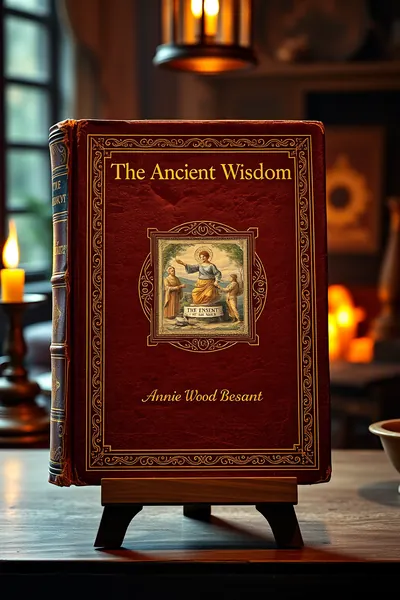




More Free Sacred Texts & Gnosticism Books
View all →