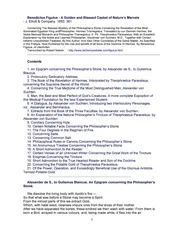
B. Figulus (1893), A Golden and Blessed Casket of Nature's Marvels
 77
77

B. Figulus (1893), A Golden and Blessed Casket of Nature's Marvels



Ophelia Vance (Mystical Literature Reviewer) — Benedictus Figulus’s 'A Golden and Blessed Casket of Nature's Marvels' is an indispensable cornerstone for serious students of Western esotericism. This 1893 edition offers a lucid portal into the alchemical quest for the Philosopher’s Stone, masterfully presenting the teachings of Hermes Trismegistus, Paracelsus, and Alexander von Suchten. The text is rich with symbolic language and alchemical allegory, demanding thoughtful engagement rather than passive reading. Its strength lies in its comprehensive distillation of complex concepts, making the arduous journey of the Great Work more accessible. Ideal for dedicated practitioners, seasoned occult scholars, and those seeking a profound connection to the ancient art of spiritual transformation.
📝 Description
77
Benedictus Figulus's 'A Golden and Blessed Casket of Nature's Marvels' was translated into English in 1893.
This 1893 English translation of Benedictus Figulus's work focuses on the alchemical pursuit of the Philosopher's Stone. It compiles teachings attributed to Hermes Trismegistus, with added commentary from Paracelsus and Alexander von Suchten. Figulus presents these alchemical doctrines, blending cosmic principles with practical methods for the diligent student.
The text aims to guide practitioners toward understanding the fundamental forces of existence. It offers insights for those seeking spiritual illumination through the alchemical process. The compilation is intended for serious students of the Great Work, encouraging a deeper grasp of natural phenomena.
This work is situated within the hermetic alchemical tradition, drawing heavily on figures like Hermes Trismegistus, considered a foundational authority in alchemy and esoteric philosophy. The inclusion of commentary from Paracelsus, a Renaissance alchemist and physician, further anchors it in a period of alchemical revival and intellectual synthesis. Alexander von Suchten's contributions add another layer, reflecting the alchemical thought of the 16th century. The compilation reflects a desire to preserve and disseminate these teachings, connecting the alchemical quest for material transmutation with spiritual transformation.
💡 Why Read This Book?
Uncover the veiled truths of alchemy and the Philosopher's Stone, a journey into nature's deepest secrets. Engage with the foundational texts of Western esotericism, illuminated by legendary figures like Paracelsus. This book is essential for seekers of hidden knowledge, scholars of ancient wisdom, and practitioners aspiring to understand the Great Work’s spiritual and material dimensions.
⭐ Reader Reviews
Honest opinions from readers who have explored this book.
❓ Frequently Asked Questions
What is the primary focus of 'A Golden and Blessed Casket of Nature's Marvels'?
The book primarily focuses on the alchemical pursuit of the Philosopher's Stone, exploring its spiritual and material implications through the teachings of Hermes Trismegistus, Paracelsus, and Alexander von Suchten.
Who was Benedictus Figulus?
Benedictus Figulus (1575-1657) was a significant alchemist and compiler of esoteric texts, dedicated to preserving and disseminating the wisdom of the Great Work.
Is this book suitable for beginners in alchemy?
While challenging, the book's comprehensive nature makes it valuable for dedicated beginners who are prepared for rigorous study, especially when approached with supplementary resources.
What is the significance of the Philosopher's Stone in this text?
The Philosopher's Stone is presented not just as a substance for material transmutation, but as a symbol for spiritual perfection, enlightenment, and the attainment of divine knowledge.
What is the role of Alexander von Suchten in this work?
Alexander von Suchten provides an 'excellent explanation' and commentary, offering his learned insights to clarify and expand upon the core alchemical doctrines presented by Figulus.
🔮 Key Themes & Symbolism
The Alchemical Great Work
This theme explores the central alchemical pursuit of the Philosopher's Stone, not merely as a material goal of transmutation, but as a profound metaphor for spiritual purification, enlightenment, and the attainment of inner perfection. It looks at the stages of the Great Work, the symbolic language used to describe these processes, and the ultimate aim of achieving a state of divine unity and wisdom. Readers are invited to understand the alchemical journey as a path of self-discovery and transformation.
Hermetic Wisdom and Hermes Trismegistus
The text places immense value on the foundational principles attributed to Hermes Trismegistus, the legendary progenitor of Hermetic philosophy. This theme examines how the 'Corpus Hermeticum' and related teachings serve as the bedrock for alchemical understanding, emphasizing concepts such as 'As Above, So Below,' the unity of all things, and the divine spark inherent in nature. It highlights the reverence for ancient wisdom and the continuous effort to decipher its profound truths.
Symbolism and Hidden Meanings
A critical aspect of this work is its collection of symbolism, where everyday substances and processes are imbued with esoteric significance. This theme investigates the alchemical language, the allegorical representations of metals, planets, and elements, and the hidden meanings concealed within seemingly simple statements. It underscores the importance of allegorical interpretation and the necessity of a prepared mind to unlock the deeper, spiritual dimensions of alchemical texts.
💬 Memorable Quotes
Direct passages from the work, attributed to the author.
“Nature reveals herself to the patient seeker.”
— This emphasizes the virtue of perseverance and dedication in the alchemical pursuit. True understanding of nature's marvels is not instantaneous but is earned through diligent effort and a receptive spirit.
“The Art of Alchemy is a Divine Science.”
— This highlights the sacred and spiritual dimension of alchemy, viewing it not as mere chemistry, but as a divinely inspired pursuit aimed at understanding and participating in the creative forces of the universe.
“Transmutation is both outward and inward.”
— This dual meaning of transmutation is crucial: it refers to the physical alteration of substances in the laboratory, but more importantly, to the spiritual transformation and purification of the alchemist's own soul.
💡 Key Ideas
Editorial paraphrase of the work's core concepts — not direct quotes.
The Stone is the Key to Nature's Secrets.
This quote captures the alchemical belief that the Philosopher's Stone is not just an artifact, but a fundamental principle or substance that unlocks the hidden workings and profound mysteries of the natural world.
Within the microcosm lies the macrocosm.
A core Hermetic principle, this quote points to the interconnectedness of the human being (microcosm) and the universe (macrocosm), suggesting that by understanding oneself, one can understand the greater cosmic order.
🌙 Esoteric Significance
Tradition
This work is deeply rooted in the Western Esoteric Tradition, specifically within the alchemical branches of Hermeticism and Paracelsianism. It represents a key text for understanding the practical and philosophical underpinnings of the alchemical quest, bridging the gap between ancient mystical philosophies and the more systematic, albeit symbolic, approaches to spiritual development.
Symbolism
The text is replete with rich alchemical symbolism. Key symbols include the Philosopher's Stone itself (representing perfection, enlightenment, and the unification of opposites), the four elements (earth, air, fire, water), the seven planets (representing specific energies and stages), and various metallic and animal archetypes. These symbols are not merely decorative but serve as a coded language for conveying profound spiritual and material truths.
Modern Relevance
In contemporary times, this book remains highly relevant for those exploring personal transformation, consciousness studies, and the philosophical underpinnings of nature. Its emphasis on patience, diligent practice, and the interconnectedness of all things offers timeless wisdom for navigating modern challenges, fostering a deeper appreciation for the subtle forces at play in the universe and within ourselves.
👥 Who Should Read This Book
This key work is indispensable for serious students of alchemy, hermeticism, and the Western esoteric tradition. Scholars of historical occultism will find it an invaluable primary source, offering direct access to foundational alchemical thought. Seekers of profound spiritual knowledge and personal transformation will benefit from its allegorical depth and philosophical insights. While demanding, practitioners aiming to integrate alchemical principles into their magical or spiritual work will discover a rich wellspring of wisdom and practical guidance within its pages.
📜 Historical Context
Published in 1893, 'A Golden and Blessed Casket of Nature's Marvels' emerges from a period of fervent interest in occultism, spiritualism, and esoteric traditions in the late Victorian era. This was a time when secret societies flourished, and ancient texts were being rediscovered, translated, and disseminated among a growing readership fascinated by the hidden dimensions of reality. The book's focus on alchemy, particularly the Philosopher's Stone, resonated with a culture seeking meaning beyond the material advancements of the Industrial Revolution. It tapped into a lineage of Hermetic and Paracelsian thought that had persisted through centuries, offering a bridge to a perceived older, more profound wisdom. The Esoteric Library's edition preserves this vital connection to a rich intellectual and spiritual heritage.
📔 Journal Prompts
Reflect on the concept of 'As Above, So Below' within your own life. Where do you see the macrocosm reflected in your microcosm?
Consider the alchemical process as a metaphor for personal growth. What 'base metals' in your life are you seeking to transmute into 'gold'?
Analyze a common natural phenomenon through an alchemical lens. What symbolic meanings can be ascribed to its processes?
How does the idea of patient seeking, as described in the text, apply to your current life goals or spiritual journey?
Meditate on the dual nature of transmutation—both material and spiritual. Which aspect resonates more deeply with you, and why?
🗂️ Glossary
Philosopher's Stone
The legendary alchemical substance believed to be capable of transmuting base metals into gold and producing the elixir of life, symbolizing ultimate perfection and spiritual enlightenment.
Alchemy
An ancient proto-scientific and philosophical tradition aiming at the purification, perfection, and transformation of matter and spirit, often associated with the quest for the Philosopher's Stone.
Hermes Trismegistus
A legendary, syncretic figure who embodies the wisdom of Hermeticism, credited with a vast body of esoteric knowledge concerning the universe, magic, and alchemy.
Paracelsus
A Swiss physician, alchemist, and astrologer of the Renaissance, renowned for his contributions to toxicology, his radical medical theories, and his deep engagement with alchemical philosophy.
The Great Work (Major work)
The alchemical process of creating the Philosopher's Stone, encompassing both the physical manipulation of substances and the spiritual purification and transformation of the alchemist.
This book appears in 2 collections
🔮 Readers Also Liked
Browse all →







From the “Secret Societies” Collection
View all →







More Free Freemasonry & Secret Societies Books
View all →