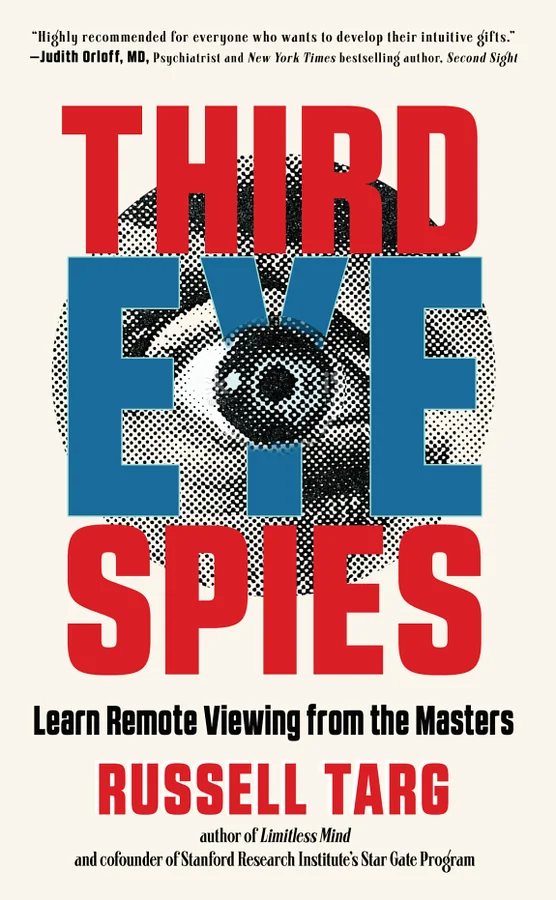
Third Eye Spies
 71
71

Third Eye Spies
Russell Targ's "Third Eye Spies" offers a direct, almost clinical, account of his decades spent investigating psychic phenomena, particularly remote viewing. The book's strength lies in its unvarnished presentation of experimental data and the historical context of the SRI program, making a compelling case for the reality of psi. Targ’s firsthand involvement, beginning in 1972 with the CIA-sponsored research, lends significant weight to his narrative. However, the prose, while factual, occasionally lacks the evocative quality one might expect from exploring such extraordinary claims. The detailed descriptions of protocols, while crucial for credibility, can sometimes feel repetitive. A particularly impactful section details the identification of the ring-leader of the Patty Hearst kidnapping, showcasing remote viewing’s potential for real-world application. While the evidence presented is substantial, the book could benefit from a more explicit discussion of the philosophical implications of non-local consciousness. Nevertheless, "Third Eye Spies" is an essential historical document for anyone serious about parapsychology.
📝 Description
71
Russell Targ's 1996 book details his work with psychic abilities and remote viewing for the CIA.
Russell Targ's "Third Eye Spies" presents a case for psychic abilities, specifically remote viewing, based on his work beginning in 1972 with the CIA-sponsored ESP research program at Stanford Research Institute (SRI). The book documents decades of controlled experiments and training methods aimed at developing human perception beyond the usual five senses. Targ's goal was to show that psychic phenomena are skills that can be learned and refined, not merely innate talents possessed by a select few.
This book is for those interested in the connections between consciousness, science, and the unexplained. It addresses skeptics by providing evidence from rigorous experiments, appeals to parapsychology practitioners, and offers guidance for those wanting to cultivate their own precognitive or clairvoyant capacities. Readers interested in the history of government involvement in psychic research, particularly the SRI program, will find detailed accounts of specific methods used. It also speaks to those curious about or already believing in the human mind's potential for non-local perception.
Targ's involvement at SRI from 1972 onwards placed him at the center of government-backed investigations into psychic phenomena during a period of diverse theories in consciousness studies and psychotronics. His work, emphasizing practical remote viewing, differed from purely theoretical approaches to psi. The SRI program, funded by agencies like the CIA, represented a substantial, though often secret, investment in exploring these capabilities.
This work sits within the tradition of modern parapsychology, which gained momentum in the late 20th century. Targ's direct experience with government-funded research into psychic phenomena, specifically remote viewing at SRI, places him in a unique position. His approach focused on practical application and skill development, contrasting with more abstract theories of consciousness prevalent in fields like psychotronics. The book reflects a period where government agencies, including the CIA, actively, though discreetly, sought to understand and potentially utilize psychic abilities.
💡 Why Read This Book?
• Gain insight into the specific methodologies of remote viewing as developed and taught by Russell Targ, a key figure in SRI's ESP research, enabling you to understand practical training techniques. • Understand the historical significance of the CIA-sponsored ESP research program at Stanford Research Institute starting in 1972, providing concrete examples of its operational successes. • Explore the evidence for psychic perception through the lens of rigorous scientific experimentation, offering a grounded perspective on consciousness beyond conventional sensory input.
⭐ Reader Reviews
Honest opinions from readers who have explored this book.
❓ Frequently Asked Questions
What was the primary goal of the CIA-sponsored ESP research program at Stanford Research Institute?
The primary goal was to investigate the potential military and intelligence applications of psychic abilities, particularly remote viewing, to gain an advantage over adversaries.
Who is Russell Targ and what is his contribution to remote viewing?
Russell Targ is a physicist who co-founded the SRI ESP research program in 1972. He is instrumental in developing and teaching remote viewing protocols, documenting decades of research and training.
Can anyone learn remote viewing according to 'Third Eye Spies'?
Yes, Targ presents remote viewing as a skill that can be learned and developed through consistent training and practice, not solely an innate talent.
What kind of evidence does 'Third Eye Spies' present for psychic powers?
The book presents evidence from controlled experiments conducted at SRI, detailing specific instances and statistical analyses designed to validate psychic phenomena like remote viewing.
Besides intelligence, what other applications does Targ suggest for remote viewing?
Targ suggests applications in personal development, problem-solving, and enhancing intuition, indicating a broader potential for these abilities beyond espionage.
When was Russell Targ's 'Third Eye Spies' first published?
The book 'Third Eye Spies' by Russell Targ was first published in 2023.
🔮 Key Themes & Symbolism
Operational Remote Viewing
The book details the development and application of remote viewing as a practical skill, emphasizing its use in intelligence gathering and information acquisition. Targ outlines the rigorous protocols established at SRI, beginning in 1972, designed to train individuals to perceive distant or hidden targets with accuracy. It highlights instances where remote viewing provided actionable intelligence, such as identifying a secret Russian weapons factory or the ring-leader of the Patty Hearst kidnapping, showcasing its potential beyond theoretical parapsychology.
Evidence-Based Parapsychology
A core theme is the presentation of empirical evidence for psychic abilities, grounded in scientific methodology. Targ focuses on the statistical significance of experimental results from the SRI program, aiming to demonstrate that phenomena like clairvoyance and precognition are not mere anecdotes but observable, repeatable occurrences under controlled conditions. The book challenges skepticism by detailing the careful experimental designs and peer review processes employed.
Accessible Psychic Skills
Targ argues that psychic abilities, particularly remote viewing, are latent potentials within most individuals that can be cultivated through training. He shares insights from over fifty years of teaching these skills, clarifying the process and presenting it as an accessible discipline rather than an esoteric mystery. The book aims to empower readers by suggesting they too can learn to access their intuitive faculties through learned techniques.
Consciousness and Non-Locality
The work implicitly and explicitly explores the nature of consciousness and its potential to operate independently of the physical body or conventional space-time constraints. By detailing successful remote viewing sessions, Targ supports the idea of a non-local consciousness that can access information across distances. This challenges materialistic views of the mind and suggests a broader, interconnected reality accessible through specific perceptual states.
💬 Memorable Quotes
Direct passages from the work, attributed to the author.
“The SRI program described a secret Russian weapons factory in Siberia.”
— This factual statement from the blurb highlights a specific, verifiable success of the remote viewing program, demonstrating its potential for obtaining actionable intelligence on sensitive geopolitical matters.
“Russell Targ has been successfully teaching people how to get in touch with their psychic abilities for more than fifty years.”
— This emphasizes Targ's extensive practical experience and the pedagogical aspect of his work, suggesting that psychic development is a trainable skill rather than a rare, innate gift.
“This began in 1972 when he cofounded the CIA sponsored ESP research program at Stanford Research Institute.”
— This anchors the narrative in a specific historical event and institutional context, lending credibility to the research by associating it with government funding and scientific inquiry.
“The program... identified the ring-leader of the Patty Hearst kidnapping.”
— This points to a high-profile, real-world application of remote viewing, illustrating its potential for solving crimes and providing crucial information in significant public events.
“The program... located several kidnapped”
— This fragment suggests that the research extended to humanitarian applications, such as locating missing persons, further broadening the perceived utility of psychic abilities.
🌙 Esoteric Significance
Tradition
While not strictly adhering to a single esoteric lineage, Targ's work interfaces with traditions that explore consciousness beyond the physical, such as certain interpretations within Hermeticism and Gnosticism that posit hidden layers of reality accessible through inner perception. It departs from mystical traditions by framing psychic abilities as scientifically verifiable skills rather than divine gifts or esoteric secrets. The focus on reproducible results and empirical evidence aligns it with a more modern, materialist-adjacent approach to understanding the subtle realms.
Symbolism
The 'Third Eye' itself is a potent symbol, representing inner vision, intuition, and enlightenment, often linked to the pineal gland in esoteric thought. In Targ's work, this symbol is literalized through the practice of remote viewing – the ability to 'see' beyond the physical senses. The 'Spies' aspect transforms this inner faculty into a tool for information gathering, suggesting that the esoteric potential of consciousness can be practically applied in the material world.
Modern Relevance
Targ's research continues to influence contemporary parapsychology and consciousness studies. Modern remote viewing protocols, often practiced independently or in small research groups, draw directly from the SRI methodologies he helped pioneer. Thinkers exploring consciousness, quantum entanglement, and non-local awareness often reference Targ's work as empirical evidence supporting their theories. His approach provides a foundation for those seeking to scientifically validate and develop intuitive and precognitive abilities in fields ranging from personal development to investigative psychology.
👥 Who Should Read This Book
• Individuals interested in the history of government-funded psychic research, particularly the CIA's involvement with Stanford Research Institute's ESP program starting in 1972. • Aspiring practitioners of remote viewing seeking to understand the foundational techniques and evidence presented by a key originator of the methodology. • Skeptics and researchers looking for detailed accounts of experimental protocols and results in parapsychology, aiming to evaluate the evidence for psychic phenomena.
📜 Historical Context
Russell Targ's "Third Eye Spies" emerges from a period of intense, often covert, exploration into psychic phenomena, particularly during the Cold War era. His co-founding of the CIA-sponsored ESP research program at Stanford Research Institute in 1972 placed him at the nexus of government interest and scientific investigation. This era saw significant, though often secretive, funding for parapsychology, driven by a desire to understand and potentially weaponize perceived advantages held by rival nations like the Soviet Union. While figures like J.B. Rhine had earlier pioneered laboratory-based psi research, Targ's work at SRI focused more on operational applications, notably remote viewing. This approach differed from more esoteric or spiritual interpretations of psychic ability prevalent in other circles. The program's findings, including descriptions of Soviet facilities and involvement in identifying individuals in high-profile criminal cases like the Patty Hearst kidnapping, represented a tangible, albeit controversial, output. Reception was mixed, with proponents citing rigorous methodology and skeptics questioning interpretation and potential fraud.
📔 Journal Prompts
The concept of 'associative remote viewing' and its application to target description.
Personal experiences with intuition or precognition and how they align with Targ's descriptions.
The historical context of the SRI program and its implications for the study of consciousness.
Developing a personal protocol for practicing and documenting perceived psychic impressions.
The ethical considerations of using remote viewing for information gathering.
🗂️ Glossary
Remote Viewing
The ability to perceive information about a distant or unseen target using psychic means, developed as a trainable skill through specific protocols.
Stanford Research Institute (SRI)
An independent research institute where Russell Targ co-founded a CIA-sponsored program to investigate ESP phenomena, beginning in 1972.
Parapsychology
The study of alleged psychic phenomena and other paranormal claims, including telepathy, precognition, and psychokinesis.
Non-local Consciousness
The theoretical concept that consciousness is not confined to the brain but can exist or operate independently of physical location or time.
Clairvoyance
The purported ability to perceive objects or events in the future or beyond normal sensory contact.
Precognition
The ability to see or know future events before they happen.
Associative Remote Viewing (ARV)
A specific protocol of remote viewing that associates psychic impressions with pre-assigned random outcomes, often used for prediction.
This book appears in 1 collection
🔮 Readers Also Liked
Browse all →







From the “Remote Viewing” Collection
View all →








More Free Esoteric History & Biography Books
View all →