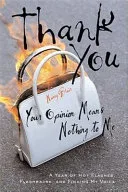
Thank You, Your Opinion Means Nothing to Me
 80
80

Thank You, Your Opinion Means Nothing to Me
Nancy Blair's 2004 offering, "Thank You, Your Opinion Means Nothing to Me," presents a year of lived experience with a refreshing lack of pretense. The narrator's voice is the undeniable strength here, sharp and self-aware, even when detailing moments of profound awkwardness. A passage describing a disastrous attempt at small talk at a book club meeting, where the narrator internally dissects their own social missteps with brutal honesty, exemplifies the book’s particular brand of humor. Its limitation, however, lies in its relentless focus on the narrator's internal world; at times, the narrative feels insular, lacking broader thematic exploration beyond the immediate personal. The work’s unapologetic stance on external opinion is its defining characteristic. Ultimately, it’s a diverting, if somewhat narrowly focused, examination of self-possession.
📝 Description
80
Nancy Blair's 2004 book, 'Thank You, Your Opinion Means Nothing to Me,' rejects external validation.
Published in 2004, 'Thank You, Your Opinion Means Nothing to Me' follows an unnamed narrator through a year of personal experiences. The book unfolds as a collection of vignettes, capturing both small victories and daily struggles. It focuses on the specific details of life, from casual social encounters to internal thoughts, rather than large, overarching stories.
This work is for readers who enjoy humor rooted in introspection and honest depictions of everyday life. It will resonate with those who find significance in ordinary moments and prefer narratives centered on an individual's inner world as they grow and interact with society. Those seeking an alternative to typical self-help books or plot-heavy fiction may find this book's distinct voice appealing.
Emerging in 2004, this work aligns with a broader cultural shift toward valuing individual experience and authenticity, echoing sentiments found in confessional literature and early blog culture. While not tied to a specific esoteric school, it shares with certain traditions an emphasis on inner authority and liberation from societal conditioning. The book’s core message about disregarding external judgment for personal freedom resonates with philosophies that advocate for self-sovereignty and a focus on one's own path, moving away from seeking approval.
💡 Why Read This Book?
• Gain a practical framework for detaching from external judgment, as illustrated by the narrator’s year-long journey and specific anecdotes like the "book club disaster" mentioned in the review. • Discover the therapeutic value of unfiltered self-observation, learning to reframe personal shortcomings not as failures, but as data points for growth, a key takeaway from the book's 2004 publication context. • Cultivate a stronger sense of personal agency by internalizing the core message of prioritizing one's own perspective, a concept explored throughout the book's narrative arc.
⭐ Reader Reviews
Honest opinions from readers who have explored this book.
❓ Frequently Asked Questions
What is the central message of "Thank You, Your Opinion Means Nothing to Me"?
The central message is the liberation found in disregarding external opinions and validations. The narrator's year-long journey emphasizes prioritizing one's own perspective to achieve personal autonomy and authentic living.
Who is the author, Nancy Blair, and what is her background?
Nancy Blair first published "Thank You, Your Opinion Means Nothing to Me" in 2004. While specific biographical details are scarce, her writing suggests a keen observer of human nature and a practitioner of introspective prose.
Is "Thank You, Your Opinion Means Nothing to Me" a self-help book?
While it offers profound lessons on self-reliance and mental fortitude, it is not structured as a typical self-help guide. It presents its insights through a narrative of personal experience rather than prescriptive advice.
What is the tone of the book?
The tone is predominantly humorous, often self-deprecating, and consistently honest. It balances moments of absurdity with poignant reflections on the human condition.
When was "Thank You, Your Opinion Means Nothing to Me" first published?
The book was first published in 2004, placing it within the early 2000s literary landscape that saw a rise in confessional and introspective writing.
What kind of reader would enjoy this book?
Readers who appreciate relatable, unvarnished narratives about personal growth, introspective humor, and a strong, authentic voice will find this book engaging.
🔮 Key Themes & Symbolism
Autonomy Over Opinion
The core theme is the cultivation of inner authority. The narrator's year-long experiment in disregarding external judgment serves as a practical exploration of psychological freedom. This work posits that true self-acceptance arises not from external praise but from an internal resolution to value one's own perspective, a concept explored through a series of often comical, sometimes poignant, everyday scenarios.
The Mundane as Sacred
Blair elevates ordinary experiences, demonstrating that profound personal growth can occur within the seemingly trivial moments of daily life. The book finds significance in social awkwardness, mundane routines, and internal monologues, suggesting that the path to self-understanding is paved with attention to the granular details of existence, rather than grand pronouncements.
Authenticity Through Self-Awareness
The narrative is a evidence of the power of radical self-honesty. By dissecting her own thoughts, motivations, and social interactions with unflinching candor, the narrator models a process of becoming authentically oneself. This exploration of self-awareness, particularly evident in the 2004 publication context, highlights the value of internal dialogue in navigating external pressures.
The Rejection of External Metrics
The book challenges conventional societal metrics for success and worth. It argues implicitly that relying on the opinions of others—whether friends, family, or strangers—is a futile and disempowering pursuit. The narrator's journey is an active shedding of these external dependencies, leading to a more grounded and self-directed life.
💬 Memorable Quotes
Direct passages from the work, attributed to the author.
“The year was 2004, and I decided everyone else's thoughts about me were irrelevant.”
— This declaration sets the stage for the entire narrative, establishing the narrator's central thesis and the temporal framework of their personal experiment in self-validation.
“My internal monologue was far more interesting than any conversation I could force.”
— This highlights the narrator's preference for introspection and self-discovery over superficial social engagement, underscoring the book's focus on the inner world.
“The book club disaster proved that trying to impress people is a fool's errand.”
— This refers to a specific, likely humorous, anecdote illustrating the futility of seeking external approval, a recurring motif in the book's exploration of personal autonomy.
“I stopped performing and started living.”
— This concise statement captures the transformative shift the narrator undergoes, moving from a state of external validation-seeking to authentic self-expression.
“My opinion of myself became the only one that mattered.”
— This expresses the ultimate goal and achievement of the narrator's year-long journey: the attainment of profound self-acceptance and internal authority.
🌙 Esoteric Significance
Tradition
While not overtly tied to a specific esoteric lineage like Hermeticism or Gnosticism, the work strongly appeals to principles found in Stoicism and certain branches of Western Esotericism focused on inner alchemy and psychological self-mastery. Its emphasis on detaching from external validation and cultivating an unshakeable inner core aligns with practices aimed at achieving a state of equanimity and self-sovereignty, independent of worldly circumstances.
Symbolism
The "year" itself functions as a symbolic container for transformation, a common motif in initiatory cycles. The "book club disaster" serves as a potent symbol of social anxieties and the struggle for authentic expression within group dynamics. The very title, "Thank You, Your Opinion Means Nothing to Me," acts as a potent mantra, a symbolic rejection of parasitic external validation.
Modern Relevance
In contemporary discourse, particularly within wellness, mindfulness, and self-development circles, Blair's work finds echoes in the emphasis on setting boundaries, cultivating self-compassion, and the popularization of concepts like 'imposter syndrome' and 'people-pleasing'. Thinkers and practitioners focused on cognitive behavioral techniques and radical self-acceptance often draw implicitly on the very principles Blair articulates through her narrative.
👥 Who Should Read This Book
• Individuals seeking to cultivate greater self-reliance and reduce anxiety stemming from social judgment, benefiting from the narrator's direct experiences and the book's 2004 publication context. • Readers who enjoy introspective humor and appreciate narratives that find profound meaning in the everyday, drawn to the book's focus on the "mundane as sacred." • Those exploring psychological autonomy and looking for relatable examples of how to prioritize one's inner compass over external validation, as exemplified by the "rejection of external metrics" theme.
📜 Historical Context
Published in 2004, "Thank You, Your Opinion Means Nothing to Me" emerged during a period characterized by the rise of personal blogs and memoirs that prioritized unfiltered self-expression. While not directly aligned with a specific literary movement like Beat or Confessional poetry, it shares a spirit with the growing online culture that valued authentic, often mundane, personal narratives. This era saw authors like Cheryl Strayed beginning to gain prominence for their raw accounts of life experiences. The book's focus on individual psychology and the rejection of external validation reflects a broader cultural shift towards introspection, perhaps influenced by early digital communities that encouraged sharing personal journeys. Its directness and lack of overt philosophical jargon distinguished it from more academic explorations of the self, offering a relatable, grounded perspective.
📔 Journal Prompts
The narrator's decision in 2004 to dismiss external opinions: How does this compare to your own relationship with validation?
The 'book club disaster': What social situations trigger your desire for approval, and how can you reframe them?
The concept of 'internal monologue': How can you intentionally cultivate a more supportive and authentic inner dialogue?
The rejection of external metrics: Identify one societal expectation you can begin to disregard.
The shift from 'performing' to 'living': What small step can you take today to live more authentically?
🗂️ Glossary
Internal Monologue
The unspoken stream of thoughts, reflections, and self-talk occurring within an individual's mind. In this work, it represents a private space for authentic processing, often contrasted with public discourse.
Book Club Disaster
A specific, likely humorous, incident recounted in the book where a social gathering intended for literary discussion devolves into an awkward or uncomfortable experience for the narrator, reinforcing the theme of social anxiety.
External Validation
Seeking approval, praise, or acceptance from others as a primary source of self-worth. The book argues against this reliance, advocating for internal self-acceptance.
Autonomy
The state of self-governance and independence. In this context, it refers to psychological autonomy—the ability to think and act according to one's own principles and desires.
Performing
Behaving in a way that is intended to impress or influence others, often involving a degree of inauthenticity or adherence to social expectations. The book contrasts this with genuine living.
Self-Awareness
Consciousness of one's own character, feelings, motives, and desires. The book emphasizes this as a foundation for authentic living and shedding external pressures.
Mundane
Lacking interest or excitement; commonplace. The book finds profound significance and opportunities for growth within everyday, ordinary events.