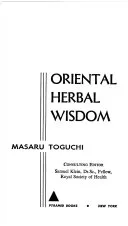
Oriental Herbal Wisdom
 72
72

Oriental Herbal Wisdom
Masaru Toguchi’s Oriental Herbal Wisdom offers a dense, scholarly exploration of East Asian herbalism, distinct from contemporary popularizations. Its strength lies in its rigorous adherence to traditional principles, particularly its detailed examination of Qi and meridian correspondences in plant use. The 1973 publication date lends it an authentic, pre-commercialized feel. However, the text’s academic density can be a barrier for absolute beginners, requiring a prior understanding of foundational esoteric concepts. A particularly insightful passage discusses the energetic signature of specific roots, linking them to the Earth element and spleen-stomach system with remarkable precision. This work is a significant, albeit demanding, resource for serious students of esoteric botany.
📝 Description
72
Masaru Toguchi's Oriental Herbal Wisdom, published in 1973, details East Asian herbal medicine.
Masaru Toguchi's 1973 book, Oriental Herbal Wisdom, details the medicinal and spiritual uses of herbs from East Asian traditions. It goes beyond a simple list of plants to explain the energetic qualities and philosophical basis of herbal remedies. The book acts as a guide to the connection between botany, energy work, and older healing ideas.
This work is for practitioners of Traditional Chinese Medicine, Kampo, and anyone interested in the esoteric side of herbalism. Scholars of religion, students of esoteric botany, and those wanting to combine holistic healing with an understanding of plant energies will find it useful. Readers who respect historical accuracy and original sources will value this text. It appeared during a time of growing interest in Eastern thought and alternative medicine, following the 1960s counterculture. Toguchi's book offered a different view, introducing complex herbal systems to Western readers.
Emerging in 1973, Oriental Herbal Wisdom arrived as Western interest in Eastern philosophies grew. It presented complex herbal systems, rooted in Taoist and Buddhist thought, to a Western audience. The book connects botanical knowledge with concepts like Qi and energetic harmonization, placing it within the discourse of Western esoteric traditions that sought alternative healing modalities.
💡 Why Read This Book?
• Gain access to the intricate energetic classifications of herbs, as detailed in Toguchi’s specific framework for understanding Qi in plants, offering a unique perspective beyond Western botanical analysis. • Understand the application of Yin and Yang principles to herbal combinations, moving beyond simple symptom treatment to energetic balancing as outlined in the text's approach to Kampo medicine. • Explore the historical integration of herbalism with spiritual practices, as presented in the book's discussion of how certain botanicals were used for meditation and energetic cultivation in ancient East Asia.
⭐ Reader Reviews
Honest opinions from readers who have explored this book.
❓ Frequently Asked Questions
What is the significance of Qi in Oriental Herbal Wisdom?
Qi, or vital energy, is central to the book's philosophy. Toguchi explains how herbs possess their own Qi, which interacts with the body's energetic system to restore balance and promote healing, a core concept in East Asian medicine since ancient times.
When was Oriental Herbal Wisdom first published and by whom?
The book was first published in 1973 by Masaru Toguchi, marking an early contribution to the Western understanding of East Asian herbal traditions.
Does the book discuss specific East Asian medical systems?
Yes, Oriental Herbal Wisdom extensively covers principles found in systems like Traditional Chinese Medicine (TCM) and Kampo, detailing their unique approaches to herbal materia medica and energetic diagnostics.
What kind of herbs are primarily featured in the book?
The book focuses on herbs traditionally used in East Asian healing practices, including roots, leaves, flowers, and barks, examined for their medicinal and energetic properties according to ancient texts.
Is Oriental Herbal Wisdom suitable for beginners in herbalism?
While comprehensive, the book's depth and reliance on esoteric concepts like Qi and meridian theory may be more accessible to those with some background in Eastern philosophies or advanced herbal studies.
What distinguishes this book from modern herbal guides?
Its distinction lies in its 1973 origin and focus on the esoteric and energetic dimensions of herbs, rather than purely biochemical or symptomatic approaches prevalent in many contemporary guides.
🔮 Key Themes & Symbolism
Energetic Properties of Herbs
This theme explores how plants are viewed not just for their chemical constituents but for their inherent vital energy, or Qi. Toguchi details how different herbs possess distinct energetic signatures—warming, cooling, drying, or moistening—and how these qualities interact with the body's own energetic balance according to principles like Yin and Yang. The book emphasizes selecting herbs based on their energetic profile to harmonize imbalances, a concept deeply rooted in Taoist philosophy and medical traditions dating back centuries.
Meridian Correspondences
Oriental Herbal Wisdom maps the use of specific herbs to the body's energetic pathways, known as meridians. This approach, fundamental to Traditional Chinese Medicine, suggests that certain botanicals preferentially influence particular meridians and their associated organs. Toguchi illustrates how understanding these correspondences allows for highly targeted herbal applications, aiming to restore the smooth flow of Qi and address root causes of disharmony rather than just surface symptoms.
Holistic Healing Philosophy
The work presents a view of health that integrates the physical, energetic, and spiritual dimensions. Herbs are seen as potent allies not only for treating physical ailments but also for cultivating inner balance, mental clarity, and spiritual awareness. This holistic perspective draws from Buddhist and Taoist traditions, viewing the human being as an integral part of the natural world, where botanical remedies play a role in reconnecting individuals with universal energies.
Historical Materia Medica
This theme focuses on the historical compilation and classification of medicinal plants within East Asian traditions. Toguchi draws upon ancient texts and scholarly lineage to present a detailed materia medica, examining the traditional uses, preparation methods, and perceived efficacies of numerous herbs. The book serves as a repository of knowledge, preserving and informative botanical wisdom that has been passed down through generations, particularly emphasizing its 1973 publication context.
💬 Memorable Quotes
Direct passages from the work, attributed to the author.
“The energy of a plant is as crucial as its physical form.”
— This concise statement expresses the core tenet of the book: that the vital force (Qi) within herbs is paramount to their healing efficacy, guiding their interaction with the human energetic system.
“Harmony of Yin and Yang dictates the efficacy of a herbal formula.”
— This highlights the foundational principle of balancing opposing yet complementary forces within herbal prescriptions, ensuring that remedies work to restore equilibrium rather than create new imbalances.
“Select herbs that clear meridian blockages.”
— This points to the diagnostic and therapeutic application of understanding herb-meridian connections, aiming to facilitate the unimpeded flow of vital energy throughout the body.
“Botanical remedies can nurture the spirit as well as the body.”
— This reflects the holistic approach, suggesting that the use of herbs extends beyond physical health to encompass mental well-being and spiritual development, aligning with ancient esoteric practices.
“The wisdom of the ancients lies in observing nature's energetic patterns.”
— This emphasizes the source of traditional knowledge, crediting the deep observation of natural cycles and plant energies by past healers as the foundation for effective herbal medicine.
🌙 Esoteric Significance
Tradition
This work is firmly rooted in the esoteric traditions of East Asian medicine, drawing heavily from Taoist alchemy, Buddhist principles of interconnectedness, and the sophisticated diagnostic and therapeutic frameworks of Traditional Chinese Medicine (TCM) and Japanese Kampo. It departs from purely physical interpretations by emphasizing the subtle energetic body, the flow of Qi, and the spiritual resonance of plants, aligning it with Hermetic and alchemical philosophies that seek correspondences between the macrocosm and microcosm.
Symbolism
Key symbols include the Yin-Yang duality, representing the fundamental energetic polarities inherent in all things, including herbs, and their necessary balance for health. The Meridian system, visualized as a network of energetic pathways, symbolizes the interconnectedness of the body's organs and functions, with specific herbs acting as keys to unlock or regulate these channels. The concept of Qi itself functions as a primary symbol for life force, breath, and the vital essence that animates both plants and humans.
Modern Relevance
Contemporary practitioners of integrative medicine, naturopathy, and advanced herbalism often reference the foundational principles presented in works like Toguchi's. Thinkers exploring consciousness studies and plant intelligence also find resonance in its energetic approach. Schools teaching TCM and Kampo medicine continue to utilize such texts for their depth in explaining the subtle aspects of botanical energetics and their application in holistic healing paradigms.
👥 Who Should Read This Book
• Students of East Asian medicine (TCM, Kampo) seeking a deeper understanding of the energetic and philosophical underpinnings of herbalism beyond basic materia medica. • Esoteric practitioners interested in botany and plant-based remedies, looking to connect botanical applications with subtle energy systems and spiritual practices. • Comparative religion scholars or historians of medicine exploring the intersection of natural sciences, philosophy, and healing traditions across different cultures.
📜 Historical Context
Published in 1973, Masaru Toguchi’s Oriental Herbal Wisdom arrived during a period of burgeoning Western interest in Eastern philosophies and alternative healing modalities, spurred by the counterculture movement. While scientific materialism dominated Western medicine, texts like Toguchi's provided a bridge to complex indigenous knowledge systems. It predates the widespread popularization of concepts like Qi and meridians in the West, offering a scholarly, less commodified introduction. This work stood in contrast to emerging Western herbalism focused on phytochemistry. Its publication offered a vital counterpoint, drawing from traditions that had been refined over millennia, particularly within the context of Japanese Kampo medicine and its roots in Chinese medical theory. The reception was likely among niche academic and esoteric circles, lacking the broad public reach of later works, but cementing its importance as an early, serious exploration of its subject matter.
📔 Journal Prompts
The energetic signature of the Ginseng root and its specific meridian influence.
How the concept of Qi in plants informs your personal understanding of vitality.
A specific herbal combination for harmonizing Yin and Yang imbalances.
Reflecting on the Taoist principle of observing nature's energetic patterns in healing.
The symbolic meaning of the Meridian system in relation to herbal applications.
🗂️ Glossary
Qi (氣)
The fundamental vital life force or energy that flows through all living beings and the universe. In herbalism, it refers to the energetic properties of plants and their influence on the body's energy.
Yin and Yang
The dualistic, complementary forces that govern all phenomena in the universe. In herbal medicine, they describe the energetic qualities of herbs (e.g., cooling/Yin, warming/Yang) and the state of balance within the body.
Meridians
Channels or pathways through which Qi circulates in the body, connecting organs and regulating physiological functions. Specific herbs are understood to act upon particular meridians.
Kampo
A traditional Japanese system of medicine heavily influenced by Chinese herbal medicine, focusing on diagnosis through observation and the use of herbal formulas.
Materia Medica
A body of knowledge about the medicinal properties, uses, and preparation of substances used for healing, particularly plants in this context.
Energetic Signature
The distinct energetic quality or pattern of a substance, such as an herb, described by its temperature, taste, and influence on Yin and Yang balance and Qi flow.
Harmonization
The process of restoring balance and proper flow to the body's Qi and Yin-Yang energies, often achieved through the careful selection and combination of herbal remedies.