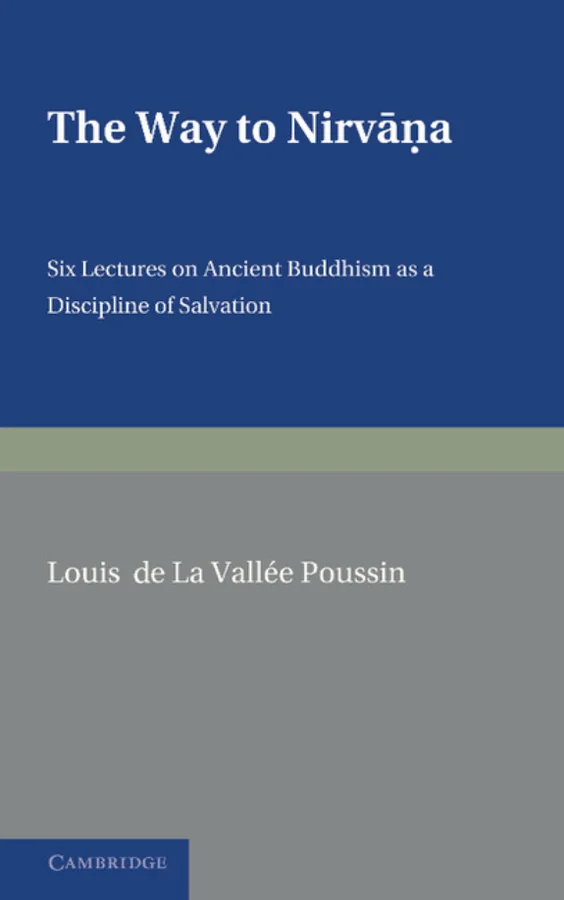
The Way to Nirvana
 74
74

The Way to Nirvana
Louis De La Vallée Poussin’s "The Way to Nirvana" offers a scholarly examination of Ancient Buddhism as a path to salvation, grounded in a series of lectures from 1917. Poussin’s strength lies in his meticulous approach, dissecting the early Buddhist conception of Nirvana and the practices intended to achieve it. He avoids the romanticism that often characterized early Western engagement with Eastern thought, instead focusing on the doctrinal and disciplinary aspects. A potential limitation for the contemporary reader might be the academic tone, which, while precise, can feel dense. The discussion on the concept of 'no-self' (anātman) and its role in liberation, for instance, is handled with a scholarly rigor that requires focused attention. The work serves as a valuable historical document of Buddhist studies, offering a specific lens on a tradition that continues to evolve. It is a serious academic text for those interested in the historical underpinnings of Buddhist soteriology.
📝 Description
74
Louis de La Vallée Poussin delivered six lectures on the path to Nirvana in 1917.
Published in 1917, this volume contains six lectures by Louis de La Vallée Poussin. The lectures focus on Ancient Buddhism not just as a historical subject, but as a practical system for achieving spiritual liberation. Poussin's aim is to clarify the early Buddhist understanding of the path to Nirvana. The work is useful for those studying early Buddhist philosophy, comparative religion, or the historical growth of spiritual practices. It is especially helpful for readers who want to see Buddhism as a way to salvation, beyond its philosophical or ethical dimensions.
Poussin's lectures were given during a period of growing Western engagement with Asian religions. The early 1900s marked a significant rise in interest in Buddhism, though this interest was sometimes shaped by colonial perspectives or theosophical ideas. Poussin, however, pursued a more academic approach, relying on textual study and historical context to understand the subject.
This work engages with the soteriological aims of early Buddhism, a tradition concerned with liberation from suffering. Poussin's analysis places these teachings within the broader context of contemplative and spiritual disciplines seeking ultimate release. His scholarship attempts to articulate the core tenets of this path, distinguishing it from later interpretations and focusing on the practical application of its principles for spiritual attainment.
💡 Why Read This Book?
• Gain insight into the historical academic understanding of Ancient Buddhism’s salvific path, particularly as explored in Poussin's 1917 lectures, offering a specific scholarly perspective on the pursuit of Nirvana. • Understand Buddhism as a discipline of salvation by examining core concepts like suffering and cessation, as presented in the work's detailed textual analysis. • Appreciate the historical context of early 20th-century Buddhist scholarship, differentiating Poussin's rigorous approach from contemporary, potentially less critical, interpretations.
⭐ Reader Reviews
Honest opinions from readers who have explored this book.
❓ Frequently Asked Questions
What is the primary focus of Louis De La Vallée Poussin's "The Way to Nirvana"?
The book focuses on Ancient Buddhism as a discipline of salvation, exploring the path and ultimate goal of Nirvana as understood in early Buddhist traditions through six lectures.
When was "The Way to Nirvana" originally published?
The original publication date for this volume of lectures by Louis De La Vallée Poussin was 1917.
Who is Louis De La Vallée Poussin?
Louis De La Vallée Poussin was a prominent Belgian scholar and philologist known for his significant contributions to the study of Sanskrit and Buddhist texts in the early 20th century.
What kind of Buddhism does this book discuss?
The book specifically addresses Ancient Buddhism, examining its doctrines and practices related to achieving salvation and understanding Nirvana from a historical perspective.
Is "The Way to Nirvana" suitable for absolute beginners to Buddhism?
While informative, the book's scholarly nature, stemming from 1917 lectures, makes it more suitable for those with some prior knowledge or an academic interest in Buddhist philosophy and history.
What does 'soteriology' mean in the context of this book?
Soteriology refers to the study of salvation. In this book, it means exploring Buddhist teachings and practices specifically as a means to achieve liberation from suffering and attain Nirvana.
🔮 Key Themes & Symbolism
The Discipline of Salvation
The central theme is Buddhism viewed as a practical system for liberation. Poussin examines the doctrines and practices that constitute this salvific path, moving beyond mere philosophical inquiry to the 'how-to' of spiritual attainment. This perspective highlights the active, disciplined nature of the Buddhist quest for Nirvana, emphasizing the practical application of teachings for overcoming suffering and achieving ultimate release.
The Nature of Nirvana
Poussin meticulously explores the concept of Nirvana within Ancient Buddhism. He differentiates early understandings from later interpretations, focusing on its significance as the cessation of suffering and the ultimate goal of the Buddhist path. The lectures aim to clarify this profound concept, presenting it as the culmination of the disciplined practice of the Dharma.
Early Buddhist Doctrine
The work looks at foundational Buddhist teachings as understood in its early period. This includes an examination of concepts such as the Four Noble Truths, the Eightfold Path, and the doctrine of no-self (anātman), all presented within the framework of achieving salvation. Poussin's analysis provides a scholarly perspective on the intellectual architecture supporting the Buddhist journey.
Historical Scholarship of Buddhism
This book represents a significant scholarly engagement with Buddhism from the early 20th century. It showcases a rigorous academic approach to understanding religious traditions, attempting to reconstruct and interpret ancient doctrines based on textual evidence. The work serves as a historical marker in the development of Western Buddhist studies.
💬 Memorable Quotes
Direct passages from the work, attributed to the author.
“Ancient Buddhism as a discipline of salvation.”
— This core phrase expresses Poussin's thesis: Buddhism is not just a philosophy, but a structured method for achieving spiritual liberation from suffering and the cycle of rebirth.
“The path toward Nirvana.”
— This refers to the specific practices, ethical guidelines, and mental training advocated in early Buddhism, understood as the means to reach the ultimate goal of enlightenment and peace.
“The cessation of suffering.”
— A fundamental definition of Nirvana, highlighting its role as the ultimate objective within the Buddhist salvific framework – the end of all forms of dissatisfaction and pain.
“The analysis of doctrines and practices.”
— This suggests Poussin's method involves detailed examination of Buddhist teachings and the actions prescribed by them, aiming to provide a clear understanding of their salvific purpose.
“The historical context of early Buddhist thought.”
— Emphasizes the book's focus on the foundational period of Buddhism, seeking to understand its original intent and structure before subsequent developments and interpretations arose.
🌙 Esoteric Significance
Tradition
While Poussin's work is primarily academic, it engages with the core soteriological aims often found in esoteric traditions worldwide – the quest for liberation and transformation. His focus on the 'discipline of salvation' aligns with the practical, transformative goals characteristic of many esoteric paths, even as his methodology remains historical and textual.
Symbolism
The concept of Nirvana itself functions as a supreme symbol of ultimate attainment and peace, representing the unconditioned state beyond ordinary existence. The 'path' or 'discipline' also symbolizes the structured journey, akin to initiatory paths in esoteric lore, requiring diligent practice and understanding to reach the goal.
Modern Relevance
Contemporary practitioners and scholars interested in the historical roots of Buddhist meditation and philosophy, particularly those seeking to understand the original intent behind practices aimed at liberation, draw upon Poussin's foundational scholarship. His work remains a reference point for understanding the historical development of Buddhist thought on salvation.
👥 Who Should Read This Book
• Students of comparative religion seeking to understand Buddhism as a salvific system, moving beyond superficial comparisons to grasp its historical doctrinal framework. • Scholars of early Buddhist philosophy interested in detailed textual analysis and the historical academic interpretation of concepts like Nirvana and the path to its attainment. • Individuals exploring the history of Western engagement with Eastern religions, appreciating a rigorous, early 20th-century scholarly perspective distinct from more esoteric or syncretic interpretations.
📜 Historical Context
Delivered in 1917, Louis De La Vallée Poussin's lectures on "The Way to Nirvana" emerged during a period of intense Western academic and public interest in Buddhism. Scholars like Paul Carus were popularizing Buddhist ideas, often blending them with Western concepts. Poussin, however, represented a more rigorous, philological approach, focusing on Sanskrit and Pali texts. His work engaged with the emerging field of comparative religion, seeking to present a scholarly account of Buddhism's soteriological dimension. This era also saw the influence of Theosophy, which often presented a syncretic and sometimes esoteric view of Eastern traditions. Poussin's lectures, by contrast, aimed for historical accuracy and doctrinal precision, situating Ancient Buddhism within its own historical and philosophical context rather than merging it with contemporary Western spiritual movements.
📔 Journal Prompts
The discipline of salvation as presented by Poussin.
Reflecting on the concept of Nirvana in Ancient Buddhism.
The structure of the Eightfold Path as a means to cessation.
Differentiating Poussin's 1917 scholarship from modern Buddhist studies.
The role of 'no-self' (anātman) in achieving liberation.
🗂️ Glossary
Nirvana
The ultimate goal in Buddhism, signifying the cessation of suffering, the extinguishing of the fires of greed, hatred, and delusion, and liberation from the cycle of rebirth (samsara).
Discipline of Salvation
A framework describing religious or spiritual practices and doctrines aimed at achieving liberation from suffering and attaining a state of ultimate well-being or salvation.
Ancient Buddhism
Refers to the earliest forms and teachings of Buddhism, typically associated with the period shortly after the Buddha's death up to the development of Mahayana traditions.
Soteriology
The branch of theological or religious study concerned with the doctrine of salvation; how individuals are saved or liberated.
Dukkha
A fundamental concept in Buddhism, often translated as 'suffering,' 'dissatisfaction,' or 'stress,' referring to the inherent unsatisfactoriness of conditioned existence.
Anātman
The doctrine of 'no-self' or 'non-soul,' asserting that there is no permanent, unchanging, independent self or essence in living beings.
Philology
The study of language in oral and written historical sources; it is the intersection of textual criticism, literary criticism, history, and linguistics.
This book appears in 1 collection
🔮 Readers Also Liked
Browse all →









From the “Nirvana” Collection
View all →








More Free Sacred Texts & Gnosticism Books
View all →