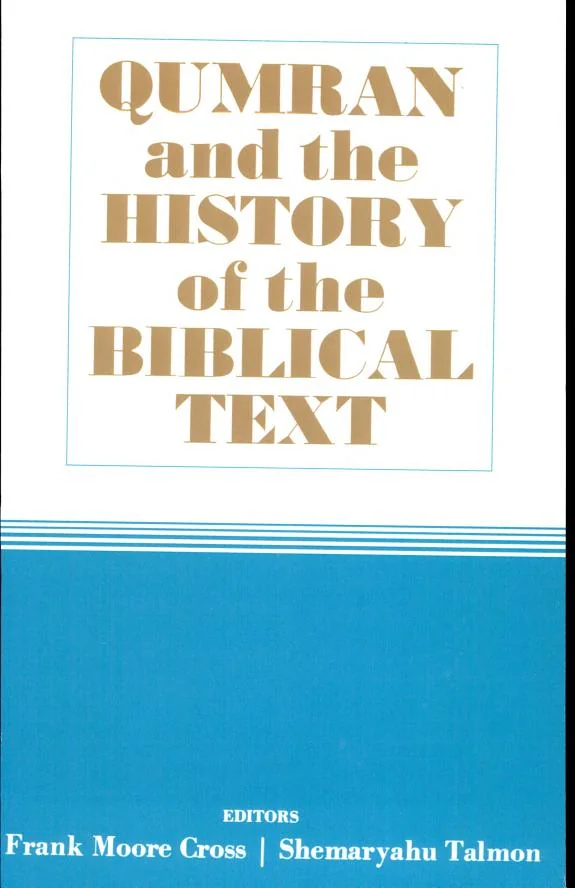
Qumran and the History of the Biblical Text
 82
82

Qumran and the History of the Biblical Text
Frank Moore Cross and Shemaryahu Talmon's 1975 compilation, 'Qumran and the History of the Biblical Text,' arrives as a necessary synthesis for a field suddenly awash in new evidence. The sheer volume of scholarly output following the Dead Sea Scrolls' discovery necessitated such a consolidation. One strength is the caliber of contributors, who were actively shaping the discourse around textual criticism at the time. The work's exploration of the textual variations found in the Qumran fragments, particularly their relationship to the Masoretic Text and the Septuagint, remains a significant contribution. However, the very nature of a collected volume means that the essays, while thematically linked, can sometimes feel disparate in their specific focus and methodological approaches. The section detailing the textual history of Jeremiah, for instance, highlights a specific textual puzzle, but the broader implications for other biblical books might not be immediately apparent to all readers. Ultimately, this collection functions as a vital snapshot of a field in flux, offering valuable primary scholarship for those tracking the evolution of biblical texts.
📝 Description
82
Published in 1975, this collection assesses the biblical text's history after the Qumran discoveries.
This 1975 volume gathers essays that reassess the textual history of the Hebrew Bible, spurred by the 1947 discovery of the Dead Sea Scrolls at Qumran and other Judean Desert sites. The essays address how these findings reshaped biblical scholarship and demanded a new look at textual criticism. The collection brings together leading scholars to summarize the state of research following the initial wave of discoveries.
The book is for advanced students and scholars of biblical studies, textual criticism, and ancient Near Eastern history. It particularly suits those interested in the academic debates and methods that arose after the Dead Sea Scrolls were found. Researchers studying the transmission of ancient texts and the formation of the biblical canon will find significant material here. The publication date, roughly 25 years after the scrolls' discovery, marks a time when the field had seen immense growth, making prior surveys outdated. This volume aimed to gather key findings and ongoing discussions, reflecting the intellectual excitement surrounding the scrolls and their impact on understanding the biblical text's development.
While not explicitly esoteric in a mystical sense, this book engages with the historical and textual questions surrounding one of the most significant archaeological finds related to ancient religious texts. The Dead Sea Scrolls, and the scholarly analysis presented here, touch upon the formation and transmission of foundational texts that became central to major religious traditions. The study of these ancient manuscripts and their variants is a crucial element in understanding the historical development of religious thought and scripture, making it relevant to those interested in the deep history of religious ideas.
💡 Why Read This Book?
• Understand the immediate scholarly impact of the Dead Sea Scrolls discoveries, specifically how they reshaped biblical textual criticism after 1947. • Grasp the complex relationship between manuscript families like the proto-Masoretic and Septuagintal texts, as illuminated by Qumran findings. • Gain insight into the methodologies employed by scholars like Frank Moore Cross in analyzing scribal habits and textual transmission in the Second Temple period.
⭐ Reader Reviews
Honest opinions from readers who have explored this book.
❓ Frequently Asked Questions
When was the book 'Qumran and the History of the Biblical Text' first published?
The book 'Qumran and the History of the Biblical Text' was first published in 1975. This publication date places it in a crucial period following the initial discoveries of the Dead Sea Scrolls.
Who are the primary editors of 'Qumran and the History of the Biblical Text'?
The primary editors of 'Qumran and the History of the Biblical Text' are Frank Moore Cross and Shemaryahu Talmon. Both were prominent scholars in the field of biblical studies and ancient Near Eastern texts.
What major archaeological discovery heavily influenced this book?
The major archaeological discovery that heavily influenced this book was the finding of the Dead Sea Scrolls. These manuscripts were discovered in caves near Qumran and other sites in the Judean Desert starting in 1947.
What academic field does 'Qumran and the History of the Biblical Text' primarily address?
The book primarily addresses the field of biblical textual criticism. It examines the history and transmission of the biblical text in light of the Qumran discoveries.
What was the state of biblical textual criticism before this book's publication?
Before the book's publication in 1975, biblical textual criticism was considered largely obsolete by many scholars due to the unprecedented influx of new manuscript evidence from Qumran, necessitating new approaches.
Besides Qumran, what other region is mentioned as a source of relevant finds?
Besides Qumran, the Wilderness of Judah is mentioned as a region yielding significant manuscript finds relevant to the study of the biblical text.
🔮 Key Themes & Symbolism
Textual Variants and Transmission
The work meticulously details variations found in biblical manuscripts discovered at Qumran, contrasting them with the established Masoretic Text and the Septuagint. It explores how scribal practices, intentional changes, and accidental errors shaped the text's transmission over centuries. The essays investigate specific cases, such as textual differences in Jeremiah, to illustrate the fluid nature of the biblical text before its standardization.
Impact of Qumran Discoveries
A central theme is the revolutionary effect the 1947 discovery of the Dead Sea Scrolls had on biblical scholarship. The sheer volume and antiquity of these manuscripts forced a re-evaluation of existing theories regarding the Hebrew Bible's textual history and canonization. The book serves as a critical assessment of this rethinking and the new avenues of research it opened.
Methodologies in Textual Criticism
The essays implicitly and explicitly discuss the critical tools and approaches necessary for analyzing ancient biblical texts. Scholars like Cross engage with principles of source criticism, the identification of textual families, and the challenges of reconstructing the earliest possible text. It highlights the ongoing scholarly debate on which manuscript traditions best represent the original wording.
The Hebrew Bible's Formation
Beyond mere textual variants, the book touches upon the broader question of how the Hebrew Bible took shape. By examining the textual evidence from the Second Temple period, it offers insights into the process by which certain texts gained authoritative status. The diversity of textual readings found at Qumran speaks to a period of literary fluidity before the final redaction of the canon.
💬 Memorable Quotes
Direct passages from the work, attributed to the author.
“The discovery of manuscripts in Qumran... has stimulated a period of outstanding activity in the study of the biblical text.”
— This statement captures the seismic shift in biblical scholarship initiated by the Dead Sea Scrolls. It underscores how these finds moved the study from theoretical speculation to evidence-based analysis, creating a new era of research.
“Students and teachers in this field are overwhelmed with the thousands of articles that have appeared in hundreds of journals in the last thirty years.”
— This highlights the sheer volume of research generated by the Qumran finds. It explains the need for collected works like this one, which attempt to synthesize and make sense of the rapidly expanding body of knowledge.
“The older handbooks surveying biblical textual criticism have become hopelessly obsolete.”
— This assertion emphasizes the inadequacy of pre-scroll era scholarship. It signals that the new discoveries fundamentally challenged established conclusions, requiring a complete overhaul of how the biblical text's history was understood.
“Frank Cross and Shemaryahu Talmon have designed a collection of essays...”
— This introductory framing points to the editorial intent: to provide a curated selection of the most pertinent scholarly discussions, offering guidance through the complex range of post-Qumran biblical textual studies.
💡 Key Ideas
Editorial paraphrase of the work's core concepts — not direct quotes.
The impact of these manuscripts on the historical criticism of the Bible cannot be overstated.
This paraphrased concept reflects the consensus that the Qumran discoveries were not just incremental additions but transformative events for understanding the Bible's historical development and textual integrity.
🌙 Esoteric Significance
Tradition
While primarily a work of academic biblical scholarship, its focus on textual origins and transmission appeals to esoteric traditions that seek hidden meanings and original purity in sacred texts. Kabbalistic and Gnostic studies, for instance, often involve deep dives into textual variants and the perceived mystical significance of Hebrew letters and scriptural layers. This book provides the critical apparatus for understanding the raw material these traditions might interpret.
Symbolism
The Qumran scrolls themselves, as ancient, hidden artifacts, carry symbolic weight within esoteric thought, representing lost wisdom or a more authentic spiritual lineage. The very act of textual reconstruction and variant analysis mirrors esoteric quests for hidden truths obscured by historical accretion. The fragmented nature of the scrolls can symbolize the fragmented state of spiritual knowledge in the present era, awaiting rediscovery.
Modern Relevance
Contemporary scholars of early Jewish mysticism and Second Temple Judaism, particularly those examining the historical context of nascent Christian and rabbinic traditions, draw upon the foundational textual analysis presented in works like this. Researchers exploring the historical Jesus or the development of the biblical canon continue to reference the textual work of Cross and Talmon for its rigorous approach to manuscript evidence.
👥 Who Should Read This Book
['• Advanced students of Biblical Studies: Those pursuing graduate-level work in Old Testament/Hebrew Bible studies will find essential background on textual criticism and the Qumran impact.', '• Scholars of Ancient Near Eastern History: Researchers interested in the socio-religious range of Second Temple Judaism will gain critical context regarding the textual production of the era.', '• Comparative Religion Researchers: Individuals studying the evolution of Jewish and early Christian texts will benefit from the detailed analysis of manuscript traditions and textual variants.']
📜 Historical Context
Published in 1975, 'Qumran and the History of the Biblical Text' emerged during a period of intense academic re-evaluation spurred by the Dead Sea Scrolls. The initial discoveries, beginning in 1947, had unleashed a torrent of research, making older textual criticism handbooks obsolete. This collection sought to capture the state of scholarship approximately twenty-five years into this transformative era. Leading scholars of the time, such as Millar Burrows (whose work 'The Dead Sea Scrolls' from 1955 predates this collection but engaged with similar themes) and William F. Albright, were instrumental in shaping the initial interpretations. The intellectual currents were dominated by the need to integrate the Qumran evidence—representing a Jewish textual tradition from the Second Temple period—with the existing Masoretic Text and the Greek Septuagint. This work represented a significant contribution to the ongoing scholarly dialogue, attempting to synthesize findings and establish new consensus points in a rapidly evolving field.
📔 Journal Prompts
The textual variants at Qumran and their implications for the Masoretic Text.
Frank Moore Cross's contribution to understanding biblical textual history.
The challenge of textual criticism posed by the Wilderness of Judah discoveries.
Re-evaluating biblical canonization in light of the Qumran scrolls.
The scholarly response to the Dead Sea Scrolls in the decades following 1947.
🗂️ Glossary
Dead Sea Scrolls
Ancient Jewish manuscripts discovered in caves near the Dead Sea, primarily between 1947 and 1956. They include the oldest known copies of books from the Hebrew Bible and other non-biblical Jewish writings from the Second Temple period.
Qumran
An archaeological site near the Dead Sea, believed to be the settlement of a Jewish sect (possibly Essenes) that produced or preserved many of the Dead Sea Scrolls. The discovery of scrolls in caves surrounding Qumran is central to this work.
Biblical Textual Criticism
The academic discipline focused on identifying and correcting errors in ancient texts, particularly sacred scriptures, to reconstruct the original wording as closely as possible. It involves comparing different manuscript versions and analyzing scribal practices.
Masoretic Text (MT)
The authoritative medieval Hebrew text of the Jewish Bible, established by the Masoretes. It is the basis for most modern translations, but its textual history is complex and debated, especially in light of earlier manuscripts.
Septuagint (LXX)
The ancient Greek translation of the Hebrew Bible, dating primarily from the 3rd to 1st centuries BCE. It often preserves readings that differ from the Masoretic Text and is crucial for understanding the Bible's reception in the Hellenistic world.
Scribal Practices
The methods and habits employed by ancient scribes in copying texts. Studying these practices helps scholars understand how texts were transmitted, identify intentional alterations, and differentiate between errors and purposeful changes.
Second Temple Period
The era of Jewish history from the rebuilding of the Second Temple in Jerusalem (c. 516 BCE) until its destruction by the Romans in 70 CE. The Dead Sea Scrolls primarily date from this period.
This book appears in 1 collection
🔮 Readers Also Liked
Browse all →







From the “Dead Sea Scrolls” Collection
View all →





More Free Sacred Texts & Gnosticism Books
View all →