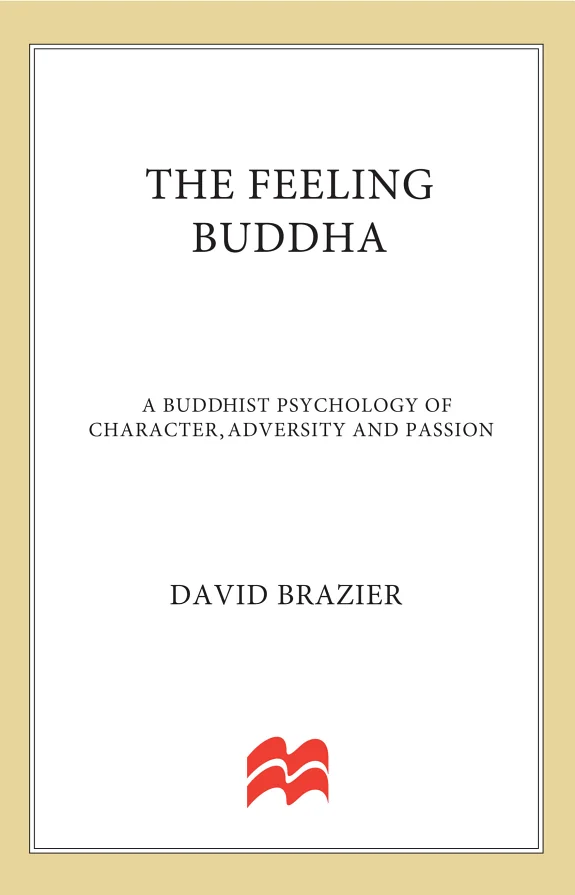
The Feeling Buddha
 76
76

The Feeling Buddha
David Brazier’s *The Feeling Buddha* offers a welcome, if occasionally uneven, exploration of Buddhist psychology. Brazier, drawing on his extensive background in both Buddhist practice and Western psychotherapy, attempts to ground abstract Buddhist concepts in the concrete reality of human emotion. The strength of the book lies in its commitment to making the Dharma accessible through the lens of feeling, a universally experienced aspect of existence. A particularly compelling section discusses the Buddhist understanding of attachment not merely as desire, but as a complex emotional clinging that fuels suffering, a nuanced point often lost in popular retellings. However, the book sometimes struggles to maintain a consistent academic rigor, occasionally veering into generalized psychological observations that lack specific Buddhist textual grounding. The narrative could benefit from more direct engagement with specific sutras or commentaries to bolster its claims. Despite these limitations, Brazier’s endeavor to connect the contemplative path with emotional intelligence is commendable. It serves as a valuable bridge for those seeking a more embodied understanding of Buddhist principles.
📝 Description
76
David Brazier published The Feeling Buddha in 1997, aiming to connect Buddhist thought with Western psychology.
Published in 1997, David Brazier's The Feeling Buddha synthesizes Buddhist philosophy and Western psychology. The book prioritizes the experiential and emotional aspects of Buddhist teachings over purely doctrinal ones. Brazier uses Buddhist principles to examine human feelings, providing a framework for emotional regulation and self-awareness. It challenges common interpretations by focusing on the practical, affective core of spiritual practice.
This book is for anyone interested in applying Buddhist wisdom to their emotional lives. It will especially resonate with readers who find traditional Buddhist texts too abstract. Those familiar with basic Buddhist ideas but seeking a more psychological viewpoint will find it useful. Therapists, counselors, and spiritual directors may also benefit from its insights for their own work.
The Feeling Buddha emerged in the late 20th century, a time when Western engagement with Eastern religions was growing. Brazier's focus on emotion and psychology fits a trend of making Buddhist teachings more accessible and relevant to modern life. This work continues a dialogue started by earlier figures who introduced Eastern philosophy to Western audiences, contributing a psychologically informed perspective to the lineage of Western Buddhism.
💡 Why Read This Book?
• Gain a psychologically informed understanding of core Buddhist principles like impermanence and non-self, directly applied to your emotional landscape, as explored in Brazier's analysis of emotional clinging. • Discover practical methods for mindful engagement with difficult emotions, moving beyond mere intellectual comprehension to direct experiential insight, a key tenet of the book's approach. • Explore the intersection of Buddhist philosophy and Western psychology, learning how ancient wisdom can inform contemporary emotional well-being, as Brazier integrates these two fields.
⭐ Reader Reviews
Honest opinions from readers who have explored this book.
❓ Frequently Asked Questions
When was The Feeling Buddha first published?
The Feeling Buddha by David Brazier was first published in the United Kingdom in 1997 by Robinson, an imprint of Constable & Robinson Ltd.
What is the main focus of The Feeling Buddha?
The book focuses on integrating Buddhist philosophy and practice with Western psychological understanding, particularly concerning human emotions and feelings.
Who is David Brazier?
David Brazier is an author and Zen practitioner who has written extensively on Buddhism, psychotherapy, and the intersection of the two fields. He founded the Amida Trust.
Does the book discuss specific Buddhist meditation techniques?
While the book's primary focus is on the theoretical and psychological application of Buddhist concepts to feelings, it implicitly supports mindful awareness practices central to Buddhist meditation.
Is The Feeling Buddha suitable for beginners to Buddhism?
Yes, the book is written to be accessible to those new to Buddhist concepts, as it explains them through the familiar lens of emotional experience and psychological insight.
What does the title 'The Feeling Buddha' imply?
The title suggests an approach to Buddhist teachings that emphasizes the emotional and experiential dimensions of enlightenment and practice, rather than solely intellectual understanding.
🔮 Key Themes & Symbolism
Emotion as Spiritual Path
Brazier posits that human emotions are not mere distractions from spiritual practice but are, in fact, the very ground upon which liberation is sought. The book explores how Buddhist principles like anicca (impermanence) and anatta (non-self) directly illuminate the transient nature of our feelings, offering a framework to observe them without identification. This perspective challenges ascetic ideals that might seek to bypass emotional experience, instead advocating for a direct, mindful engagement with the affective realm as central to understanding suffering and its cessation.
Buddhist Psychology
The work functions as an introduction to Buddhist psychology, examining the mind's workings through the lens of the Dharma. It draws parallels between Buddhist concepts of consciousness and emotional conditioning and those found in Western psychology. Brazier highlights the Buddha's own profound understanding of the human psyche, emphasizing that the core teachings are designed to address psychological distress and promote well-being. The book frames Buddhist ethics and philosophy as a sophisticated system for emotional regulation and self-understanding.
The Nature of Suffering (Dukkha)
A central theme is the Buddhist understanding of dukkha, often translated as suffering, but more accurately encompassing dissatisfaction and unease. Brazier connects this pervasive human condition directly to our relationship with our feelings—how we cling to pleasant emotions, resist unpleasant ones, and remain ignorant of their impermanent nature. By dissecting the mechanisms of emotional attachment and aversion, the book offers insights into the roots of suffering and points towards the possibility of its alleviation through mindful awareness.
Bridging Traditions
The Feeling Buddha represents a significant effort to bridge the gap between Eastern contemplative traditions and Western psychological thought. Brazier, with his background in both, skillfully integrates concepts from Buddhist philosophy with terminology and frameworks familiar to those trained in Western psychotherapeutic approaches. This cross-disciplinary dialogue aims to make the practical wisdom of Buddhism more accessible and relevant to contemporary individuals grappling with modern psychological challenges and emotional complexities.
💬 Memorable Quotes
Direct passages from the work, attributed to the author.
“The Buddha's path is fundamentally about understanding and transforming the way we feel.”
— This statement expresses the book's core thesis, suggesting that Buddhist practice is not an abstract intellectual pursuit but a deeply emotional and experiential one aimed at alleviating suffering through altered feeling states.
“We tend to mistake our emotional states for our permanent selves.”
— This interpretation highlights the Buddhist concept of anatta (non-self) as applied to emotions, pointing out the common human error of identifying with fleeting feelings, which paradoxically perpetuates suffering.
“Attachment to pleasant feelings is as much a source of suffering as aversion to unpleasant ones.”
— This concept underlines the Buddhist view that suffering arises from craving (tanha) in all its forms, including the desire to prolong positive experiences and the rejection of negative ones.
💡 Key Ideas
Editorial paraphrase of the work's core concepts — not direct quotes.
Mindfulness allows us to observe feelings without being swept away by them.
This paraphrase emphasizes the practical application of Buddhist mindfulness (sati) as a tool for emotional regulation, enabling individuals to witness their feelings objectively rather than reactively.
The path to liberation involves understanding the impermanent nature of all phenomena, including our emotions.
This paraphrased idea connects the Buddhist doctrine of anicca (impermanence) directly to the experience of emotions, suggesting that recognizing their transient quality is key to freedom from suffering.
🌙 Esoteric Significance
Tradition
While not strictly adhering to a single Western esoteric lineage like Hermeticism or Gnosticism, *The Feeling Buddha* draws heavily from the Mahayana Buddhist tradition, particularly Zen. Its esoteric significance lies in its reinterpretation of core Buddhist doctrines (like non-self and impermanence) through a psychological framework accessible to a Western audience. It functions as a bridge, translating the experiential insights of a major Eastern spiritual path into language that speaks to contemporary explorations of consciousness and the psyche, often found within esoteric circles interested in mind-body integration.
Symbolism
The book implicitly engages with the symbol of the Buddha not just as a historical figure, but as an archetype representing awakened consciousness and emotional mastery. The 'feeling' aspect symbolizes the raw, immediate experience of existence, the very stuff from which suffering and liberation arise. By focusing on this 'feeling' dimension, Brazier draws attention to the embodied nature of spiritual practice, moving beyond purely intellectual or ritualistic interpretations common in some esoteric traditions. The concept of 'emptiness' (sunyata), central to Buddhism, is explored through the lens of emotional impermanence.
Modern Relevance
Contemporary mindfulness and acceptance-based therapies (like ACT - Acceptance and Commitment Therapy) owe a debt to the kind of integration Brazier champions. Thinkers and practitioners exploring embodied cognition, emotional intelligence, and the intersection of contemplative practice with mental health find resonance in his approach. His work is relevant to modern esotericists seeking practical, psychologically sound methods for inner transformation that move beyond purely theoretical frameworks, connecting ancient wisdom to the lived emotional realities of the 21st century.
👥 Who Should Read This Book
• Individuals interested in applying Buddhist principles to manage and understand their emotions, seeking practical psychological insights rather than purely religious doctrine. • Therapists, counselors, and spiritual directors looking to integrate contemplative wisdom and mindfulness concepts into their professional practice for enhanced client well-being. • Students of comparative religion and psychology seeking to explore the intersection of Eastern contemplative traditions and Western psychological thought.
📜 Historical Context
David Brazier’s *The Feeling Buddha*, first published in 1997, emerged during a period of burgeoning Western engagement with Buddhism, particularly Zen and Tibetan traditions. This era saw a notable increase in the secularization and psychologization of Eastern contemplative practices, a trend exemplified by works like Jon Kabat-Zinn's mindfulness-based stress reduction (MBSR). Brazier's contribution aligns with this movement by explicitly framing Buddhist teachings through the lens of emotion and psychology, differentiating it from more purely philosophical or monastic interpretations. While figures like D.T. Suzuki had earlier popularized Zen, the late 20th century witnessed a deeper integration into Western therapeutic discourse. Brazier’s work can be seen as part of this broader intellectual current, offering a synthesized perspective that speaks to individuals seeking practical emotional and psychological benefits from Buddhist principles, rather than solely metaphysical or doctrinal understanding.
📔 Journal Prompts
The Buddha's emphasis on feeling as the core of practice: How does this perspective shift your view of emotional states?
Reflect on the concept of emotional clinging and its role in perpetuating dissatisfaction in your life.
Consider the principle of anicca (impermanence) as it applies to a recent strong emotional experience.
How can mindful observation, as described in the book, help you engage with difficult feelings differently?
The archetype of the 'Feeling Buddha': What does emotional mastery look like in practice for you?
🗂️ Glossary
Anicca
Pali term for impermanence; the Buddhist doctrine that all conditioned phenomena are in a constant state of flux, including emotions and thoughts.
Anatta
Pali term for non-self; the Buddhist doctrine that there is no permanent, unchanging self or soul, applicable also to the transient nature of emotional experiences.
Dukkha
Pali term often translated as suffering, but encompassing a broader sense of dissatisfaction, unease, or stress inherent in conditioned existence.
Mindfulness (Sati)
A key Buddhist practice involving paying attention to the present moment, thoughts, feelings, and sensations non-judgmentally.
Craving (Tanha)
The insatiable thirst or desire that fuels suffering according to Buddhist teachings, including craving for pleasant experiences and aversion to unpleasant ones.
Psychology
The scientific study of the mind and behavior, often concerned with emotions, cognition, and interpersonal relationships.
Dharma
In Buddhism, the teachings of the Buddha, the truth about reality, and the path to liberation.
This book appears in 1 collection
🔮 Readers Also Liked
Browse all →









From the “Nirvana” Collection
View all →









More Free Sacred Texts & Gnosticism Books
View all →