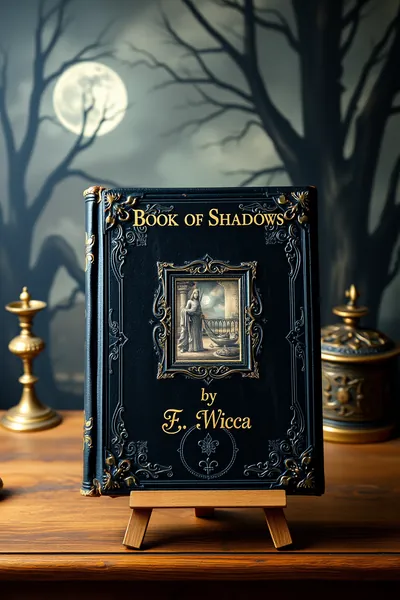
Book of Shadows: Step-By-Step Guide to Book of Shadows

 82
82

Book of Shadows: Step-By-Step Guide to Book of Shadows
Buckland's "Book of Shadows" offers a refreshingly direct approach to a topic often shrouded in mystique. It commendably demystifies the process of creating a personal grimoire, presenting it as an essential tool for any serious practitioner, rather than an arcane secret. The strength lies in its practical, step-by-step methodology, making the creation of a Book of Shadows accessible even to those unfamiliar with esoteric record-keeping. A particular passage detailing the organization of elemental correspondences is lucid and immediately applicable. However, the work could benefit from a more in-depth exploration of the psychological underpinnings of journaling as a magical practice, moving beyond mere procedural instruction. Ultimately, this book provides a solid, actionable foundation for anyone wishing to establish or enhance their personal Book of Shadows.
📝 Description
82
Lisa Buckland's 2006 guide offers a practical method for creating personal grimoires.
This book provides a structured approach to compiling a personal Book of Shadows. It explains the purpose of such a grimoire, which is to record magical practices, spiritual insights, and ritual components. While the concept of a Book of Shadows gained prominence in the mid-20th century, its practice is now a core element for many modern witches.
The guide is suitable for those new to witchcraft and Wicca, offering a clear way to document magical experiences. It also benefits experienced practitioners by helping them improve their record-keeping. Anyone interested in spiritual development and the value of written records will find this manual useful. Buckland stresses that the Book of Shadows is a unique reflection of each practitioner's spiritual path.
The practice of keeping a Book of Shadows, or personal grimoire, has roots in occult traditions where practitioners recorded magical knowledge and rituals. Gerald Gardner popularized this concept for Wicca in the mid-20th century with his own Book of Shadows. Buckland's work acknowledges this history but presents a modern, accessible guide for contemporary witches. It focuses on making the grimoire a useful, personal tool for spiritual growth, distinct from earlier, more private journals.
💡 Why Read This Book?
• Learn how to structure your personal Book of Shadows, moving beyond vague intentions to concrete sections like spell components and ritual outlines, as detailed in the organizational advice. • Understand the evolution of the Book of Shadows practice from its mid-20th century popularization by figures like Gerald Gardner to its modern iteration. • Gain practical skills for documenting your spiritual journey, ensuring your magical experiences and insights are recorded for future reference and growth, a core tenet of Buckland's guide.
⭐ Reader Reviews
Honest opinions from readers who have explored this book.
❓ Frequently Asked Questions
What is the primary purpose of a Book of Shadows according to Lisa Buckland?
Lisa Buckland emphasizes that a Book of Shadows is primarily a personal record of a witch's magical dealings and spiritual journeys. It serves as an essential tool for learning, record-keeping, and reflecting on one's evolving esoteric path.
Is a Book of Shadows a requirement for all Wiccans?
While popularized within Wicca, Buckland notes that practitioners of many paths keep Books of Shadows. It's presented as an important, though not ancient, component that aids personal practice and spiritual documentation.
How does Buckland suggest organizing a Book of Shadows?
Buckland stresses that the organization is entirely up to the individual practitioner. The book guides users on deciding what to include and how to structure it, focusing on personal utility and meaning.
Can I include personal reflections in my Book of Shadows?
Absolutely. Buckland highlights that a Book of Shadows is deeply personal. It's an ideal place to record spiritual insights, personal growth, and reflections alongside spells and rituals.
When was Lisa Buckland's "Book of Shadows" first published?
Lisa Buckland's "Book of Shadows: Step-By-Step Guide to Book of Shadows" was first published on October 10, 2018.
What distinguishes Buckland's approach to Books of Shadows?
Buckland's approach focuses on a step-by-step, practical guide for contemporary practitioners. It emphasizes accessibility and personalization, distinguishing it from historical or more rigidly structured grimoires.
🔮 Key Themes & Symbolism
Personalized Grimoire Creation
The central theme is the creation of a highly personalized Book of Shadows. Buckland stresses that this is not a one-size-fits-all text but a unique reflection of the individual practitioner's path. The book guides the reader through the process of deciding what content is essential, from spell formulations and ritual structures to personal insights and symbolic interpretations, ensuring the final grimoire is a functional and meaningful tool.
Record-Keeping as Spiritual Practice
This work positions record-keeping not as a mundane task but as an integral component of spiritual development within witchcraft. By meticulously documenting magical workings, observations, and spiritual journeys, practitioners can track their progress, identify patterns, and deepen their understanding of esoteric principles. The act of writing itself becomes a form of magical practice and self-reflection.
Evolution of Wiccan Tools
Buckland situates the Book of Shadows within the broader context of evolving Wiccan religious practices. While acknowledging its roots and popularization by figures like Gerald Gardner, the book presents a modern, accessible framework. It highlights how this tool, though not ancient, has become a significant element of contemporary Wiccan identity and practice for many across different paths.
Practical Application of Magic
The guide emphasizes the practical application and utility of a Book of Shadows. It moves beyond theoretical discussions to provide actionable advice on organizing spells, understanding correspondences, and structuring rituals. This focus on practicality aims to empower readers to actively engage with their chosen path and make their magical studies and practices more effective and systematic.
💬 Memorable Quotes
Direct passages from the work, attributed to the author.
“All of a Witch's magical dealings and spiritual journeys are recorded in a Book of Shadows.”
— This statement expresses the fundamental purpose of the grimoire: it is the repository of a practitioner's entire magical and spiritual life, serving as a comprehensive personal archive.
“Although not of ancient origin, the Book of Shadows has evolved as an important part of the Wiccan religion.”
— This highlights the modern development and significance of the Book of Shadows within Wicca, distinguishing it from older, more traditional magical texts while affirming its current importance.
“Practitioners of many paths keep them.”
— This indicates the widespread adoption and adaptability of the Book of Shadows concept beyond a single tradition, suggesting its universal appeal as a tool for personal spiritual documentation.
“They are useful instruments for learning and for record keeping.”
— This underscores the dual function of the Book of Shadows: as an educational resource for deepening knowledge and as a practical system for logging magical activities and results.
“Because a Book of Shadows is very personal, ultimately you will have to decide for yourself how to organize it and what to include.”
— This emphasizes the core principle of individual autonomy in creating a Book of Shadows, empowering the practitioner to tailor the text to their unique needs and spiritual journey.
🌙 Esoteric Significance
Tradition
Buckland's work fits within the modern esoteric landscape, particularly the Wiccan and neo-pagan movements that gained traction in the mid-20th century. While not directly tied to ancient Hermetic or Gnostic traditions, it draws upon the general concept of a magical grimoire, a practice found across many historical esoteric lineages. It adapts this concept for contemporary practitioners, emphasizing personal experience and self-directed learning within a framework influenced by figures like Gerald Gardner.
Symbolism
While Buckland's text is primarily practical, the act of creating a Book of Shadows inherently engages with symbolism. The choice of materials (paper, ink, binding) can be imbued with symbolic meaning related to the elements or personal intent. Furthermore, the organization of the book itself—perhaps dedicating sections to planetary correspondences, elemental symbols, or deity representations—allows for the integration and exploration of symbolic language central to many esoteric paths.
Modern Relevance
The principles outlined in Buckland's guide are highly relevant to contemporary practitioners of witchcraft, modern paganism, and personal spiritual development. Many online communities and contemporary authors on witchcraft draw upon the idea of a personalized grimoire for documenting spells, rituals, and spiritual insights. The emphasis on practical application and individual autonomy speaks to the decentralized nature of many modern esoteric practices.
👥 Who Should Read This Book
• Aspiring Witches and Pagans: Individuals new to witchcraft seeking a structured method to begin documenting their magical practices, spells, and spiritual insights. • Practicing Witches seeking organization: Those already engaged in witchcraft who wish to create a more systematic and personal record of their workings beyond scattered notes. • Students of Esotericism: Individuals interested in comparative religion or the history of magical practices who want to understand the function and creation of a personal grimoire in modern traditions.
📜 Historical Context
Lisa Buckland's "Book of Shadows: Step-By-Step Guide to Book of Shadows," published in 2018, emerges in an era where interest in witchcraft and esoteric practices has seen a significant resurgence, partly fueled by online communities and accessible literature. The concept of the Book of Shadows itself gained prominence in the mid-20th century, largely through the writings and practices of Gerald Gardner, the founder of Gardnerian Wicca. Gardner's own Book of Shadows, purportedly containing rituals and lore passed down through a coven, became a foundational text for this tradition. However, Buckland's guide distinguishes itself by offering a contemporary, practical manual, catering to a broader audience than the historically specific rituals found in Gardner's work or the more cryptic personal journals of earlier occultists like Aleister Crowley. While Gardner's influence is undeniable, Buckland focuses on empowering individual creation rather than adherence to a specific, inherited text, reflecting a more decentralized approach to modern witchcraft.
📔 Journal Prompts
Your personal Book of Shadows: What initial sections will you prioritize?
Reflect on the significance of documenting your spiritual journey.
Consider the evolution of magical record-keeping practices.
Identify three types of entries you will consistently include in your grimoire.
How will your Book of Shadows serve as a learning instrument?
🗂️ Glossary
Book of Shadows
A personal journal or grimoire used by Witches and practitioners of various esoteric paths to record magical spells, rituals, correspondences, and spiritual insights.
Wicca
A contemporary Neopagan religion that follows a tradition of witchcraft. It was revived in England in the first half of the 20th century and was popularized by Gerald Gardner.
Grimoire
A textbook of magic, typically containing instructions on how to create magical tools, perform rituals, and cast spells. The term 'Book of Shadows' is often used synonymously within Wicca.
Correspondences
In magical practice, these are symbolic associations between various elements, such as herbs, colors, planets, deities, and magical effects, used to enhance spellcasting and ritual.
Ritual
A set sequence of actions or words performed in a specific order, often for a religious or magical purpose, such as invoking deities or consecrating tools.
Spell
A magical act or formula intended to achieve a specific outcome, often involving focused intent, visualization, and the use of correspondences.
Esoteric
Intended for or likely to be understood by only a small number of people with a specialized knowledge or interest, particularly concerning mystical, spiritual, or occult subjects.
This book appears in 1 collection
🔮 Readers Also Liked
Browse all →






From the “Book of Shadows” Collection
View all →





More Free Sacred Texts & Gnosticism Books
View all →