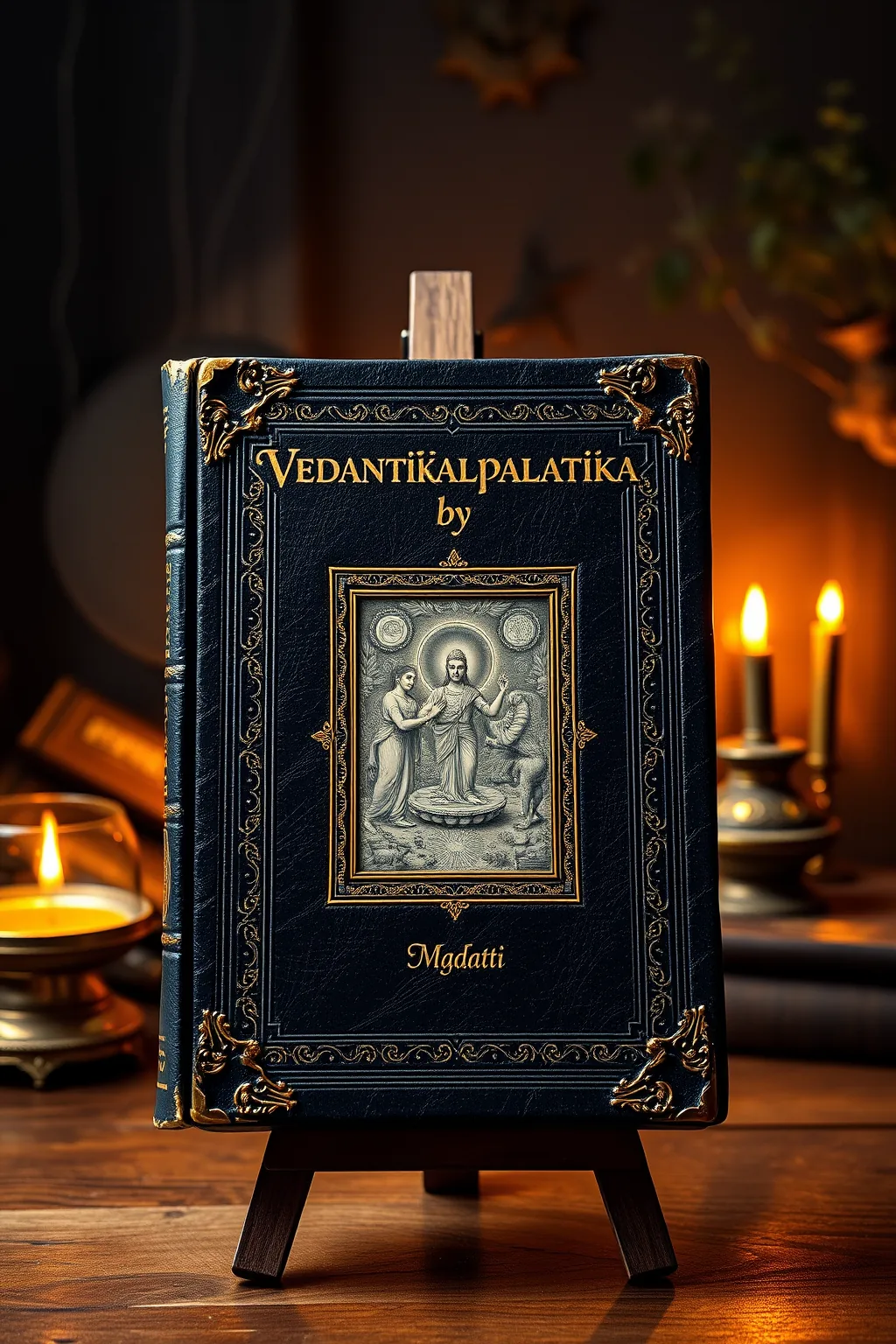
Vedantakalpalatika Madhusudan Saraswati
 79
79

Vedantakalpalatika Madhusudan Saraswati



As the Hermetic Studies Editor, I find 'Vedantakalpalatika' to be an indispensable addition to our collection. Madhusudan Saraswati masterfully distills the complex Advaita Vedanta into accessible yet profound insights. The text offers a rare window into pre-1500 A.D. Indian spiritual thought, revealing esoteric doctrines that resonate deeply with Western occult traditions. Its strength lies in its clarity and systematic approach, guiding the reader towards the direct experience of Brahman. This book is essential for serious students of comparative mysticism and anyone seeking to grasp the ultimate nature of reality through an ancient, potent lens. A truly illuminating work.
📝 Description
79
Madhusudan Saraswati's Vedantakalpalatika, likely composed in the 16th century, explicates Advaita Vedanta.
This English translation presents Vedantakalpalatika, a Sanskrit text attributed to Madhusudan Saraswati. The work details the philosophical underpinnings of Vedanta, specifically focusing on the non-dualistic perspective of Advaita. It explains core concepts central to this school of thought, aiming to illuminate the nature of ultimate reality.
The book functions as a manual for spiritual understanding. It aims to guide readers toward realizing the unity of all existence, a central teaching in Advaita. The text discusses methods and insights considered crucial for self-realization, drawing from a long tradition of Indian metaphysical inquiry. It seeks to provide a framework for comprehending the divine interconnectedness described in these traditions.
Vedantakalpalatika is situated within the broad tradition of Vedanta, one of the six orthodox schools of Hindu philosophy. Its specific focus on Advaita, or non-dualism, aligns it with a lineage that emphasizes the identity of the individual soul (Atman) and the ultimate reality (Brahman). This perspective has been a dominant stream within Vedanta, particularly from the time of Shankara. Texts like this aim to systematically articulate the philosophical arguments and practical implications of this non-dual view, serving as guides for practitioners seeking to understand and realize this truth.
💡 Why Read This Book?
Delve into the profound wisdom of Advaita Vedanta, uncover the secrets of ultimate reality, and explore a foundational text of Hindu spiritual philosophy. Ideal for seekers of truth, scholars of Eastern religions, and practitioners of meditation and yoga seeking deeper theoretical understanding. 'Vedantakalpalatika' offers a direct link to ancient spiritual lineages and a path towards self-discovery.
⭐ Reader Reviews
Honest opinions from readers who have explored this book.
❓ Frequently Asked Questions
Who was Madhusudan Saraswati?
Madhusudan Saraswati was a prominent Indian philosopher and scholar who lived before 1500 A.D. He is renowned for his contributions to Advaita Vedanta, synthesizing its teachings into accessible manuals for spiritual seekers.
What is Advaita Vedanta?
Advaita Vedanta is a non-dualistic school of Hindu philosophy that emphasizes the oneness of the individual soul (Atman) and the ultimate reality (Brahman), asserting that all perceived multiplicity is ultimately illusory.
What is the 'Vedantakalpalatika'?
The 'Vedantakalpalatika' is a Sanskrit manual that systematically explains the core concepts of Vedanta and Advaita, aiming to guide readers towards an understanding of ultimate reality and the nature of the Self.
Is this book suitable for beginners?
While the subject matter is profound, the translation aims for clarity. Beginners interested in Eastern philosophy will find it a rich, albeit challenging, introduction to Advaita Vedanta's core principles.
Can I download this book?
Yes, 'Vedantakalpalatika' is available as a free PDF e-book for download on our platform, offering 232 pages of profound wisdom.
🔮 Key Themes & Symbolism
The Nature of Brahman
This theme explores the quintessential Advaita concept of Brahman – the absolute, unchanging, and singular reality that underlies all existence. The text explores Brahman not as a distant deity, but as the very essence of consciousness, the substratum upon which the illusion of the phenomenal world is projected. It illuminates how the perceived separation between the individual self and the universal consciousness is a fundamental misunderstanding, and guides the reader towards recognizing their inherent unity with this ultimate principle. This exploration is crucial for dismantling egoic limitations and experiencing the boundless nature of the divine.
The Illusion of Maya
Central to Advaita Vedanta is the concept of Maya, the cosmic illusion that veils the true nature of reality and creates the appearance of multiplicity and duality. 'Vedantakalpalatika' meticulously unravels the workings of Maya, explaining how our senses, mind, and intellect bind us to the phenomenal world, obscuring the singular truth of Brahman. Understanding Maya is presented not as an act of negation, but as a process of discernment, allowing the practitioner to see through the veil and recognize the impermanence and unreality of worldly phenomena, thereby paving the way for liberation from suffering.
The Path to Moksha (Liberation)
This theme focuses on the ultimate goal of Advaita Vedanta: Moksha, liberation from the cycle of birth and death, and the attainment of self-realization. The text outlines the spiritual disciplines and philosophical insights necessary to achieve this state. It emphasizes that liberation is not an external reward but an inherent realization of one's true nature as Brahman. Through practices like self-inquiry, discrimination (viveka), and detachment (vairagya), the reader is guided towards transcending ignorance and achieving the blissful state of oneness, a profound spiritual awakening that marks the end of all existential angst.
💬 Memorable Quotes
Direct passages from the work, attributed to the author.
“That which is, is one; That which is not, is not.”
— A concise statement of Advaita's core principle: reality is singular and unchanging, while the perceived world of change is ultimately unreal.
“The knower, the known, and the knowing are but one.”
— Highlights the non-dual nature of consciousness, where the subject, object, and act of cognition merge into a singular experience of awareness.
“To see the Self is to see the All.”
— Emphasizes that realizing one's true, divine nature leads to the understanding that all beings and phenomena are interconnected and part of the same ultimate consciousness.
“Ignorance is the root of all suffering.”
— Points to the fundamental cause of human distress as a lack of true knowledge about the Self and reality, and the illusion of separation.
“The world is a dream, and the waking is the reality.”
— Illustrates the concept of Maya, comparing the perceived world to a dream from which true awakening (realization of Brahman) liberates the individual.
🌙 Esoteric Significance
Tradition
This work is a core part of the Advaita Vedanta tradition within Hindu philosophy. While often studied academically, Advaita is profoundly esoteric in its aim: the direct, experiential realization of non-duality. It offers a sophisticated metaphysical framework that aligns with mystical traditions worldwide, focusing on the transcendence of the ego and the direct apprehension of ultimate consciousness. Its teachings are a guide for the inner alchemist, seeking to transform the ordinary self into the divine.
Symbolism
The title itself, 'Vedantakalpalatika' (meaning 'Wish-fulfilling Creeper of Vedanta'), is rich in symbolism, suggesting that the text bears the fruits of spiritual knowledge as a divine creeper. Within its pages, concepts like 'Brahman' symbolize the boundless ocean of consciousness, while 'Maya' represents the veiling power of illusion, akin to a cosmic mist. The journey described is one of peeling back layers of ignorance, symbolized by the shedding of leaves, to reach the core of absolute truth, the radiant blossom of self-realization.
Modern Relevance
In an age of increasing fragmentation and existential searching, the non-dualistic message of 'Vedantakalpalatika' offers profound solace and a path to inner peace. Its emphasis on the inherent oneness of all beings resonates deeply with contemporary concerns for unity and interconnectedness. The text provides a timeless philosophical anchor for individuals exploring consciousness, meditation, and the deeper meaning of life, offering practical insights for working through the complexities of the modern world with spiritual clarity and wisdom.
👥 Who Should Read This Book
This text is a treasure for the serious spiritual seeker, offering clear insights into the nature of reality and the Self. Scholars of Eastern religions and comparative mysticism will find it an invaluable primary source. Practitioners of yoga and meditation seeking a deeper philosophical understanding of their practice will benefit immensely. Beginners curious about the core tenets of Advaita Vedanta will find a challenging yet rewarding introduction. Ultimately, anyone yearning to transcend the limitations of the ego and explore the boundless depths of consciousness will find 'Vedantakalpalatika' a guiding light on their path.
📜 Historical Context
Written sometime before 1500 A.D., 'Vedantakalpalatika' emerges from the vibrant intellectual and spiritual range of medieval India, a period marked by profound philosophical discourse and the flourishing of various schools of Hindu thought. Advaita Vedanta, as championed by figures like Adi Shankaracharya, had already established itself as a dominant philosophical system, emphasizing the non-dual nature of reality. This era saw intense scholarly debate and the refinement of metaphysical concepts. Madhusudan Saraswati, as a product of this rich tradition, synthesized and elucidated these complex doctrines, making them accessible through his writings. The existence of this text, and its subsequent translation, speaks to the enduring appeal and universal relevance of these ancient Indian philosophical insights, transcending geographical and temporal boundaries.
📔 Journal Prompts
Reflect on the concept of Maya: In what ways does illusion influence your perception of reality on a daily basis?
Consider the statement 'The knower, the known, and the knowing are but one.' How does this concept challenge your understanding of self and experience?
What does the idea of Brahman as the singular, unchanging reality mean to you on an intellectual and intuitive level?
How can the pursuit of Moksha be integrated into a modern, active life?
Explore the symbolism of the 'Wish-fulfilling Creeper of Vedanta.' What spiritual 'fruits' do you seek, and how might this text help you attain them?
🗂️ Glossary
Brahman
In Advaita Vedanta, Brahman is the supreme, unchanging, absolute reality that is the substratum of all existence. It is considered the ultimate consciousness, beyond all attributes and distinctions.
Atman
The individual soul or self. In Advaita Vedanta, Atman is ultimately identical with Brahman, meaning the true nature of the self is divine and one with the universal consciousness.
Maya
A Sanskrit term referring to illusion or the cosmic power that veils the true nature of reality, creating the appearance of multiplicity and duality in the phenomenal world.
Moksha
Liberation or release from the cycle of birth, death, and rebirth (samsara). It is the ultimate spiritual goal in Hinduism, achieved through self-realization and the understanding of one's oneness with Brahman.
Advaita Vedanta
A prominent school of Hindu philosophy that emphasizes the non-dualistic nature of reality, asserting that Atman and Brahman are one and the same, and that all perceived diversity is ultimately an illusion.
This book appears in 6 collections
🔮 Readers Also Liked
Browse all →









From the “Tantra” Collection
View all →





More Free Spiritual Development Books
View all →