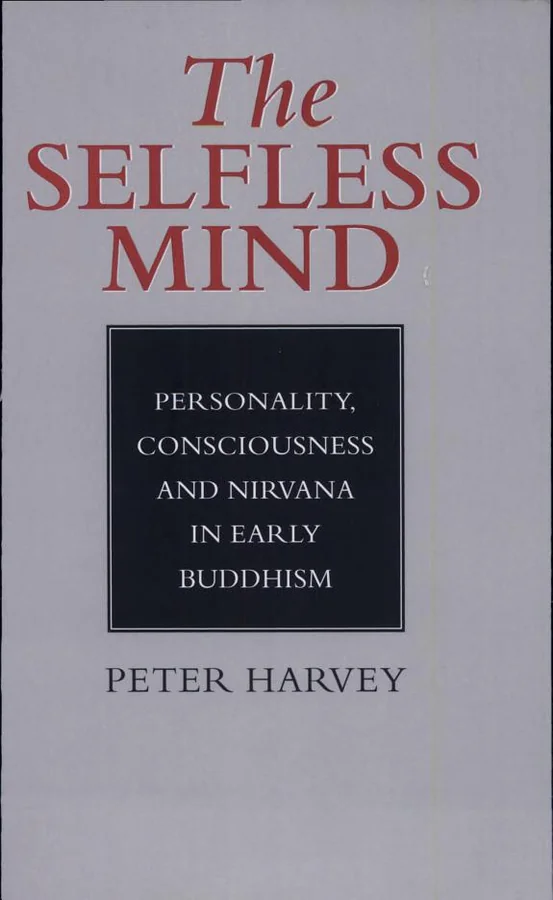
The Selfless Mind
 79
79

The Selfless Mind
Brian Peter Harvey's 'The Selfless Mind' is a meticulous dissection of early Buddhist soteriology, offering a clarifying perspective on the doctrine of 'anatta'. Harvey avoids sensationalism, instead presenting a lucid, scholarly argument for understanding the 'person' not as an illusion to be dispelled, but as a complex, continuously arising process of mental and physical events. The strength of the work lies in its systematic exploration of the practical and ethical ramifications of this doctrine, particularly its engagement with the 'undetermined questions'. A notable limitation, however, is the dense academic prose, which may present a barrier for readers not already immersed in Buddhist philosophical discourse. The analysis of the 'between-lives' period, for instance, while intellectually rigorous, demands significant prior knowledge. Despite this, the book remains a vital resource for anyone seeking an unvarnished intellectual encounter with the foundational principles of Buddhist thought, culminating in a sober yet illuminating exposition.
📝 Description
79
Brian Peter Harvey's 1995 book examines early Buddhist philosophy's concept of 'anatta'.
Published in 1995, Brian Peter Harvey's work scrutinizes early Buddhist philosophy, focusing on the doctrine of 'anatta', or no-self. Harvey dissects the Buddhist view of existence as a continuous flow of mental and physical processes, rather than a fixed entity. His analysis moves past simple denial to build a positive understanding of emergent consciousness and moral causality within this framework.
Harvey's study emerged during a time of renewed academic interest in early Buddhist texts. It countered interpretations leaning towards Mahayana ideas by re-emphasizing the Pali Canon's focus on unanswered questions. This was significant as scholars like Richard Gombrich were also examining the historical Buddha's teachings. Harvey's detailed analysis of the 'person' as a collection of changing phenomena directly addressed ethical and existential questions.
Harvey's exploration of 'anatta' places it within the contemplative traditions of early Buddhism, particularly as preserved in the Pali Canon. The book engages with the philosophical implications of recognizing existence as conditioned arising, a core tenet of these traditions. It addresses the practical and ethical consequences of understanding the self not as a static entity but as a process, a concept central to liberation in many Buddhist schools.
💡 Why Read This Book?
• Gain a precise understanding of 'anatta' beyond common misconceptions, learning how Harvey’s analysis of the Pali Canon frames the 'person' as a dynamic continuity of mental processes, not a static entity. • Explore the ethical implications of a non-self doctrine, as detailed in the book's examination of moral responsibility and self-development within the context of impermanence. • Grasp the significance of the 'undetermined questions' in early Buddhism, understanding how Harvey's work elucidates these complex philosophical inquiries as central to the path to liberation.
⭐ Reader Reviews
Honest opinions from readers who have explored this book.
❓ Frequently Asked Questions
What is the primary focus of Brian Peter Harvey's 'The Selfless Mind'?
The book's primary focus is a detailed analysis of early Buddhist thought, specifically the doctrine of 'anatta' or no-self, exploring its implications for understanding consciousness, ethics, and the nature of existence.
When was 'The Selfless Mind' first published?
Brian Peter Harvey's 'The Selfless Mind' was first published in 1995, contributing to scholarly discussions on Buddhist philosophy during that period.
Does the book discuss the concept of rebirth or the afterlife?
Yes, the work examines issues relating to the 'between-lives' period and the state of a liberated one after death, as understood within early Buddhist frameworks.
Is 'The Selfless Mind' suitable for beginners in Buddhist studies?
While insightful, the book's scholarly depth and focus on nuanced philosophical arguments make it more suitable for advanced students and scholars of Buddhist philosophy rather than absolute beginners.
What does the book mean by 'undetermined questions'?
In the context of early Buddhism, 'undetermined questions' (avyākata) refer to philosophical inquiries that the Buddha deliberately left unanswered, such as those concerning the origin of the world or the nature of the enlightened being after death.
How does the book define the 'person'?
Harvey's analysis defines the 'person' not as a permanent entity, but as a flowing continuity centered on consciousness and composed of changing mental and physical processes, in line with the 'anatta' doctrine.
🔮 Key Themes & Symbolism
The Nature of Anatta
Harvey meticulously unpacks the doctrine of 'anatta' (no-self) not as a nihilistic void, but as a sophisticated understanding of existence. The book details how early Buddhist thought posits a 'person' as a dynamic, impermanent aggregation of mental and physical processes. This perspective challenges notions of a fixed, enduring ego, framing liberation as the direct realization of this conditioned arising and impermanence, rather than the annihilation of a non-existent self.
Consciousness and Continuity
Central to the analysis is the role of consciousness as the locus of perceived continuity. The work explores how mental processes, though ever-changing, create the impression of a stable self. Harvey examines concepts like the 'bhavanga' or the 'between-lives' state, discussing how Buddhist thought accounts for karmic continuity and rebirth without recourse to a transmigrating soul, focusing instead on the causal nexus of consciousness.
Ethical and Existential Ramifications
Beyond metaphysical speculation, 'The Selfless Mind' examines the practical and ethical consequences of the no-self teaching. It addresses how moral responsibility can be understood and maintained when there is no permanent agent. The book also confronts the 'undetermined questions'—cosmological and eschatological issues left unaddressed by the Buddha—interpreting their omission as central to focusing practitioners on the immediate path to liberation.
The Flowing Person
Harvey articulates the concept of the 'person' as a 'flowing continuity'. This perspective emphasizes the stream of consciousness and its associated mental factors as the functional equivalent of a self in everyday experience. The book analyzes how this understanding informs self-development, guiding practitioners to observe mental phenomena without attachment, recognizing their impermanent and interdependent nature.
💬 Memorable Quotes
Direct passages from the work, attributed to the author.
“a rich analysis of changing and potent mental processes is developed”
— This phrase highlights Harvey's focus on the dynamic, active nature of the mind within the Buddhist framework. It suggests that Buddhist psychology offers a sophisticated map of mental phenomena, emphasizing their constant flux and power, rather than a static model of the self.
“no permanent Self is accepted”
— This core tenet of Buddhist philosophy, as presented by Harvey, is foundational. It signifies a radical departure from many other philosophical systems, asserting that what we conventionally identify as 'self' is an impermanent, conditioned phenomenon, not an immutable essence.
“the 'person' as a flowing continuity centred on consciousness”
— This interpretation of the 'person' emphasizes process over substance. It suggests that our sense of identity arises from the continuous stream of conscious experience, rather than from a fixed, underlying entity, aligning with the doctrine of 'anatta'.
“issues relating to the not-Self teaching”
— This points to the practical and ethical dimensions explored in the book. It signifies that the doctrine of 'anatta' has significant implications for understanding moral agency, personal development, and the nature of suffering and liberation.
“the 'undetermined questions' on the world, on the 'life principle' and on the liberated one after death”
— This refers to specific philosophical quandaries within Buddhism that the Buddha declined to answer directly. Harvey's work examines why these questions were considered 'undetermined' and their relevance to the path of practice.
🌙 Esoteric Significance
Tradition
While rooted in early Buddhist Pali Canon exegesis, 'The Selfless Mind' touches upon themes resonant with esoteric traditions that explore consciousness beyond the material. Its detailed analysis of mental processes and the constructed nature of selfhood can inform practices within contemplative lineages that seek to transcend ego-identification, finding parallels in certain non-dualistic philosophies and mystical introspective methods.
Symbolism
The primary 'symbol' explored is the 'person' itself, re-framed not as a fixed entity but as a dynamic, conditioned process. The concept of 'dukkha' (suffering) functions as a pervasive motif, arising from the misapprehension of impermanent phenomena as permanent. The 'flowing continuity' of consciousness serves as a key metaphor, illustrating the ever-changing nature of existence without a static core.
Modern Relevance
Contemporary mindfulness-based therapies and certain schools of secular Buddhism draw implicitly or explicitly on the principles Harvey elaborates regarding the impermanent nature of mental states and the deconstruction of ego-centric perspectives. Thinkers in consciousness studies and those exploring non-dual philosophies also find resonance in its detailed exploration of mind without a fixed, substantial self.
👥 Who Should Read This Book
• Advanced students of Buddhist philosophy: Gain a deep, scholarly understanding of the 'anatta' doctrine and its intricate arguments, moving beyond superficial interpretations. • Comparative religion scholars: Acquire detailed insights into early Indian philosophical discourse and the unique position of Buddhist thought regarding the self. • Contemplative practitioners seeking intellectual grounding: Deepen your practice by understanding the philosophical underpinnings of ego-deconstruction and the nature of consciousness.
📜 Historical Context
Brian Peter Harvey's 'The Selfless Mind,' published in 1995, arrived during a significant phase of Western academic engagement with early Buddhist scriptures. This period saw scholars actively re-examining the Pali Canon, often in contrast to later Mahayana developments. Harvey’s work stood in dialogue with contemporary researchers like K.R. Norman, who were crucial in translating and interpreting early Buddhist texts, and Richard Gombrich, whose work on the historical Buddha provided context. The book specifically addressed the 'avyākata' or 'undetermined questions' – cosmological and eschatological issues the Buddha left unanswered – arguing for their importance in understanding the original intent of the teachings. This focus offered a counterpoint to more generalized or syncretic interpretations of Buddhism prevalent in some popular circles, providing a rigorous scholarly analysis of the 'anatta' doctrine and its ethical implications.
📔 Journal Prompts
The flowing continuity of consciousness: Observe a single thought-stream without judgment.
Moral responsibility in 'anatta': How does the absence of a permanent self alter ethical decision-making?
The 'undetermined questions': Reflect on an existential query you find unanswerable and its impact on your focus.
Analyzing mental processes: Identify and label a sequence of distinct mental phenomena in your immediate experience.
The 'person' as a composite: Consider the five aggregates (skandhas) and their impermanent nature.
🗂️ Glossary
Anatta
The Buddhist doctrine of 'no-self' or 'non-self'. It asserts that there is no permanent, unchanging, independent self or soul in any phenomenon, including sentient beings.
Puggala
A term in early Buddhist texts often translated as 'person' or 'individual'. Harvey's work analyzes this concept as a conventional designation for a complex of interdependent, impermanent phenomena.
Bhavanga
A concept in Abhidharma Buddhism referring to the passive, subconscious mind or the 'life-continuum' that underlies conscious states and persists between death and rebirth.
Undetermined Questions (Avyākata)
Philosophical or metaphysical questions that the Buddha intentionally did not answer, such as the origin of the world or the state of an enlightened being after death, deeming them irrelevant to the path of liberation.
Flowing Continuity
A description of the 'person' as a dynamic, ever-changing stream of mental and physical processes, rather than a static, enduring entity, central to Harvey's interpretation of 'anatta'.
Self-Development
In the context of 'anatta', this refers to the process of spiritual and ethical growth achieved through understanding the impermanent nature of phenomena and reducing attachment to the illusion of a permanent self.
Moral Responsibility
The capacity and obligation for an individual to be accountable for their actions. Harvey explores how this concept functions within a framework that denies a permanent, independent agent.
This book appears in 1 collection
🔮 Readers Also Liked
Browse all →









From the “Nirvana” Collection
View all →






More Free Occult Philosophy Books
View all →