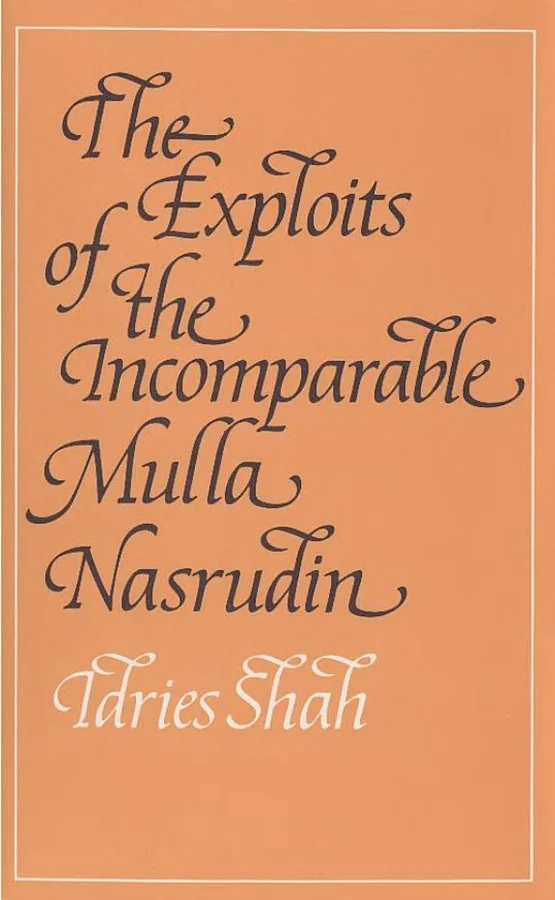
The Exploits of the Incomparable Mulla Nasrudin
 72
72

The Exploits of the Incomparable Mulla Nasrudin
Idries Shah's compilation of Mulla Nasrudin tales offers a potent, if occasionally uneven, encounter with a figure who has long served as a folk philosopher. The strength of this collection lies in its sheer breadth and the consistent, understated humor that underpins Nasrudin's seemingly absurd exploits. Shah masterfully curates stories that, while ancient in origin, possess a startling relevance to contemporary human foibles. A particular passage involving Nasrudin and a borrowed pot, where the pot is described as dying of natural causes, exemplifies the book's capacity to expose logical fallacies with disarming simplicity. However, the sheer volume of stories, without extensive commentary on their variations or deeper allegorical layers, can leave the reader wishing for more direct guidance on interpretation, a common challenge with teaching tales. The work functions best as a series of intellectual provocations rather than a fully explicated system. Ultimately, The Exploits of the Incomparable Mulla Nasrudin provides a valuable, often amusing, insight into a unique narrative tradition.
📝 Description
72
Idries Shah's 1983 collection gathers Mulla Nasrudin tales, known for their humor and paradox.
The Exploits of the Incomparable Mulla Nasrudin presents a wide range of anecdotes and parables featuring the legendary Mulla Nasrudin. These stories, prevalent in the folklore of Central Asia, the Middle East, and parts of Europe, use humor, paradox, and a disarming logic. They convey deeper meanings through a narrative style that challenges conventional thinking. Many tales have circulated orally for centuries before their collection in this volume.
The book appeals to readers interested in folklore, humor, and wisdom literature. It is for those who appreciate stories operating on multiple levels, providing both entertainment and intellectual stimulation. Individuals seeking an alternative to overtly didactic texts, or those curious about the transmission of wisdom across cultures, will find value here. It is especially suited for readers exploring Sufi traditions or the category of 'teaching stories'.
Published in 1983, this collection appeared during a period of growing Western interest in Eastern philosophies. Idries Shah, a proponent of Sufi thought, used the Mulla Nasrudin figure to illustrate practical wisdom applicable to contemporary life. The stories themselves originate from a long history of oral transmission, with variations appearing in manuscripts predating many formal philosophical systems. They represent a tradition of teaching stories designed to circumvent rigid intellectual patterns.
💡 Why Read This Book?
• You will learn to question conventional logic by encountering Nasrudin's paradoxical actions, such as his method of weighing bread, which exposes the limitations of simplistic cause-and-effect thinking. • You will gain an appreciation for indirect teaching methods, as exemplified by the structure of the stories themselves, which prompt self-discovery rather than direct instruction. • You will understand the historical roots of folk wisdom, tracing the lineage of Mulla Nasrudin tales from ancient oral traditions to their compilation in 1983 by Idries Shah.
⭐ Reader Reviews
Honest opinions from readers who have explored this book.
❓ Frequently Asked Questions
Who is Mulla Nasrudin and where do his stories come from?
Mulla Nasrudin is a legendary folk character, a wise fool whose anecdotes are found in the folklore of Central Asia, the Middle East, and parts of Europe. His stories have been transmitted orally for centuries, predating their formal collection.
What makes the stories of Mulla Nasrudin 'incomparable'?
The term 'incomparable' refers to the unique nature of Nasrudin's wisdom, which often operates through paradox, humor, and apparent foolishness to challenge conventional thought and reveal deeper truths.
What is the original publication year of this book?
The Exploits of the Incomparable Mulla Nasrudin was first published in 1983 by Idries Shah.
Are these religious stories?
While Nasrudin stories are often associated with Sufi traditions and contain wisdom applicable to spiritual development, they are not exclusively religious texts. They function as secular teaching stories with broad philosophical and psychological applications.
How do these stories differ from fables or jokes?
Unlike simple jokes, Nasrudin stories operate on multiple levels, often carrying profound psychological or philosophical insights beneath a humorous surface. They are designed to provoke thought and self-reflection, a key characteristic of teaching tales.
What kind of 'exploits' does Mulla Nasrudin engage in?
Nasrudin's exploits typically involve everyday situations where his unconventional approach, often based on a literal interpretation or a subversion of logic, leads to unexpected and revealing outcomes.
🔮 Key Themes & Symbolism
The Fool as Sage
Nasrudin embodies the archetype of the 'wise fool,' whose apparent foolishness and illogical actions serve to expose the rigidities and blind spots of conventional human behavior and thinking. His exploits, often seemingly absurd, function as subtle critiques of societal norms and individual pretensions. This theme challenges the reader to reconsider their definitions of wisdom and intelligence, suggesting that true insight can emerge from unexpected sources and methods.
Paradox and Non-Logic
Central to the Nasrudin narratives is the use of paradox and what can be termed 'non-logic.' These stories do not adhere to straightforward linear reasoning. Instead, they present situations where the most apparent or logical solution is ineffective, and Nasrudin's unconventional, often contradictory, approach yields a surprising result. This technique aims to bypass the reader's habitual patterns of thought and encourage a more flexible, intuitive understanding.
Perception and Reality
Many tales highlight the subjective nature of reality and the unreliability of perception. Nasrudin's experiences often demonstrate how individuals interpret events based on their preconceived notions, biases, and limited viewpoints. The stories implicitly suggest that what appears to be 'real' or 'true' is often a construct of the observer, prompting a deeper examination of how we construct our understanding of the world around us.
Oral Tradition and Transmission
The collection itself is a evidence of the power and longevity of oral tradition. These stories, gathered by Idries Shah, have been part of a living folklore for centuries, evolving and adapting across cultures. Their transmission highlights methods of wisdom dissemination that rely on narrative, humor, and shared experience, offering a contrast to purely academic or written forms of knowledge.
💬 Memorable Quotes
Direct passages from the work, attributed to the author.
“Nasrudin was asked how he managed to weigh bread without scales. He replied that he used his own head.”
— This anecdote playfully illustrates a reliance on subjective or arbitrary measurement. It critiques systems that lack objective standards or apply personal biases, suggesting a humorous lack of rigor.
“A man complained that Nasrudin had stolen his pot. Nasrudin replied that the pot had died of natural causes.”
— This story is a classic example of Nasrudin's ability to twist logic and create absurd justifications. It highlights how language can be manipulated and how one can evade responsibility through clever, albeit nonsensical, argument.
“The Mulla decided to sell his donkey. He tried to find a buyer, but no one would offer a good price. Finally, he decided to buy it himself.”
— This tale humorously points to self-deception or an inability to accurately assess value, especially when personal desire is involved. It critiques the logic of negotiation when driven by self-interest.
“When asked to explain a difficult concept, Nasrudin offered a story instead.”
— This reflects the pedagogical method of teaching through narrative, a core element of the book. It suggests that direct explanation is not always the most effective way to convey complex ideas, preferring indirect experiential learning.
💡 Key Ideas
Editorial paraphrase of the work's core concepts — not direct quotes.
Nasrudin, when asked if he knew anything, said: 'Yes, I know that I know nothing.'
This paraphrase echoes Socratic wisdom, presenting humility and self-awareness as a foundation for knowledge. It suggests that recognizing one's own ignorance is a crucial first step toward genuine understanding.
🌙 Esoteric Significance
Tradition
The Nasrudin stories are deeply embedded within the Sufi tradition, functioning as pedagogical tools designed to foster self-awareness and bypass intellectual conditioning. Within Sufism, these tales are not merely entertainment but are considered 'teaching stories' or 'anecdotes,' intended to transmit subtle psychological and spiritual insights. They depart from purely devotional or scholastic forms of religious expression, emphasizing a practical, experiential path to understanding that relies on observing one's own reactions to paradoxical situations.
Symbolism
A key symbol is Nasrudin himself, representing the awakened but often disguised sage who operates within the mundane world. His donkey frequently symbolizes the material body or the lower self, often acting as a foil or burden to Nasrudin's quest for understanding. The settings, typically ordinary villages or marketplaces, represent the everyday world where spiritual lessons are to be found, suggesting that the extraordinary is accessible within the ordinary.
Modern Relevance
Contemporary thinkers and practitioners in areas such as psychology, coaching, and mindfulness draw upon the Nasrudin narratives. Their paradoxical nature makes them relevant to exploring cognitive biases, creativity, and problem-solving. Schools of thought that emphasize experiential learning and the critique of rigid thinking patterns find resonance in Shah's curation of these tales, seeing them as tools for developing psychological flexibility and a more nuanced perception of reality.
👥 Who Should Read This Book
• Students of comparative folklore and mythology: These readers will gain access to a rich collection of narratives that have traversed numerous cultures, offering insights into cross-cultural storytelling and the evolution of folk wisdom. • Seekers of wisdom literature: Individuals interested in texts that convey philosophical or spiritual insights through indirect means will appreciate the cleverness and depth of Nasrudin's tales. • Those interested in Sufism or Eastern philosophies: This book provides an accessible entry point into the pedagogical methods and the spirit of practical wisdom often associated with Sufi traditions.
📜 Historical Context
Published in 1983, Idries Shah's collection of Mulla Nasrudin stories arrived during a period of significant Western engagement with Eastern esoteric traditions, particularly Sufism. Shah was a prominent figure in introducing Sufi thought and teaching stories to a global audience, often contrasting their practical, experiential nature with more theoretical or dogmatic approaches. This era saw a surge in interest in figures like G.I. Gurdjieff and writings that explored consciousness and altered states. The Nasrudin tales, with their roots in centuries of oral tradition stretching back to at least the 15th century, offered a counterpoint to the more structured philosophical systems prevalent in academia. While not facing overt censorship, Shah's work often encountered skepticism from those who viewed Sufism or similar traditions as mere superstition or a precursor to 'New Age' movements. His contemporaries included scholars like Annemarie Schimmel, who also worked extensively on Islamic mysticism and literature, though their approaches often differed in emphasis.
📔 Journal Prompts
Nasrudin's approach to weighing bread, The Mulla's reliance on his own head as a measuring device.
The significance of the donkey in the tales, its role as a symbol of burden or companion.
The use of paradox in the story of the stolen pot, how Nasrudin deflects blame.
The context of the 1983 publication, its place within Idries Shah's broader work on Sufism.
Nasrudin's appearance in ordinary settings, the potential for wisdom in everyday life.
🗂️ Glossary
Mulla
A title of respect for a learned man, especially a religious leader, in Islamic cultures. In the context of Nasrudin, it signifies a figure of authority or wisdom, albeit one who subverts conventional expectations.
Nasrudin
The central character of the collection, known for his wit, wisdom, and often nonsensical actions. He is a folk hero embodying a combination of foolishness and clear insights.
Folklore
The traditional beliefs, customs, and stories of a community, passed through the generations by word of mouth. Nasrudin tales are a prominent part of Central Asian and Middle Eastern folklore.
Teaching Story
A narrative designed to convey a lesson or insight, often indirectly. These stories function as pedagogical tools, encouraging self-reflection and understanding rather than direct instruction.
Paradox
A statement or situation that appears self-contradictory or absurd but may contain a deeper truth. Nasrudin's exploits frequently employ paradox to challenge conventional thinking.
Sufism
The mystical dimension of Islam, focused on inner spiritual experience and the pursuit of divine love. Idries Shah presented many Nasrudin stories as having roots in Sufi traditions.
Non-Logic
A term used to describe reasoning or actions that deviate from conventional, linear, or rational thought processes, often employed in esoteric traditions to bypass intellectual barriers.
This book appears in 1 collection
🔮 Readers Also Liked
Browse all →








From the “Sufism” Collection
View all →




More Free Sacred Texts & Gnosticism Books
View all →