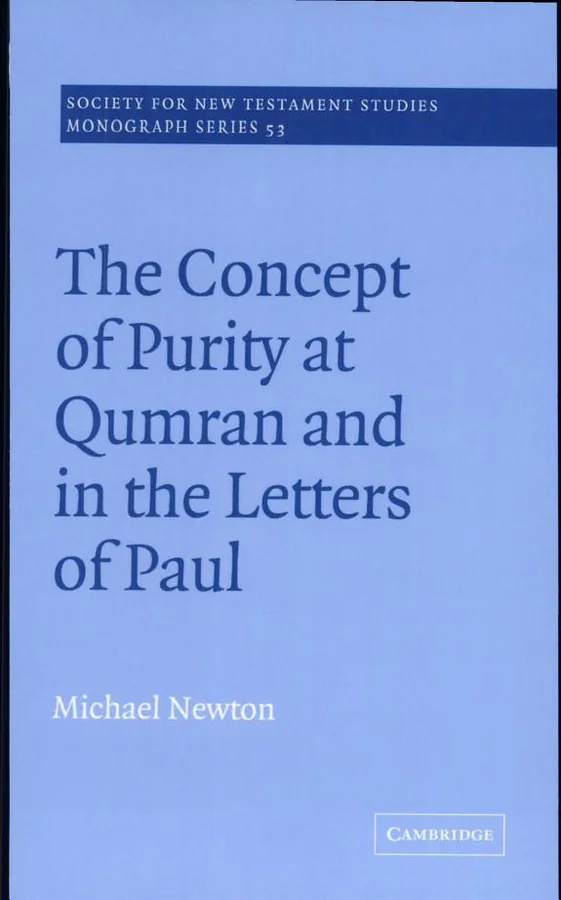
The Concept of Purity at Qumran and in the Letters of Paul
 79
79

The Concept of Purity at Qumran and in the Letters of Paul
Newton’s meticulous analysis of purity concepts at Qumran and in Pauline literature provides a crucial comparative framework. The strength of the book lies in its detailed exegesis, drawing clear lines between the ascetic separatism of the Qumran sect and the inclusive, albeit sometimes exclusivist, message of Paul. Newton effectively demonstrates how purity, far from being a simple ritual concern, served as a core element of each group’s self-definition and theological outlook. A point of limitation, however, is the book’s academic density; it presumes significant prior knowledge of both the Dead Sea Scrolls and Pauline theology, making it less accessible to the general reader. The exploration of Paul’s reinterpretation of purity, particularly concerning Gentile inclusion (e.g., Acts 10-11 and Galatians), is exceptionally well-argued. Ultimately, Newton delivers a valuable scholarly contribution that clarifies complex theological and social dynamics.
📝 Description
79
Michael Newton's 2005 book examines purity concepts at Qumran and in Paul's letters.
Michael Newton's study, published in 2005, scrutinizes the concept of purity as it informed religious identity and practice in two ancient contexts: the Qumran community and the early Pauline churches. Newton investigates how notions of purity functioned to define communal boundaries and shape individual behavior within these groups. He contrasts the Qumran sectarians' emphasis on material and ritual purity, which often led to communal separation, with the theological reinterpretation of purity within Pauline communities, where it was frequently understood through a Christological framework.
The book situates itself within the academic discourse of its time, a period marked by significant scholarly attention to the Dead Sea Scrolls and the Pauline corpus. This era saw active exploration of early Christianity's Jewish roots, often juxtaposing perceived legalistic aspects of Judaism with Paul's message of grace. Newton's work contributes to this discussion by comparing the distinct purity requirements and theological outlooks of the Qumran community against those found in Paul's writings.
While not overtly esoteric in the sense of occult traditions, Newton's work engages with concepts of purity that are fundamental to many spiritual disciplines. The Qumran community's focus on ritual cleanliness and communal separation, and Paul's theological redefinition of purity through Christ, touch upon ideas of initiation, sanctification, and the delineation of sacred space. These themes resonate with traditions that seek to understand the spiritual life through concepts of separation from the profane and attainment of a purified state, whether through ritual action or inner transformation.
💡 Why Read This Book?
• Learn how the stringent purity laws of the Qumran community shaped their communal identity, providing a stark contrast to later interpretations. • Understand Michael Newton's analysis of Paul's redefinition of purity, moving beyond ritual observance to spiritual and ethical transformation within the body of Christ. • Gain insight into the historical context of 1st-century Judea and the early Christian movement, specifically the role of purity in defining group boundaries and theological divergence.
⭐ Reader Reviews
Honest opinions from readers who have explored this book.
❓ Frequently Asked Questions
What is the primary focus of Michael Newton's book regarding Qumran and Paul?
The book's primary focus is examining religious self-understanding through the concept of purity. Newton compares how purity shaped identity and practice in the Qumran community and within the early Christian churches addressed by the Apostle Paul.
When was 'The Concept of Purity at Qumran and in the Letters of Paul' first published?
The book was first published on October 6, 2005, making it a relatively recent scholarly contribution to the study of ancient religious thought.
Does the book discuss the Dead Sea Scrolls?
Yes, the book extensively discusses the Qumran community, which is famously associated with the discovery of the Dead Sea Scrolls. It analyzes their specific purity concepts and practices.
What is the author's stance on Paul's view of purity?
Michael Newton explores how Paul reinterpreted purity, often linking it to spiritual renewal and ethical conduct rather than strict adherence to Mosaic ritual laws, thereby offering a different perspective from the Qumran sect.
Is this book suitable for beginners in religious studies?
While informative, the book is written for a scholarly audience. It assumes a foundational knowledge of early Judaism and Pauline Christianity, making it more suitable for advanced students and academics.
What historical period does the book cover?
The book covers the 1st century CE, focusing on the Qumran community and the early Pauline churches, providing context for the development of early Jewish and Christian thought.
🔮 Key Themes & Symbolism
Purity as Identity Marker
Newton argues that purity was a critical mechanism for defining group boundaries and collective identity in both the Qumran sect and early Pauline churches. For the Qumran community, adherence to strict purity laws created a distinct, often isolated, community of the righteous separated from the perceived impurity of the wider Jewish society. Similarly, Paul utilizes purity concepts to delineate the boundaries of the Christian community, though often redefined through spiritual transformation and inclusion in Christ.
Ritual vs. Spiritual Purity
A core theme is the contrast between the emphasis on ritual and material purity at Qumran and Paul's shift towards a more spiritual or ethical understanding. While Qumran focused on the proper observance of laws concerning physical contact, food, and communal meals to maintain ritual purity, Paul often speaks of purity in terms of an inner transformation, the cleansing of the heart, and ethical behavior, particularly in his letters to churches like Corinth and Rome.
Theological Reinterpretation of Purity
Newton meticulously traces how Paul, influenced by his understanding of Jesus's ministry and resurrection, recontextualized the concept of purity. This involved moving away from a solely Levitical framework towards one centered on the believer's new status in Christ. The book examines how this reinterpretation facilitated the inclusion of Gentiles into the nascent Christian movement, challenging traditional Jewish purity norms.
Purity and Communal Practice
The work demonstrates how purity concerns directly impacted the daily life and communal practices of these groups. At Qumran, this manifested in rules regarding communal meals, ritual baths (miqvaot), and separation from those deemed impure. In Pauline communities, discussions around purity often informed ethical guidelines for sexual conduct, dietary practices, and participation in worship, reflecting a new covenantal reality.
💬 Memorable Quotes
Direct passages from the work, attributed to the author.
“Purity as a boundary-defining concept.”
— This captures Newton's central thesis: purity wasn't just about cleanliness, but about establishing who belonged to the group and who did not, both at Qumran and in the Pauline churches.
“Paul's redefinition of purity beyond Mosaic Law.”
— This highlights the significant theological shift Newton explores, where Paul applies purity to an inner, spiritual state rather than solely external ritual observance.
“The Qumran community's emphasis on communal separation through ritual.”
— This points to the stark contrast Newton draws between Qumran's asceticism and the often more inclusive, though still defined, community of early Christians.
“Purity shaping religious self-understanding.”
— This phrase underscores the book's aim: to show how a group's understanding of itself is deeply intertwined with its specific notions and practices of purity.
“The contrast between material and spiritual purity.”
— Newton uses this distinction to analyze how different groups conceptualized and implemented purity, moving from the physical to the ethical and theological.
🌙 Esoteric Significance
Tradition
While Newton's work is primarily academic historical-critical scholarship, its examination of purity concepts touches upon themes relevant to various esoteric traditions that emphasize purification, initiation, and the demarcation of sacred space or states of being. The Qumran community's focus on communal purity and distinctiveness can be seen as an ancient manifestation of group formation based on shared spiritual ideals, a common thread in many esoteric orders. Paul's redefinition of purity speaks to esoteric notions of inner transformation and spiritual rebirth.
Symbolism
The concept of 'purity' itself functions symbolically, representing not just physical cleanliness but spiritual or moral integrity, separation from the profane, and readiness for divine encounter. At Qumran, water (for ritual baths) and prescribed diets symbolize adherence to divine law and communal distinctiveness. In Pauline thought, the 'washing' or 'cleansing' often symbolizes baptism and the Spirit's work, representing a new, spiritually pure identity within the body of Christ.
Modern Relevance
Contemporary esoteric practitioners, particularly those involved in ceremonial magic, Western esotericism, or certain forms of neo-paganism, often engage with concepts of purification rituals, sacred space, and spiritual cleansing. Newton's analysis provides historical and theological grounding for understanding the deep roots of these practices, illustrating how fundamental the concept of purity has been in defining religious and spiritual communities throughout history.
👥 Who Should Read This Book
• Academic researchers in religious studies and biblical scholarship seeking detailed comparative analysis of purity concepts in 1st-century Judaism and early Christianity. • Students of early Christianity and Jewish history interested in the socio-historical context that shaped the Qumran community and Pauline churches. • Theologians and philosophers of religion examining the development and reinterpretation of core religious concepts like purity across different historical movements.
📜 Historical Context
Michael Newton’s *The Concept of Purity at Qumran and in the Letters of Paul* emerged in 2005, a period when scholars were deeply engaged in understanding the relationship between Second Temple Judaism and early Christianity. The discovery and ongoing analysis of the Dead Sea Scrolls had significantly illuminated the diversity within Judaism, particularly highlighting groups like the Qumran sect with their distinct halakhic interpretations. Newton’s work fits within the broader scholarly conversation that sought to situate Paul and his theology within his Jewish matrix, often contrasting Pauline thought with that of other Jewish groups. Contemporaries like E.P. Sanders had already explored the 'Jewishness' of Jesus and Paul, and Newton builds upon this by specifically focusing on the crucial concept of purity. Unlike scholars who might emphasize shared Essene-like practices across various Jewish sects, Newton carefully distinguishes the Qumran community's specific purity concerns from the ways Paul adapted or reinterpreted similar ideas for his Gentile-inclusive mission.
📔 Journal Prompts
The Qumran community's stringent purity laws and their impact on communal life.
Paul's redefinition of purity in contrast to Levitical standards.
How notions of purity create boundaries between religious groups.
The symbolic meaning of ritual washing in ancient religious contexts.
Connecting ancient purity concepts to modern spiritual practices of cleansing.
🗂️ Glossary
Purity Laws
Regulations concerning ritual cleanliness, often derived from biblical texts, dictating what is considered pure or impure and the means to achieve or restore purity.
Qumran Community
The sectarian group associated with the Dead Sea Scrolls, known for its asceticism, eschatological beliefs, and emphasis on ritual purity and communal distinctiveness.
Pauline Letters
Epistles written by or attributed to the Apostle Paul, forming a significant portion of the New Testament and offering insights into early Christian theology and practice.
Halakha
The collective body of Jewish religious laws derived from the Written and Oral Torah, guiding religious practice and daily life.
Ritual Washing
Ceremonial cleansing, often involving immersion in water (like a mikveh), performed to achieve ritual purity before engaging in religious activities or entering sacred spaces.
Second Temple Period
The era of Jewish history from the rebuilding of the Second Temple in Jerusalem (c. 516 BCE) to its destruction by the Romans in 70 CE.
Gentile Inclusion
The process and theological debate surrounding the acceptance of non-Jews into the early Christian movement without requiring full conversion to Judaism.
This book appears in 1 collection
🔮 Readers Also Liked
Browse all →







From the “Dead Sea Scrolls” Collection
View all →






More Free Sacred Texts & Gnosticism Books
View all →