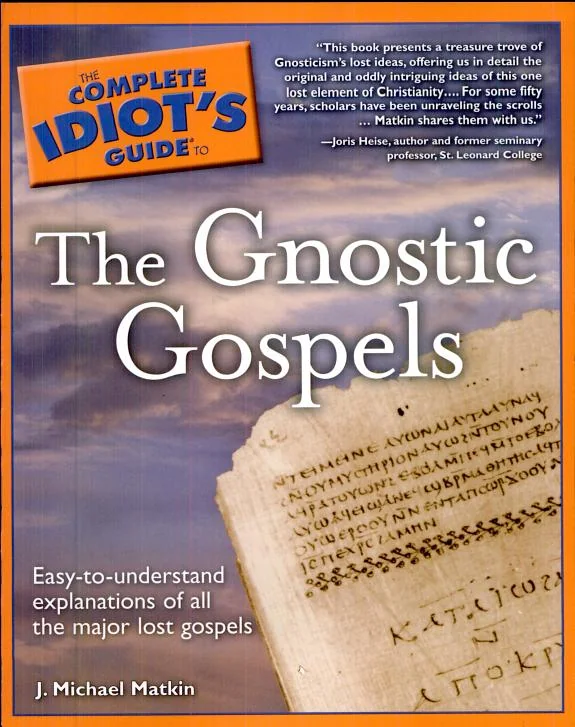
The Complete Idiot's Guide to the Gnostic Gospels
 80
80

The Complete Idiot's Guide to the Gnostic Gospels
Matkin's 'Complete Idiot's Guide' tackles the challenging subject of the Gnostic Gospels with commendable clarity. The book’s strength lies in its systematic breakdown of the Nag Hammadi library, offering a digestible overview of texts like the Gospel of Thomas and the Gospel of Philip. For readers unfamiliar with Gnosticism, it provides essential context, explaining core concepts like the Demiurge and the pursuit of Gnosis. However, the 'Idiot's Guide' format, while accessible, occasionally simplifies complex theological and philosophical debates to a degree that might frustrate more seasoned scholars. A particular passage discussing the interpretation of Sophia (Wisdom) in the Gospel of Mary Magdalene, while clear, glosses over some of the intricate debates regarding her role and relationship with the divine. Despite this, the work serves as a valuable, if introductory, portal to a fascinating and often misunderstood branch of early Christian thought, offering a solid foundation for further exploration.
📝 Description
80
J. Michael Matkin's 2003 guide provides a clear introduction to the Gnostic Gospels.
The Complete Idiot's Guide to the Gnostic Gospels, written by J. Michael Matkin, serves as a structured entry into the complex world of early Christian apocrypha and Gnostic thought. It draws on the significant cache of texts discovered at Nag Hammadi, Egypt, systematically unpacking the content and implications of these rediscovered documents. The book aims to illuminate the philosophical and religious environment from which these texts emerged and the unique perspectives they offer on nascent Christianity.
This guide is designed for the curious layperson who wants to understand Gnosticism and its scriptures without needing extensive academic background. It appeals to those interested in comparative religion, early Christian history, and alternative spiritual traditions. Readers who find traditional Christian narratives incomplete or wish to explore the diversity of early religious thought will find this an accessible starting point. The discovery of the Nag Hammadi library between 1945 and 1947 fundamentally altered scholarly understanding of early Christianity and Gnosticism. These Coptic texts, dating to the 4th century CE but representing earlier Greek originals, offered direct access to Gnostic teachings. Matkin's work places these discoveries within this post-discovery era, explaining their importance for understanding the pluralistic religious environment of the Roman Empire.
This book engages with Gnosticism, a set of religious ideas and systems of thought that emerged in the first few centuries CE. Gnosticism generally emphasizes spiritual knowledge, or 'gnosis,' as the key to salvation. It often posits a distinction between a supreme, unknowable God and a lesser creator deity responsible for the material world. The Gnostic Gospels, unlike the canonical New Testament, often present alternative narratives about Jesus and the nature of reality, highlighting a path to liberation through inner enlightenment rather than through faith or works alone. Matkin's guide makes these concepts accessible to a general audience.
💡 Why Read This Book?
• Gain a foundational understanding of Gnosticism, learning about core concepts like 'Gnosis' and the 'Demiurge' directly from explanations of the Nag Hammadi texts. • Explore alternative early Christian narratives, understanding how texts like the Gospel of Thomas offer different perspectives on Jesus' teachings and salvation. • Appreciate the historical significance of the Nag Hammadi discovery in 1945-1947, recognizing its impact on our knowledge of religious diversity in the Roman Empire.
⭐ Reader Reviews
Honest opinions from readers who have explored this book.
❓ Frequently Asked Questions
What is the significance of the Nag Hammadi discovery for understanding early Christianity?
The discovery of the Nag Hammadi library in 1945-1947 in Egypt provided direct access to Gnostic texts, previously known mostly through hostile accounts. This revealed the diversity of early Christian thought beyond the proto-orthodox canon.
Who was the Demiurge in Gnostic cosmology?
The Demiurge, often identified with the God of the Old Testament, is a lesser, ignorant creator deity in Gnostic systems. He fashioned the material world, which Gnostics viewed as flawed or a prison for the spirit.
What does 'Gnosis' mean in the context of the Gnostic Gospels?
Gnosis refers to a special, intuitive knowledge or direct spiritual insight. For Gnostics, achieving Gnosis was the key to liberation from the material world and union with the true, transcendent God.
How does the Gospel of Thomas differ from canonical Gospels?
The Gospel of Thomas is a collection of sayings attributed to Jesus, without narrative or crucifixion accounts. It emphasizes inner spiritual understanding and direct realization of the Kingdom of God within.
What is the role of Sophia in Gnostic traditions discussed?
Sophia, meaning 'Wisdom,' is often depicted as a divine emanation whose actions or fall led to the creation of the material world and the entrapment of spirit within it.
Is this book suitable for someone with no prior knowledge of Gnosticism?
Yes, 'The Complete Idiot's Guide to the Gnostic Gospels' is designed for beginners. It explains complex Gnostic ideas and historical context in an accessible manner, avoiding overly academic jargon.
🔮 Key Themes & Symbolism
The Nag Hammadi Library
This collection, unearthed in 1945-1947 near Nag Hammadi, Egypt, represents an important moment in understanding Gnosticism. Matkin's work systematically introduces key texts from this cache, such as the Gospel of Thomas, the Gospel of Philip, and the Apocryphon of John. These Coptic documents offer firsthand accounts of Gnostic beliefs, cosmologies, and interpretations of Christ's teachings, providing a stark contrast to the developing orthodox Christian canon and clear the diverse spiritual range of the early centuries CE.
Gnosis and Salvation
Central to Gnostic thought is the concept of 'Gnosis,' a form of intuitive, salvific knowledge. The book explains how Gnostics believed true salvation came not through faith or works alone, but through this inner knowing of one's divine origin and the nature of reality. This differed significantly from mainstream Christian doctrines, emphasizing personal spiritual realization and liberation from the material world, which was seen as an illusion or a prison.
The Divine Feminine
Several Gnostic texts highlight the importance of feminine divine principles, often personified by figures like Sophia (Wisdom) or Mary Magdalene. Matkin's guide explores how these figures function within Gnostic cosmology, sometimes as the source of creation (often through a fall or error) and sometimes as a key revealer of Gnosis. This perspective challenged patriarchal structures prevalent in both Roman society and the emerging Christian Church.
Dualism and the Demiurge
A core tenet explored is Gnostic dualism, contrasting a transcendent, unknowable True God with the flawed creator of the material universe, the Demiurge. The book clarifies that this Demiurge is often identified with the God of the Old Testament, who is depicted as ignorant of the higher, spiritual realm. This framework helps explain the Gnostic rejection of the material world and their search for escape.
💬 Memorable Quotes
Direct passages from the work, attributed to the author.
“The Gospel of Thomas presents a series of sayings attributed to Jesus, often without narrative context.”
— This highlights the Gospel of Thomas's focus on the direct transmission of wisdom and inner understanding, positioning it as a source for contemplative and esoteric interpretation rather than historical narrative.
“Orthodox Christians condemned Gnostic texts as heretical.”
— This points to the historical conflict and power struggles within early Christianity, where Gnostic ideas represented a significant alternative to the doctrines that would eventually become mainstream.
“The material world is seen as a prison created by an ignorant deity.”
— This captures the Gnostic worldview's fundamental pessimism regarding the physical realm and its perceived separation from the divine, fueling the quest for spiritual liberation.
“Sophia's fall is often linked to the creation of the material cosmos.”
— This interpretation emphasizes the role of divine emanations and the concept of cosmic error or imbalance as the origin of the flawed material reality Gnostics sought to escape.
“Gnosis is a direct, intuitive knowledge of the divine.”
— This defines the ultimate goal of Gnosticism, differentiating it from faith-based or ritualistic paths and underscoring its emphasis on personal, experiential spiritual awakening.
🌙 Esoteric Significance
Tradition
This work engages directly with the Gnostic tradition, a complex and diverse set of early Christian and Hellenistic philosophical movements. Gnosticism posits a radical distinction between a transcendent, unknowable God and the flawed creator of the material world. Matkin's guide situates these texts within that lineage, explaining how they offer alternative paths to salvation through direct spiritual knowledge, or Gnosis, diverging from the more salvation-history focused narratives of mainstream Christianity.
Symbolism
Key symbols include Sophia (Wisdom), often depicted as a divine being whose descent or error leads to the creation of the material world. The 'light' or 'spark' within the human being represents the divine fragment trapped in matter, seeking liberation. The concept of the 'Demiurge,' the lesser creator god, symbolizes ignorance and the limitations of the material realm, contrasting with the perfection of the true, transcendent God.
Modern Relevance
Contemporary esoteric thinkers and spiritual seekers often draw inspiration from Gnostic ideas. Movements exploring consciousness, the nature of reality, and critiques of societal structures find resonance in the Gnostic emphasis on inner knowing and liberation from perceived constraints. Modern interpretations of the divine feminine and explorations of alternative spiritualities frequently reference Gnostic themes and figures, reinterpreting them for contemporary contexts.
👥 Who Should Read This Book
• Students of comparative religion: Those seeking to understand the broad spectrum of early religious thought and the historical development of Christianity beyond its canonical texts. • Seekers of alternative spiritual paths: Individuals interested in esoteric traditions, Gnosticism, or spiritual philosophies that emphasize inner knowledge and liberation from material constraints. • History enthusiasts: Readers fascinated by ancient history, the discovery of lost texts, and the intellectual and religious milieu of the Roman Empire.
📜 Historical Context
The late antique period, particularly the 2nd and 3rd centuries CE, was a crucible of religious and philosophical experimentation. Christianity was solidifying its identity amidst a vast array of competing beliefs, including various Gnostic schools, mystery cults, and Hellenistic philosophies like Platonism and Stoicism. Gnosticism, with its emphasis on esoteric knowledge (Gnosis) and a dualistic worldview, presented a significant challenge to the emerging orthodox Christian consensus. The discovery of the Nag Hammadi library in 1945-1947 provided invaluable primary source material, allowing scholars to move beyond the polemics of Church Fathers like Irenaeus of Lyons (circa 180 CE) and directly engage with Gnostic writings. The reception of these texts has been ongoing, sparking renewed academic and popular interest in the diversity of early Christian expression and its philosophical underpinnings.
📔 Journal Prompts
The concept of Gnosis as presented in the Gospel of Thomas.
Sophia's role in the creation myths discussed.
The distinction between the Demiurge and the True God.
The significance of the Nag Hammadi discovery for understanding early Christian diversity.
Personal reflections on the material world as a potential 'prison'.
🗂️ Glossary
Gnosticism
A diverse set of religious and philosophical movements prominent in the early centuries CE, characterized by a belief in salvation through secret knowledge (Gnosis) and a dualistic worldview.
Nag Hammadi Library
A collection of thirteen Coptic Gnostic texts discovered in 1945 near Nag Hammadi, Egypt, offering primary source material for Gnostic beliefs and early Christian apocrypha.
Gnosis
Greek for 'knowledge,' referring in Gnosticism to a salvific, intuitive understanding of the divine and one's true spiritual nature, leading to liberation.
Demiurge
In Gnostic cosmology, a lesser, often ignorant creator deity responsible for fashioning the material world, distinct from the supreme, transcendent God.
Sophia
Greek for 'Wisdom,' a divine female emanation in Gnosticism, whose actions or fall are often associated with the creation of the material universe.
Apocrypha
Texts, usually religious, that are not part of an official canon but are considered by some to have value or authenticity. Gnostic gospels fall into this category.
Coptic
The final stage of the ancient Egyptian language, written using a modified Greek alphabet. Many Gnostic texts were translated into Coptic.
This book appears in 1 collection
🔮 Readers Also Liked
Browse all →







From the “Gnostic Gospels” Collection
View all →









More Free Sacred Texts & Gnosticism Books
View all →