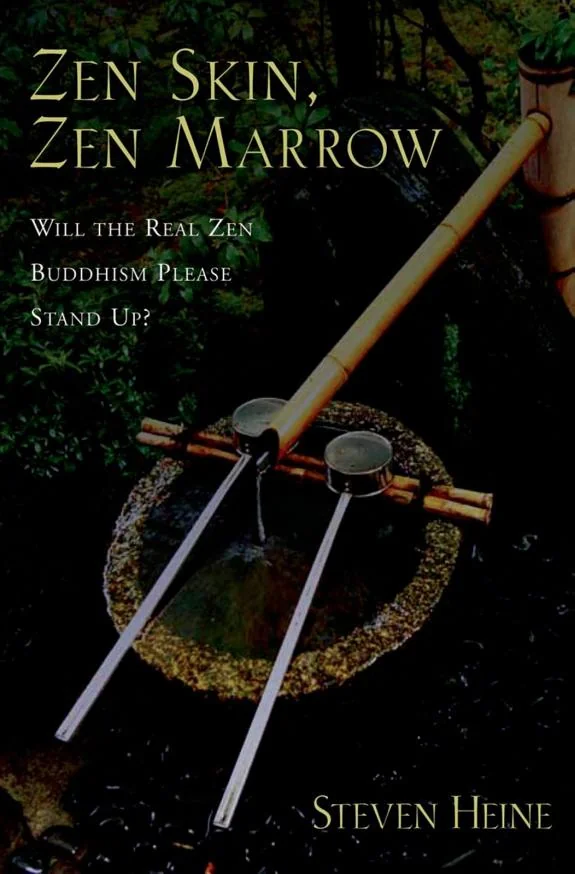
Zen Skin, Zen Marrow
 82
82

Zen Skin, Zen Marrow
Steven Heine’s Zen Skin, Zen Marrow offers a bracing corrective to the often saccharine Western understanding of Zen. He meticulously unpacks how a tradition emphasizing rigor and direct experience became associated with a vague, universally appealing spiritual balm. The section dissecting the reception of Zen in the post-World War II era, particularly its embrace by counter-culture figures and its academic champions, is especially sharp. While the book’s academic rigor is its greatest strength, occasionally the dense scholarly apparatus can feel overwhelming for a reader seeking a more accessible critique. Heine’s analysis of the scholarly camps, one romanticizing Zen and the other historicizing it, is a particularly cogent point of contention. This is essential reading for anyone who wishes to understand Zen beyond its popular mystique.
📝 Description
82
Steven Heine's 2007 book, Zen Skin, Zen Marrow, questions the Western romanticization of Zen Buddhism.
Zen Skin, Zen Marrow scrutinizes common Western views of Zen Buddhism, often presented as a simple, harmonious path. Steven Heine argues against the post-war notion of Zen as universally peaceful and holistic. The book examines how academic and popular understandings of Zen have shifted, contrasting these with its actual historical and cultural origins. It is aimed at students of Buddhism, religious studies scholars, and anyone tired of oversimplified ideas about Eastern spirituality. Readers will find a more complex picture of Zen practice and its historical development here, demanding careful attention.
The work delves into the gap between Zen as practiced in East Asia and the curated image often shown to Westerners. Heine points to cultural filters, academic shifts, and the search for spiritual alternatives as factors influencing how Zen is perceived, especially in the later 20th century. This book engages with discussions about Zen's introduction to the West, following figures like D.T. Suzuki, whose writings frequently stressed Zen's ineffable and unifying qualities.
This book engages with the Western reception of Zen Buddhism, a tradition often viewed through a mystical or contemplative lens. It specifically addresses how certain interpretations, particularly those popularized in the mid-20th century, shaped a particular image of Zen. By contrasting these popular views with historical realities, Heine places the book within a critical discourse on how Eastern spiritual traditions are understood and sometimes commodified in the West. It questions the 'spiritual but not religious' appeal that often simplifies complex practices.
💡 Why Read This Book?
• Learn how the romanticized "Zen" of post-war Western spirituality diverges from historical practice, as detailed in Heine's critique of mid-20th-century interpretations. • Understand the scholarly debate surrounding Zen's cultural transmission, specifically the clash between idealistic and critical academic viewpoints emerging in the late 20th century. • Gain a more nuanced perspective on the concept of "emptiness" (śūnyatā) as it has been presented and debated in Western Zen discourse, moving beyond superficial understandings.
⭐ Reader Reviews
Honest opinions from readers who have explored this book.
❓ Frequently Asked Questions
What is the primary argument of Steven Heine's Zen Skin, Zen Marrow?
The book argues that Western interpretations of Zen Buddhism have been overly romanticized and idealistic, diverging significantly from the historical and culturally specific practices of Zen in East Asia.
When was Zen Skin, Zen Marrow first published?
Zen Skin, Zen Marrow by Steven Heine was first published on December 31, 2007.
Who is D.T. Suzuki and why is he relevant to this book?
D.T. Suzuki was a key figure in introducing Zen to the West, often presenting it in a way that emphasized its ineffable and universally harmonious qualities, which Heine critically examines.
What does the book mean by 'clashing viewpoints' in Zen discourse?
Heine describes two opposing scholarly camps: one that perpetuates a romantic, idealistic view of Zen, and another that employs historical and cultural criticism to challenge this traditional perspective.
Does this book offer practical Zen meditation techniques?
No, Zen Skin, Zen Marrow is primarily an academic and critical examination of Zen's reception and interpretation, rather than a guide to practice.
What is the significance of the title 'Zen Skin, Zen Marrow'?
The title suggests a probing into the very essence of Zen, moving beyond superficial appearances ('skin') to its core principles and historical realities ('marrow').
🔮 Key Themes & Symbolism
Idealized vs. Historical Zen
This theme contrasts the popular, often romanticized image of Zen Buddhism in the West with its actual historical development and practice in East Asia. Heine scrutinizes how figures like D.T. Suzuki, and later popularizers, presented Zen as a path to universal harmony and effortless enlightenment, stripping it of its complex socio-cultural context and monastic rigor. The work argues that this idealized version, focusing on the 'skin' of Zen, obscures the deeper, more challenging realities of its 'marrow' – its historical challenges, doctrinal debates, and varied disciplinary practices.
Scholarly Discourse Wars
Heine meticulously documents the 'warring camps' within Zen scholarship. On one side are those who defend and perpetuate the romanticized view, often emphasizing Zen's unique experiential qualities and its potential for social transformation. On the other are scholars employing historical-critical methods, who seek to ground Zen in its specific cultural and textual lineages, revealing its human limitations and historical contingency. This theme explores the intellectual battles that shaped academic and popular understanding of Zen from the mid-20th century onwards.
Cultural Transmission and Reception
The book looks at the processes by which Zen was transmitted to and received by Western audiences. It examines how Zen was adopted and adapted by various groups, from academics and artists to counter-cultural movements, often as a spiritual antidote to Western materialism. Heine analyzes how elements of Zen were selectively emphasized or reinterpreted to fit Western spiritual needs and philosophical frameworks, leading to a significant divergence from its original context and intent.
Critique of Ineffability
A core concept challenged here is the notion of Zen's ineffability, often used to suggest a transcendent, incommunicable wisdom. Heine questions how this emphasis on the ineffable has been employed to shield Zen from critical analysis and to promote an aura of mystique. By examining specific doctrinal points and historical events, the work seeks to explain Zen, demonstrating that while it involves direct experience, its teachings and practices are amenable to rigorous scholarly investigation and historical contextualization.
💬 Memorable Quotes
Direct passages from the work, attributed to the author.
“The dominant discourse about this sect has been romantic, idealistic, and utopian.”
— This opening statement sets the critical tone, immediately challenging the prevalent, often unexamined, positive portrayals of Zen Buddhism in Western popular and academic circles.
“The essence of Zen has been described as ineffable, holistic, and promoting social harmony.”
— This highlights the idealized characteristics frequently attributed to Zen, which the book aims to deconstruct by contrasting them with historical realities and scholarly critiques.
“In recent years, however, some scholars have begun to examine Zen through the lenses of historical and cultural criticism.”
— This points to the emergence of a more critical academic approach to Zen, moving away from purely spiritual or philosophical interpretations towards a grounded, evidence-based understanding.
“These clashing viewpoints are now entrenched in two warring camps...”
— This metaphor vividly illustrates the deep divisions and ongoing debates within Zen studies between traditionalists/idealists and critical historians.
💡 Key Ideas
Editorial paraphrase of the work's core concepts — not direct quotes.
The author's intent is to explore the gap between how Zen is presented and how it actually functioned.
This paraphrased concept captures Heine's central objective: to bridge the understanding between superficial Western perceptions and the complex, historically situated reality of Zen Buddhism.
🌙 Esoteric Significance
Tradition
While Zen Buddhism is not typically categorized within Western esoteric traditions like Hermeticism or Kabbalah, its study by figures such as Carl Jung and its influence on Western psychology and spiritual seeking place it at a nexus of esoteric interest. This work fits within the broader 'esoteric' umbrella by deconstructing the 'spiritual' and 'mystical' claims often made about Zen, examining how these concepts were constructed and transmitted.
Symbolism
The 'skin' and 'marrow' in the title can be seen as symbolic. 'Skin' represents the external, often idealized or superficial understanding of Zen that Western seekers first encounter. 'Marrow' signifies the core, the essential reality, the historical substance, and the often rigorous practice that lies beneath the surface. This duality highlights the book's project of peeling back layers of interpretation to reach a more authentic understanding.
Modern Relevance
Contemporary thinkers and practitioners in fields ranging from critical religious studies to mindfulness continue to grapple with the legacy of idealized Zen. Heine's work remains relevant for its methodological approach, encouraging a critical distance from unexamined spiritual claims and promoting a historically grounded understanding of Eastern traditions. It informs discussions on cultural appropriation and the academic study of religion in a globalized world.
👥 Who Should Read This Book
• Students of comparative religion and Buddhist studies seeking to understand the historiographical debates surrounding Zen Buddhism. • Readers disillusioned with simplistic or overly romanticized portrayals of Eastern spirituality who desire a more critical and nuanced perspective. • Scholars and practitioners interested in the cultural transmission of religious ideas and the impact of Western interpretations on Eastern traditions.
📜 Historical Context
Published in 2007, Zen Skin, Zen Marrow arrived at a crucial juncture in the academic study of Buddhism. The post-war era, heavily influenced by figures like D.T. Suzuki, had largely embraced a romanticized, often decontextualized, vision of Zen. Suzuki's popularizations, beginning in the 1950s, emphasized Zen's perceived universality and its potential to offer spiritual alternatives to Western materialism, resonating with Beat Generation writers and counter-culture movements. However, by the late 20th century, a counter-movement of critical scholarship emerged, employing historical and cultural analysis to challenge these idealistic narratives. Scholars like Bernard Faure and, indeed, Steven Heine himself, began to foreground Zen's institutional history, its doctrinal complexities, and its engagement with local East Asian cultures, arguing against essentialist or purely experiential interpretations. Heine's work directly engaged with this scholarly debate, positioning itself as a crucial intervention in understanding the reception and academic study of Zen.
📔 Journal Prompts
The distinction between Zen's 'skin' and 'marrow' and its implications for your own understanding.
Critique the romanticized elements in Western portrayals of Zen, referencing specific examples from the book.
Analyze the historical context of Zen's reception in the West, particularly post-1950s.
Reflect on the 'warring camps' of Zen scholarship and how they shape contemporary discourse.
Consider the role of 'ineffability' in spiritual traditions and its potential for both insight and obfuscation.
🗂️ Glossary
D.T. Suzuki
A Japanese scholar and author who was instrumental in introducing Zen Buddhism to the Western world in the mid-20th century, often through popular and less academically rigorous accounts.
Historical Criticism
A scholarly approach that examines religious texts, practices, and traditions by situating them within their specific historical, cultural, and social contexts, often challenging essentialist or ahistorical interpretations.
Romantic Idealism
In the context of Zen, this refers to interpretations that emphasize its perceived universal appeal, ineffable qualities, and potential for effortless enlightenment, often detached from historical and cultural specificity.
Śūnyatā (Emptiness)
A central concept in Mahayana Buddhism, often translated as emptiness or voidness, referring to the lack of inherent existence or independent self-nature in all phenomena.
Beat Generation
A group of American writers, including Jack Kerouac and Allen Ginsberg, who rose to prominence in the 1950s and were known for their exploration of bohemian spirituality, jazz, and unconventional lifestyles, often influenced by Eastern philosophies like Zen.
Cultural Transmission
The process by which cultural elements, such as religious ideas, practices, and symbols, are passed from one society or group to another, often involving adaptation and reinterpretation.
Esoteric
Relating to or accessible only by a small number of people with a specialized knowledge or interest; often pertaining to mystical or spiritual traditions.