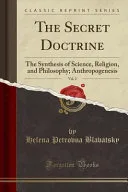
The Secret Doctrine, Vol. 2
 80
80

The Secret Doctrine, Vol. 2
Volume 2 of Blavatsky's *The Secret Doctrine* is not a casual read; it's a dense, ambitious attempt to reconcile ancient wisdom with nascent scientific understanding. The sheer breadth of cross-cultural mythology and scripture Blavatsky attempts to synthesize is staggering. Her assertion that modern science, ancient legends, and even the Bible, when 'read between the lines,' all corroborate the doctrine of evolution is a bold thesis. One particular strength lies in her detailed exploration of creation myths, presenting them not as disparate tales but as fragmented echoes of a single, profound origin narrative. However, the work's limitation is its own esoteric jargon and intricate cosmology, which can become overwhelming. For instance, the concept of the 'Seven Globes' and their sequential evolution requires significant reader effort to grasp. Despite its challenges, *The Secret Doctrine* remains a foundational text for those exploring the intersection of esoteric philosophy and cosmology.
📝 Description
80
Helena Petrovna Blavatsky's The Secret Doctrine, Volume 2, published in 1889, argues for a single, universal truth behind all religions and sciences.
The second volume of Blavatsky's The Secret Doctrine, titled 'Anthropogenesis,' was published in 1889. It attempts a synthesis of science, religion, and philosophy, focusing on the evolution of humanity. Blavatsky draws parallels between modern scientific evolutionary theories and ancient cosmogonies, proposing that a single, hidden doctrine informs all systems of belief and knowledge. The book examines creation myths and evolutionary accounts from various cultures, including Hindu scriptures, Greek philosophy, and biblical narratives. She suggests these diverse traditions point to a common, primordial source of wisdom.
This text is aimed at students of comparative mythology, ancient history, and esoteric philosophy. It will appeal to those interested in the origins of humanity, the development of consciousness, and the connection between physical and spiritual development. Readers seeking alternative frameworks to conventional scientific or religious explanations will find substantial material. Those interested in the foundational texts of Theosophy and its impact on subsequent spiritual movements will also find it of value.
The Secret Doctrine, Volume 2, emerged from the late 19th-century spiritualist and occult revival, a period when interest in Eastern religions and ancient wisdom traditions was growing. Blavatsky's work engaged directly with contemporary scientific thought, particularly Darwinian evolution. She sought to reconcile scientific findings with a spiritual worldview, positing a hidden history of human development guided by ancient, esoteric principles. This volume is a key text within Theosophy, aiming to reveal a lost spiritual science that predates all known historical religions.
💡 Why Read This Book?
• Learn about the Theosophical concept of 'Root Races' and their proposed evolutionary stages, offering a unique perspective on human origins beyond standard evolutionary biology, as detailed in the 'Anthropogenesis' section. • Understand Blavatsky's method of interpreting ancient texts, such as the 'Stanzas of Dzyan,' as keys to universal cosmogenesis, challenging conventional historical and religious scholarship. • Explore the concept of 'Dhyan Chohans,' celestial beings guiding cosmic evolution, providing an alternative to purely materialistic explanations for the universe's development and order.
⭐ Reader Reviews
Honest opinions from readers who have explored this book.
❓ Frequently Asked Questions
What is the primary focus of The Secret Doctrine, Vol. 2?
Volume 2, 'Anthropogenesis,' primarily focuses on the evolution of humanity and the cosmos. It synthesizes scientific theories with ancient religious and mythical accounts, proposing a universal origin doctrine.
When was The Secret Doctrine, Vol. 2 first published?
The Secret Doctrine, including Volume 2, was first published in 1889 by Helena Petrovna Blavatsky.
What are 'Root Races' as described in the book?
Root Races are sequential stages of human evolution proposed by Blavatsky. The book details seven Root Races, each with distinct physical and spiritual characteristics, appearing in different epochs and locations across the globe.
Does the book discuss modern scientific theories?
Yes, Blavatsky explicitly addresses and attempts to reconcile contemporary scientific theories, particularly Darwinian evolution, with her esoteric interpretations of ancient cosmogonies and religious texts.
Is The Secret Doctrine, Vol. 2 considered a religious text?
While it draws heavily on religious traditions, The Secret Doctrine is presented as a synthesis of science, religion, and philosophy, offering an esoteric framework rather than a dogma-based religious scripture.
What is the significance of the 'Stanzas of Dzyan' in this volume?
The 'Stanzas of Dzyan,' an ancient esoteric text Blavatsky claimed to have translated, serve as the foundational text for the cosmogonic and anthropogenetic narratives presented in the book.
🔮 Key Themes & Symbolism
Cosmic Evolution and Cyclic Time
The work posits a universe governed by cyclical processes, detailing vast periods of manifestation and dissolution known as Manvantaras and Pralayas. Blavatsky outlines the gradual unfolding of the cosmos from a primordial essence, moving through distinct planes of existence. This cyclical view contrasts with linear progression, suggesting that creation and destruction are integral parts of a continuous, grand cosmic rhythm. The book explores the role of cosmic intelligences, the Dhyan Chohans, in guiding this evolutionary process across immense timescales.
Anthropogenesis and the Root Races
This volume examines the origins and evolution of humanity, introducing the concept of Root Races. Blavatsky proposes that humanity has evolved through seven sequential Root Races, each representing a distinct stage of physical, mental, and spiritual development. The text details the characteristics and historical progression of these races, from the ethereal 'Spiritually-born' to the more physically manifest later races. This framework offers an esoteric perspective on human diversity and destiny, suggesting a pre-destined evolutionary path.
Synthesis of Science, Religion, and Philosophy
Blavatsky's central thesis is the existence of a singular, ancient 'Secret Doctrine' that underlies all world religions, mythologies, and philosophical systems. Volume 2 exemplifies this by drawing parallels between scientific theories of evolution (as understood in the late 19th century) and creation narratives from diverse cultures. The aim is to demonstrate a universal wisdom tradition that reconciles apparent contradictions between empirical observation and spiritual revelation, presenting a holistic worldview.
The Role of Esoteric Knowledge
The book argues that true understanding of cosmic and human origins is preserved in esoteric traditions, accessible only through allegorical interpretation and spiritual insight. Blavatsky presents the 'Stanzas of Dzyan' as an ancient source of this hidden knowledge. The work emphasizes that conventional scientific or historical methods are insufficient to grasp the deeper realities of existence, advocating for an intuitive and spiritual approach to unveiling universal truths.
💬 Memorable Quotes
Direct passages from the work, attributed to the author.
“Modern Science insists upon the doctrine of evolution; so do human reason and the Secret Doctrine.”
— This statement highlights Blavatsky's core argument: that the Secret Doctrine aligns with evolutionary principles, bridging the gap between ancient esoteric teachings and contemporary scientific thought.
“The flower develops from the bud, and the bud from its seed.”
— Used as an analogy for evolution, this natural progression illustrates the concept of development from a simpler, hidden origin to a complex manifest form, reflecting cosmic and human unfolding.
“Whence the latter, with all its predetermined programme of physical transformation?”
— This question probes the origin of the 'seed' or initial impulse for evolution, suggesting an inherent design or predetermined plan guiding the transformative process of life.
“The Bible itself, when it is read between the lines.”
— Blavatsky implies that religious texts like the Bible contain deeper, esoteric meanings related to evolution and cosmology, which are not apparent in literal interpretations but can be accessed through symbolic reading.
“Human reason and the Secret Doctrine... corroborate the idea of evolution.”
— This emphasizes Blavatsky's belief that rational inquiry and the ancient esoteric teachings are not in conflict but are complementary paths leading to the same understanding of universal laws.
🌙 Esoteric Significance
Tradition
The Secret Doctrine is a foundational text of the Theosophical tradition, which emerged in the late 19th century. It draws heavily from Hermeticism, Neoplatonism, Kabbalah, and Eastern philosophies (Hinduism and Buddhism), synthesizing them into a unique esoteric cosmology. Blavatsky claimed to be transmitting an ancient, universal doctrine, presenting Theosophy not as a new religion but as a revelation of primordial wisdom that predates all current traditions.
Symbolism
Key symbols include the Serpent eating its tail (Ouroboros), representing cyclic time, eternity, and the unity of creation. The Triangle, often seen in various configurations, symbolizes the Trinity or divine principles. The Lotus flower represents the unfolding of consciousness and the universe from primordial waters. Blavatsky extensively uses these and other symbols from global mythologies to convey complex cosmological and anthropological ideas allegorically.
Modern Relevance
Contemporary esoteric practitioners, spiritual seekers, and scholars of comparative religion continue to engage with Blavatsky's work. Theosophical societies worldwide still study and promote her teachings. Her concepts of cosmic evolution, consciousness development, and the interconnectedness of all things have influenced various New Age movements, modern occultism, and alternative philosophical thought. Thinkers exploring consciousness studies and integral philosophy often reference her synthesis of science and spirituality.
👥 Who Should Read This Book
• Students of comparative mythology and ancient religions seeking to understand Blavatsky's theory of a universal origin doctrine underlying diverse creation myths. • Aspiring Theosophists and followers of esoteric philosophy interested in the foundational texts that shaped 19th and 20th-century spiritual movements. • Researchers of late 19th-century intellectual history examining the dialogue between emerging scientific theories (like evolution) and alternative spiritual or philosophical frameworks.
📜 Historical Context
Emerging in 1889, *The Secret Doctrine* arrived amidst a late Victorian era grappling with Darwinian evolution and a burgeoning interest in global spiritual traditions. Helena Blavatsky positioned her work as a synthesis of science, religion, and philosophy, directly engaging with contemporary scientific discourse while challenging its purely materialistic interpretations. The Theosophical Society, which she co-founded, became a nexus for disseminating these ideas. Blavatsky's ambitious cosmology and anthropogenesis drew heavily on diverse mythologies and scriptures, aiming to reveal a universal, ancient wisdom. However, her work was met with significant skepticism from established scientific circles and theological authorities, who often viewed it as pseudoscientific or heretical. Contemporaries like Annie Besant championed her work, while critics like the SPR's Richard Hodgson questioned its authenticity, highlighting the controversial reception.
📔 Journal Prompts
The concept of 'Root Races' across different cosmic cycles.
Blavatsky's interpretation of the 'Stanzas of Dzyan' as a cosmogonic key.
The role of 'Dhyan Chohans' in guiding universal evolution.
Parallels drawn between scientific evolution and ancient myths.
The idea of a singular 'Secret Doctrine' underlying world religions.
🗂️ Glossary
Anthropogenesis
The study of the origin and development of humankind. In Blavatsky's work, it refers specifically to the esoteric and evolutionary history of humanity across vast cosmic cycles.
Dhyan Chohans
Cosmic intelligences or divine beings described by Blavatsky as guiding the process of evolution throughout the universe. They are seen as agents of the universal mind or Logos.
Manvantara
A Sanskrit term referring to a period of cosmic manifestation or a 'day of Brahma,' representing a vast cycle of existence between periods of cosmic dissolution (Pralaya).
Pralaya
A Sanskrit term signifying a period of cosmic dissolution or rest that occurs between cycles of manifestation (Manvantaras). It represents a state of dormancy before a new creative period begins.
Root Races
In Theosophy, these are sequential stages of human evolution, each characterized by distinct physical, mental, and spiritual attributes, appearing across different geological epochs and geographical locations.
Stanzas of Dzyan
An ancient esoteric text that Blavatsky claimed to have translated, forming the basis for the cosmogonical and anthropogenetic narratives presented in 'The Secret Doctrine'.
Seven Globes
A concept describing seven spheres or planes of existence through which a chain of worlds or a planetary evolution progresses, with humanity inhabiting specific stages on these globes.