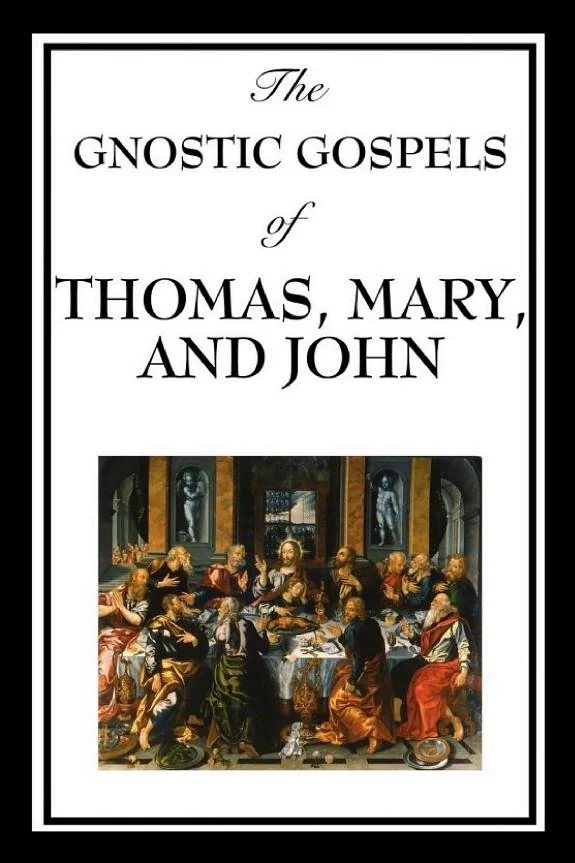
The Gnostic Gospels of Thomas, Mary & John
 76
76

The Gnostic Gospels of Thomas, Mary & John
Katherine John's compilation, The Gnostic Gospels of Thomas, Mary & John, offers a vital counterpoint to the New Testament canon, particularly in its portrayal of Jesus's inner circle. The Gospel of Thomas, with its collection of sayings, provides a stark, often aphoristic glimpse into a form of early Christianity that prioritized inner illumination over hierarchical structures. The Gospel of Mary Magdalene challenges traditional gender roles within the early church, presenting her as a significant spiritual leader and confidante. While the inclusion of John's Gospel in this specific compilation might be a point of confusion for some, as it is part of the canonical New Testament, its presence here likely serves to highlight Gnostic interpretations or connections that scholars have drawn to it. A notable strength is the direct presentation of the texts, allowing readers to engage with the material without excessive scholarly mediation. However, the book could benefit from more extensive annotation regarding the provenance and textual variations of each gospel, particularly for readers less familiar with Nag Hammadi library scholarship. The interpretation of Mary's role as a spiritual authority, as seen in her dialogue with Peter and Andrew, is a particularly compelling passage. This collection serves as an essential, albeit brief, introduction to the suppressed voices of early Christianity.
📝 Description
76
Katherine John's 2005 collection presents three early Christian texts not included in the New Testament canon.
This volume gathers the Gospel of Thomas, the Gospel of Mary, and the Gospel of John, three writings that offer a different view of Jesus's life and teachings. They come from early Christian groups whose ideas differed from the mainstream church as it developed. These texts were composed roughly between the 1st and 2nd centuries CE, a time when Christian thought was still forming and diverse.
They speak to those who want to look beyond the standard Bible accounts of Christianity. The writings are particularly interesting for understanding the role women played in early spiritual movements and for alternative ideas about God. They focus on achieving spiritual understanding through personal insight, a concept central to Gnosticism.
These texts belong to the Gnostic tradition, which flourished in the early centuries CE. Gnosticism emphasized direct, personal spiritual knowledge (gnosis) as the path to salvation. This contrasted with orthodox Christianity's focus on faith, sacraments, and church hierarchy. Gnostic writings often saw the material world as flawed or illusory and sought a transcendent reality. They frequently presented Jesus as a spiritual teacher imparting secret wisdom, not primarily as a savior through his death and resurrection.
💡 Why Read This Book?
• Gain direct access to the sayings attributed to Jesus in the Gospel of Thomas, offering a different lens on his teachings than the canonical Gospels, potentially revealing insights into early Christian mysticism. • Understand the significant role of Mary Magdalene as depicted in the Gospel of Mary, challenging patriarchal interpretations and highlighting the concept of the feminine divine within early esoteric thought. • Explore the concept of 'gnosis' or direct spiritual knowledge as presented in these texts, providing a comparative perspective on salvation and enlightenment beyond conventional theological frameworks, first articulated in the 2nd century CE.
⭐ Reader Reviews
Honest opinions from readers who have explored this book.
❓ Frequently Asked Questions
What is the primary difference between the Gnostic Gospels and the New Testament Gospels?
The Gnostic Gospels, like those of Thomas, Mary, and John presented here, often emphasize direct spiritual knowledge (gnosis) and present alternative cosmologies and interpretations of Jesus's teachings, differing significantly from the historical and theological narratives found in the canonical New Testament.
Who was Mary Magdalene according to these Gnostic texts?
In texts like the Gospel of Mary, she is portrayed as a prominent disciple, often more spiritually advanced than the male apostles, and a key interpreter of Jesus's esoteric teachings, suggesting a leadership role not recognized in the traditional New Testament accounts.
When were these Gnostic Gospels likely written?
The Gospel of Thomas is generally dated to the mid-2nd century CE, while the Gospel of Mary Magdalene is also believed to originate from the same period, reflecting the diverse theological landscape of early Christianity.
Why were these texts excluded from the Bible?
These texts were excluded primarily because their theological content, emphasizing esoteric knowledge and often presenting a dualistic worldview, did not align with the developing orthodox Christian doctrine and church hierarchy established by the 4th century.
What does 'Gnosticism' mean in the context of these Gospels?
Gnosticism refers to a diverse set of religious and philosophical movements in the early Christian era that stressed salvation through secret knowledge (gnosis). These Gospels reflect that emphasis on internal, spiritual understanding.
Where were texts like the Gospel of Thomas discovered?
The most famous discovery of the Gospel of Thomas was in 1945 at Nag Hammadi in Egypt, as part of a collection of early Christian and Gnostic texts, providing scholars with direct access to these suppressed writings.
🔮 Key Themes & Symbolism
Inner Knowledge (Gnosis)
Central to these texts is the concept of gnosis, or direct, intuitive spiritual knowledge. Unlike faith-based salvation, gnosis is an experiential understanding of the divine within oneself and the cosmos. The Gospel of Thomas, in particular, focuses on deciphering the hidden meaning of Jesus's sayings to unlock this inner awareness, positioning personal enlightenment as the ultimate goal, a stark contrast to the institutionalized salvation offered by developing orthodox Christianity.
The Feminine Divine
The Gospel of Mary Magdalene stands out for its portrayal of Mary Magdalene not merely as a follower but as a spiritual leader and confidante, privy to Jesus's deepest revelations. Her dialogues, especially her exchange with Peter, highlight a feminine principle within the divine and a recognition of her authority to interpret and transmit spiritual knowledge, challenging the patriarchal structures that would later dominate religious discourse.
Reinterpreting Jesus's Teachings
These Gospels present a Jesus whose message often diverges from or adds layers of meaning to the canonical accounts. The focus is less on his sacrificial death and resurrection as the sole path to salvation, and more on his role as a revealer of esoteric truths about the nature of reality and the human soul. His parables and sayings are often interpreted as allegories for psychological and spiritual transformation.
The Dualistic Worldview
Many Gnostic traditions, including those reflected in these texts, operate with a dualistic framework. This often involves a distinction between a transcendent, unknowable supreme God and a lesser creator deity (the Demiurge) responsible for the material world, which is seen as flawed or even a prison for the divine spark within humanity. Salvation comes from escaping this material illusion through gnosis.
💬 Memorable Quotes
Direct passages from the work, attributed to the author.
“Jesus said, 'Let him who seeks continue seeking until he finds. When he finds, he will be astonished; when he is astonished, he will rule over all. And when he has ruled, he will have rest.'”
— This saying from the Gospel of Thomas captures the Gnostic emphasis on active spiritual seeking and the ultimate reward of enlightenment. Astonishment signifies a profound awakening, leading to a state of inner authority and peace, detached from worldly concerns.
“Mary said, 'What is hidden from you I will proclaim to you.'”
— This statement from the Gospel of Mary signifies her perceived role as the bearer of secret or esoteric knowledge, entrusted to her by Jesus. It underscores the Gnostic belief that certain truths are not universally accessible but revealed to initiates.
“Peter said to Mary, 'Sister, we know that the Savior loved you more than the rest of women. Tell us the words of the Savior which you remember.'”
— This exchange highlights the special relationship between Jesus and Mary Magdalene as depicted in Gnostic texts. It also reveals the underlying tension and perhaps skepticism from male disciples regarding her spiritual authority and unique understanding.
“Jesus said, 'If they ask you, 'What is the sign of your Father in you?' say to them, 'It is movement and rest.'”
— This saying from Thomas suggests a dynamic, paradoxical nature to the divine presence within. It points to an immanent divinity that is both active (movement) and still (rest), a concept that requires inner contemplation to grasp.
💡 Key Ideas
Editorial paraphrase of the work's core concepts — not direct quotes.
Interpretation: The path to spiritual liberation involves recognizing the divine spark within oneself and transcending the limitations imposed by the material world and ignorance.
This paraphrased concept reflects the core Gnostic belief that salvation is achieved through self-knowledge and the realization of one's divine origin, rather than through external rituals or the mediation of an organized religious institution.
🌙 Esoteric Significance
Tradition
These texts are foundational to Gnosticism, a complex set of religious movements flourishing in the early centuries CE. Gnosticism sought salvation through esoteric knowledge (gnosis) and often presented a dualistic cosmology. These Gospels depart from orthodox Christianity by emphasizing the immanence of the divine within the individual and offering alternative interpretations of Jesus's mission, focusing on spiritual awakening rather than solely on historical events and sacraments.
Symbolism
The 'light' often symbolizes divine knowledge or the awakened spiritual consciousness, contrasted with the 'darkness' of ignorance. The 'kingdom of heaven' is frequently depicted not as an external place but as an inner state of being, accessible through gnosis. The figure of Mary Magdalene represents the receptive soul or the feminine principle of wisdom, crucial for understanding Jesus's esoteric teachings.
Modern Relevance
Contemporary esoteric traditions, including various schools of New Age spirituality, psychological approaches to mysticism, and comparative religious studies, frequently draw upon the Gnostic Gospels. Thinkers and practitioners interested in alternative spiritual paths, the role of women in religion, and the power of individual inner experience find resonance in these ancient texts for understanding consciousness and liberation.
👥 Who Should Read This Book
• Students of early Christianity and comparative religion seeking to understand the diversity of beliefs beyond the canonical scriptures. • Individuals interested in Gnosticism and esoteric traditions who wish to engage with primary source material on spiritual knowledge and the feminine divine. • Scholars and practitioners exploring alternative interpretations of Jesus's teachings and the nature of spiritual awakening.
📜 Historical Context
The Gnostic Gospels of Thomas, Mary & John emerge from the vibrant, often contentious, religious range of the 2nd century CE. This era witnessed a proliferation of interpretations of Jesus's life and teachings, with Gnosticism representing a significant intellectual and spiritual current. Gnostic thinkers, influenced by Hellenistic philosophy and Eastern mysticism, sought salvation through direct spiritual knowledge (gnosis). Their worldview often posited a radical distinction between the transcendent God and the flawed material world, challenging the emerging orthodox Christian narrative that was solidifying around figures like Irenaeus of Lyons. Irenaeus, in his work 'Against Heresies' around 170 CE, actively polemicized against Gnostic groups, contributing to their marginalization. The discovery of these texts at Nag Hammadi in 1945 provided direct evidence of Gnostic beliefs, countering earlier understandings based solely on refutations by their opponents.
📔 Journal Prompts
The 'astonishment' Jesus promises upon finding truth – what might this signify for your own spiritual journey?
Mary Magdalene's role as a revealer of hidden words: How does this challenge traditional spiritual authority structures?
Reflecting on the 'kingdom of heaven' as an inner state: What practices might cultivate this internal awareness?
The concept of 'gnosis' as direct knowledge: Where have you experienced moments of profound intuitive understanding?
Comparing Jesus's sayings in Thomas with canonical Gospels: What shifts in meaning emerge from these alternative interpretations?
🗂️ Glossary
Gnosis
A Greek term meaning 'knowledge,' particularly a direct, intuitive, and esoteric spiritual knowledge. In Gnosticism, gnosis is the key to salvation and liberation from the material world.
Demiurge
In Gnostic cosmology, the lesser, often ignorant or malevolent, creator deity responsible for the material universe, distinct from the true, transcendent Supreme God.
Canonical Gospels
The four Gospels (Matthew, Mark, Luke, John) recognized by the mainstream Christian Church as divinely inspired and authoritative scripture.
Nag Hammadi Library
A collection of early Christian and Gnostic texts discovered in Egypt in 1945, including the Gospel of Thomas and the Gospel of Mary, providing invaluable primary source material.
Pistis Sophia
A Gnostic text, often translated as 'Faith and Wisdom,' containing dialogues between Jesus and his disciples, particularly Mary Magdalene, after his resurrection.
Sophia
Greek for 'wisdom.' In Gnosticism, Sophia is often depicted as a divine emanation whose fall or error led to the creation of the material world and the Demiurge.
Aeons
In Gnostic cosmology, divine beings or emanations that exist in the spiritual realm (Pleroma) alongside the Supreme God.
This book appears in 1 collection
🔮 Readers Also Liked
Browse all →





From the “Gnostic Gospels” Collection
View all →








More Free Sacred Texts & Gnosticism Books
View all →