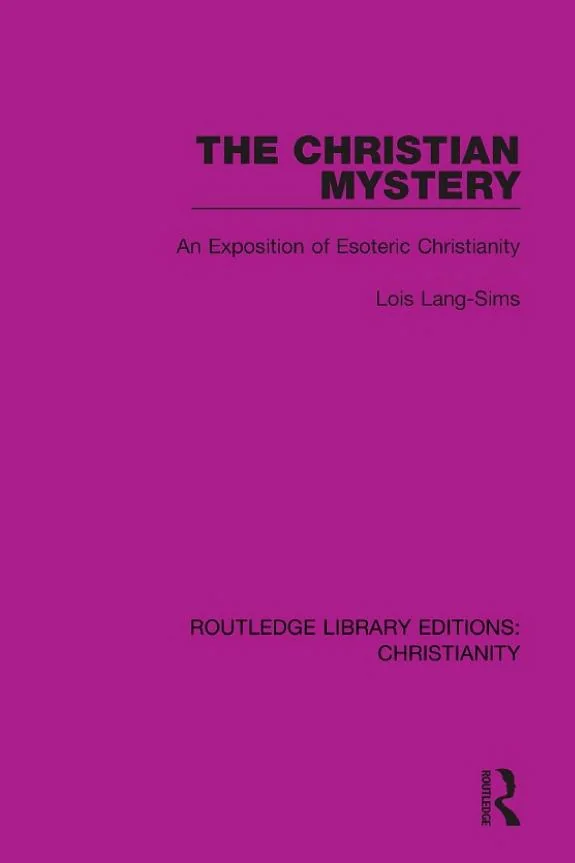
The Christian Mystery
 79
79

The Christian Mystery
Lois Lang-Sims’s The Christian Mystery offers a rigorous exploration of Christian theology through an esoteric lens, a perspective often sidelined in mainstream discourse. The book’s strength lies in its systematic deconstruction of dogma, revealing an underlying coherence that speaks to a hidden spiritual architecture. Lang-Sims’s analysis of how Jesus represents a 'Primal Tradition' is particularly compelling, suggesting a continuity of ancient wisdom far predating historical Christianity. However, the work's academic tone, while valuable for its precision, may present a barrier for readers seeking purely devotional material. A limitation is the text's relative scarcity of direct engagement with specific early Christian texts beyond general doctrine, leaving the reader wanting more textual evidence for the 'esoteric teachings known by the first Christians.' The passage examining the 'Invisible Whole' of doctrines, however, provides a potent framework for understanding faith as an integrated spiritual discipline. Ultimately, The Christian Mystery provides a scholarly yet reverent reassessment of Christian origins and meaning.
📝 Description
79
Lois Lang-Sims's 1980 book, The Christian Mystery, examines Christian doctrine as an interconnected spiritual system.
First published in 1980, The Christian Mystery by Lois Lang-Sims presents a scholarly yet devotional reading of Christian doctrine. Lang-Sims argues that the core tenets of Christianity, when understood together, form a cohesive spiritual system. She challenges common interpretations by suggesting a return to the esoteric knowledge that early Christians may have held. The book views Jesus not just as a historical figure but as the embodiment of an ancient spiritual Tradition that has developed over centuries.
This work is for readers interested in Christianity's deeper, less apparent dimensions. It will attract those who study comparative religion, especially the links between Christianity and other esoteric traditions. Students of mysticism, theology, and ancient thought will find Lang-Sims's analytical approach useful. The book also speaks to individuals who feel contemporary religious practice has strayed from the foundational spiritual energies and teachings of its origins.
The Christian Mystery appeared in 1980 during a time of growing interest in esoteric thought and comparative spirituality, influenced by movements like Theosophy and the academic study of Gnosticism. Lang-Sims engaged with theological discussions by proposing an esoteric interpretation of established doctrines, a viewpoint that differed from the dominant modernist theological trends of the era. Her work focused on the internal coherence of the faith as an esoteric system, aligning with contemporary scholars who were examining similar historical and Gnostic aspects of early Christianity.
💡 Why Read This Book?
• Gain a new framework for understanding Christian doctrines as interconnected elements of a unified spiritual system, as detailed in the concept of the 'Invisible Whole.' • Explore the argument for Jesus as the embodiment of a 'Primal Tradition,' offering a lineage of esoteric knowledge that challenges conventional historical narratives. • Understand the historical development of Christian teachings and how the work suggests a return to the original 'Mysteries of the Faith' known by early adherents.
⭐ Reader Reviews
Honest opinions from readers who have explored this book.
❓ Frequently Asked Questions
When was Lois Lang-Sims's 'The Christian Mystery' first published?
Lois Lang-Sims's 'The Christian Mystery' was first published on December 17, 2020, with its original publication date being in 1980.
What is the central thesis of 'The Christian Mystery'?
The book's central thesis is that Christian doctrines, when examined closely, form an interconnected 'invisible whole' and that the faith originated from an esoteric tradition known by early Christians.
Who would benefit from reading 'The Christian Mystery'?
Readers interested in esoteric Christianity, comparative religion, mysticism, and theological studies who seek a deeper understanding of the faith's origins and hidden meanings will find this book beneficial.
Does the book argue for a specific esoteric lineage?
Yes, the book argues that Christianity developed from a 'Primal Tradition,' suggesting a lineage of esoteric teachings that Jesus represented and which has evolved over time.
What does the book propose regarding contemporary churches?
The book suggests that churches should re-engage with the esoteric teachings and spiritual understanding that were purportedly central to early Christianity.
What is the significance of the 'Mysteries of the Faith' in Lang-Sims's work?
Lang-Sims re-examines the 'Mysteries of the Faith' not as mere metaphors, but as pointers to direct spiritual experiences and esoteric knowledge accessible to early Christians.
🔮 Key Themes & Symbolism
The Invisible Whole
This theme posits that Christian doctrines are not isolated beliefs but integral parts of a unified esoteric understanding. Lang-Sims argues that the seemingly disparate elements of Christian theology—from the Incarnation to the Resurrection—collectively form a cohesive spiritual architecture. This 'invisible whole' suggests a divinely ordered system intended for deeper comprehension beyond literal interpretation. Understanding this interconnectedness is presented as key to unlocking the true spiritual potential inherent in the faith, moving beyond surface-level adherence to a profound, integrated experience of divine truth.
Primal Tradition
Lang-Sims proposes the existence of a 'Primal Tradition,' an ancient stream of spiritual wisdom that predates historical Christianity. Jesus is presented as the ultimate representative of this Tradition, embodying and transmitting its core principles. The book traces the lineage of this esoteric knowledge, suggesting that early Christianity was a direct manifestation of this ancient stream. It implies that this Tradition continues to exist, albeit often obscured, and that its rediscovery is crucial for a more authentic spiritual practice.
Esoteric Teachings
The core of the book lies in its focus on the 'esoteric teachings known by the first Christians.' Lang-Sims contends that these original teachings, focused on direct spiritual experience and hidden meanings, have been largely lost or diluted in mainstream Christianity. The work advocates for a return to these deeper layers of understanding, suggesting they hold the key to the faith's original power and efficacy. This involves re-examining doctrines not just for their historical or ethical implications, but for their esoteric significance.
Evolution of Doctrine
Lang-Sims examines how Christian doctrines have evolved from their esoteric origins. The book implies a divergence from the original spiritual intent as Christianity developed institutionally and historically. This evolution, according to Lang-Sims, led to a more exoteric or literal interpretation, obscuring the profound spiritual truths that were once accessible. The work encourages a critical look at this historical development, prompting readers to consider what may have been lost and how it might be reclaimed for contemporary spiritual life.
💬 Memorable Quotes
Direct passages from the work, attributed to the author.
“The doctrines of Christianity constitute an invisible whole.”
— This statement expresses the book's central thesis: that Christian beliefs are not isolated points but interconnected elements of a larger, hidden spiritual system, best understood through an esoteric framework.
“Churches should turn back to the esoteric teachings.”
— This is a call to action for contemporary religious institutions, urging them to rediscover and reincorporate the deeper, often hidden, spiritual knowledge and practices of early Christianity.
“The Mysteries of the Faith require a new approach.”
— Lang-Sims advocates for moving beyond conventional, literal interpretations of Christian mysteries towards an understanding that acknowledges their esoteric dimensions and potential for direct spiritual experience.
“Christianity has developed the primal Tradition.”
— This highlights the book's view of Christianity as a continuation and expression of an even older spiritual lineage, emphasizing its esoteric roots and historical development within that context.
💡 Key Ideas
Editorial paraphrase of the work's core concepts — not direct quotes.
Jesus was the Representative of the primal Tradition.
This suggests that Jesus embodied an ancient, continuous stream of spiritual wisdom that predates historical Christianity, positioning him as a key figure in transmitting this lineage of esoteric knowledge.
🌙 Esoteric Significance
Tradition
The Christian Mystery aligns with the Hermetic and Gnostic traditions within Western esotericism, proposing that Christianity itself is a continuation and expression of a 'Primal Tradition.' Lang-Sims departs from purely historical or dogmatic interpretations to reveal the inherent esoteric structure within Christian doctrines. The work fits within the broader lineage of Christian mysticism and esoteric commentary, seeking to uncover the hidden spiritual teachings that informed the faith's earliest adherents, presenting Jesus as a central figure in this ancient, ongoing spiritual lineage.
Symbolism
The book implicitly engages with Christian symbolism by reinterpreting established doctrines. For instance, the concept of the 'Invisible Whole' can be seen as a symbolic representation of divine unity and interconnectedness underlying all creation. The figure of Jesus as the 'Representative of the primal Tradition' symbolizes the embodiment of ancient wisdom and spiritual authority. The 'Mysteries of the Faith' themselves function as symbolic gateways, pointing towards deeper spiritual realities and experiences that transcend ordinary comprehension.
Modern Relevance
Lang-Sims's work speaks to contemporary movements in esoteric Christianity, Christian mysticism, and comparative spirituality. Thinkers and practitioners interested in recovering the Gnostic or Hermetic roots of Christianity, or those exploring the integration of faith with esoteric philosophy, find value in her approach. The emphasis on understanding doctrine as an 'Invisible Whole' speaks to modern desires for holistic spiritual frameworks and a move beyond fragmented or literalistic religious understanding, connecting with contemporary spiritual seekers.
👥 Who Should Read This Book
• Students of comparative religion and esoteric traditions seeking to understand the potential esoteric dimensions of Christianity beyond conventional interpretations. • Theological scholars interested in alternative hermeneutics and the historical development of Christian doctrines from a less exoteric perspective. • Individuals drawn to Christian mysticism and spiritual inquiry who wish to explore the 'Mysteries of the Faith' as pointers to direct experience and hidden wisdom.
📜 Historical Context
Published originally in 1980, Lois Lang-Sims’s The Christian Mystery emerged during a period when interest in esoteric Christianity and comparative spirituality was gaining traction, partly fueled by the legacy of Theosophy and the academic exploration of Gnosticism and early Christian mysticism. Lang-Sims’s work offered a unique contribution by applying an esoteric hermeneutic to core Christian doctrines, aiming to reveal an underlying coherence often missed by literalist or purely historical theological approaches. This contrasted with the dominant modernist theological trends of the era, which often prioritized historical-critical methods over metaphysical interpretations. While scholars like Elaine Pagels were investigating the historical context of early Christian groups and their diverse beliefs, Lang-Sims focused on presenting Christianity itself as an esoteric system. The book’s reappearance in 2020 speaks to a sustained, perhaps resurgent, interest in these less conventional theological perspectives within contemporary spiritual and intellectual circles.
📔 Journal Prompts
The concept of the 'Invisible Whole' in Christian doctrine: how does this framework alter your perception of specific dogmas?
Reflection on the 'Primal Tradition': What connections can you draw between this idea and other ancient wisdom streams you are familiar with?
The esoteric teachings known by the first Christians: What might these have entailed beyond literal scriptural understanding?
Lois Lang-Sims suggests churches should return to esoteric teachings. What practical forms might this return take in a modern context?
Consider the 'Mysteries of the Faith' not as historical events but as symbolic gateways. What deeper truths might they represent?
🗂️ Glossary
Invisible Whole
A concept suggesting that Christian doctrines are not isolated beliefs but form an interconnected, unified spiritual system, best understood through an esoteric lens.
Primal Tradition
An ancient, continuous stream of spiritual wisdom, believed by Lang-Sims to predate historical Christianity, which Jesus is presented as representing and embodying.
Esoteric Teachings
Hidden or inner spiritual knowledge and practices, purportedly known by early Christians, that offer deeper understanding beyond literal or exoteric interpretations.
Mysteries of the Faith
Core tenets and doctrines of Christianity, re-examined by Lang-Sims not merely as historical or theological points, but as symbolic pointers to direct spiritual experience and hidden truths.
Representative
In the context of the book, this refers to Jesus's role as the ultimate embodiment and transmitter of the 'Primal Tradition' and its esoteric wisdom.
Evolution of Doctrine
The historical process by which Christian teachings have developed and potentially shifted from their original esoteric foundations towards more literal or exoteric forms.
Comparative Religion
The academic study of different world religions, often exploring their similarities, differences, and shared underlying principles, a field relevant to Lang-Sims's approach.
This book appears in 1 collection
🔮 Readers Also Liked
Browse all →






From the “Esoteric Christianity” Collection
View all →


More Free Sacred Texts & Gnosticism Books
View all →