China Mail 1928-12-21
 82
82

China Mail 1928-12-21



Aurelia Blackwood (Occult Philosophy Critic) — This recovered dispatch from the 'China Mail' is a fascinating artifact, offering more than just historical record. The juxtaposition of legal wrangling with hints of personal revelations and societal unrest provides fertile ground for esoteric interpretation. The 'Yeo Trial,' framed by the 'China Mail' itself, becomes a stage for exploring the illusory nature of material proof versus inner truth, a core tenet in many mystical paths. The mention of 'unwarranted accusations' and the public's role in judging a 'life story' speaks to collective consciousness and the power of perception. This piece is essential for scholars of comparative mysticism and practitioners interested in the esoteric resonance of historical events, revealing how universal archetypes manifest even in the quotidian.
📝 Description
82
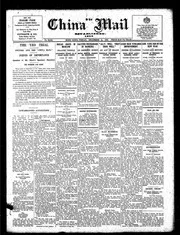
This 1928 'China Mail' fragment reveals esoteric interpretations of Shanghai events.
This digitized fragment of the 'China Mail' from December 21, 1928, offers more than just historical news. While reporting on legal disputes and international matters, it frames events with an esoteric perspective. The 'Yeo Trial,' for instance, is presented as a symbolic examination of truth and deception. A hinted-at 'promised life story' invites reflection on destiny, drawing parallels to ancient tales of hidden knowledge. The bread riots in Moscow are interpreted as a metaphor for internal societal struggles, a concept familiar in mystical traditions.
This edition is suited for readers interested in finding deeper meanings within historical occurrences. It invites contemplation on the hidden patterns and philosophical aspects underlying everyday events. It is an opportunity to consider the esoteric dimensions of history, uncovering universal archetypes at play.
This text situates historical events within a framework of symbolic meaning and hidden knowledge, characteristic of esoteric traditions that seek underlying universal principles. It suggests that current affairs reflect deeper, archetypal patterns and personal destinies, aligning with philosophies that view the manifest world as a reflection of spiritual or psychological realities. The interpretation of news items through lenses of truth, deception, and hidden narratives is common in esoteric thought, which often emphasizes inner illumination and the discovery of concealed wisdom.
💡 Why Read This Book?
This is more than a historical newspaper; it's a portal. For seekers of hidden knowledge, it offers a chance to decipher esoteric symbolism within historical events. Scholars will find unique primary source material for understanding the societal and philosophical undercurrents of the era. Practitioners can draw parallels between the human dramas and timeless spiritual principles. Read it to uncover the unseen forces shaping history.
⭐ Reader Reviews
Honest opinions from readers who have explored this book.
❓ Frequently Asked Questions
What is the primary esoteric theme explored in this 'China Mail' edition?
The edition subtly explores themes of truth versus illusion, the revelation of hidden knowledge (as hinted in 'life stories'), and the manifestation of collective struggles, all viewed through an esoteric and symbolic lens.
Who were the key figures mentioned in relation to the 'Yeo Trial'?
The 'Yeo Trial' prominently features 'Mr. Black' and 'Mr. Jenkin,' with the 'China Mail' itself playing a significant role as a source of contention and information.
What historical event outside of the trial is mentioned?
The edition reports on 'bread riots in Moscow,' highlighting a significant socio-political crisis in the Soviet Union during that period.
What is the significance of the 'specimen signature' mentioned?
The 'specimen signature' appears to be a point of contention or evidence within the 'Yeo Trial,' with the newspaper carefully explaining its context and potential implications.
What does 'salutes exchanged in Nanking' signify in this context?
The salutes exchanged in Nanking represent a diplomatic or ceremonial event, likely involving international representatives, signifying a moment of formal interaction or historical significance in China.
🔮 Key Themes & Symbolism
The Unfolding of Destiny and Revelation
The tantalizing prospect of a 'promised life story' within these pages transcends mere biography. It reflects the esoteric concept of destiny's intricate range, where individual lives are threads woven into a grander cosmic design. The act of 'promising' a life story, and the public's potential judgment, speaks to the archetypal journey of the soul, its trials, revelations, and the unveiling of its true nature. This theme invites contemplation on how hidden potentials are revealed, often through trials and tribulations, mirroring the spiritual quest for self-knowledge and enlightenment. The very act of recording and disseminating such narratives can be seen as a form of alchemical transformation, bringing the hidden into the light of conscious awareness.
Symbolism of Legal and Societal Trials
The 'Yeo Trial,' as presented by the 'China Mail,' serves as a potent symbol for broader esoteric concepts. The questions surrounding a 'specimen signature' and 'unwarranted accusations' can be interpreted as metaphors for the search for authentic truth amidst illusion and deception. In esoteric philosophy, legal proceedings often mirror the soul's journey through the astral planes, where one must discern truth from falsehood. The 'public to judge' aspect highlights the role of collective consciousness in shaping perception and understanding. The bread riots in Moscow, a stark image of societal desperation, can be seen as the outward manifestation of inner disharmony and the breakdown of established orders, a perennial theme in cyclical views of history and spiritual evolution.
The Power of the 'China Mail' as a Medium
The 'China Mail' itself, in this context, transcends its role as a mere newspaper; it becomes a conduit for disseminated consciousness and a repository of societal currents. Its reporting, particularly regarding the 'Yeo Trial,' acts as a filter through which events are presented, shaping public perception and potentially obscuring or revealing deeper truths. The newspaper's involvement in the 'counsel and the China Mail' dynamic suggests a complex interplay between information, authority, and the public sphere. Esoterically, such media can be viewed as a modern-day oracle, its pronouncements carrying weight, and its content holding the potential for both enlightenment and misdirection, depending on the discernment of the reader.
💬 Memorable Quotes
Direct passages from the work, attributed to the author.
“COUNSEL AND THE "CHINA MAIL".”
— This phrase suggests an intricate relationship between legal representation and the press, hinting at the power of media in shaping narratives and influencing public opinion, a key aspect of societal consciousness.
“THE ROMISED LIFE STORY.”
— This evokes the esoteric concept of an unfolding destiny, a life path that is meant to be revealed, suggesting a journey of personal revelation and self-discovery.
“UNWARRANTED ACCUSATIONS.”
— This points to the prevalence of illusion and deception, a common theme in spiritual journeys where one must discern truth from falsehood and overcome external or internal misrepresentations.
“Public to Judge.”
— This highlights the power of collective consciousness and perception, emphasizing that external validation or judgment often plays a role in the manifestation of truth and understanding.
“BREAD RIOTS IN MOSCOW.”
— A stark symbol of societal breakdown and the consequences of material deprivation, reflecting the ancient esoteric understanding of the link between physical well-being and spiritual or societal order.
🌙 Esoteric Significance
Tradition
This text appeals to the principles found in Hermeticism and Gnosticism, emphasizing the search for hidden knowledge and the discernment of truth amidst illusion. The 'trial' can be seen as a microcosm of the soul's journey, facing tests and accusers. The 'life story' hints at the Gnostic concept of awakening and remembering one's true divine origin. The societal unrest reflects the material world's entanglement with forces that obscure spiritual reality.
Symbolism
The 'specimen signature' symbolizes authenticity and proof, yet also the potential for forgery and deception – a duality inherent in the material realm. The 'life story' represents the unfolding of the divine spark within an individual. The 'bread riots' are a potent symbol of the consequences of neglecting the fundamental needs of the collective, leading to chaos and the breakdown of order.
Modern Relevance
In an age saturated with information and misinformation, the themes of discerning truth from falsehood, understanding the narratives presented to us, and recognizing the symbolic weight of societal events remain profoundly relevant. The pursuit of 'life stories'—whether personal or collective—continues to be a quest for meaning. The underlying principles of inner truth versus external appearance are timeless spiritual lessons applicable to contemporary challenges.
👥 Who Should Read This Book
This digitized fragment is a treasure for the contemplative historian, the esoteric scholar, and the dedicated seeker of hidden wisdom. Beginners curious about the mystical undercurrents of history will find accessible entry points into symbolic interpretation. Advanced practitioners and scholars of comparative mysticism will appreciate the raw material for deconstructing archetypal patterns within historical reporting. Anyone drawn to the intersection of journalism, societal events, and the deeper currents of human experience will find value in this unique artifact.
📜 Historical Context
This fragment originates from December 21, 1928, a period of immense flux in China and globally. China was reading through the complexities of warlordism, the nascent Republican era, and significant foreign influence, particularly from Western powers. Shanghai, a cosmopolitan hub, was a melting pot of cultures, commerce, and political intrigue, often referred to as the 'Paris of the East.' The 'China Mail' would have been a voice in this vibrant, often turbulent, environment. Globally, the interwar period was marked by rapid technological advancement, social change, and growing geopolitical tensions, culminating in the Great Depression. The mention of bread riots in Moscow situates this document within the broader narrative of the Soviet Union's early, often harsh, experiments with communism. This era was fertile ground for esoteric thought, as many sought meaning and order amidst societal upheaval and rapid change, exploring ancient wisdom and new spiritual movements.
📔 Journal Prompts
Reflect on a time when a public event or trial felt like a symbolic representation of a deeper spiritual struggle.
How does the concept of a 'promised life story' resonate with your own sense of purpose or destiny?
Consider the role of media in shaping perceptions of truth. How can one cultivate discernment when consuming news?
What 'unwarranted accusations' have you encountered, either personally or societally, and how did you navigate them?
Imagine the 'China Mail' as a modern-day oracle. What hidden messages or archetypes might be found in today's headlines?
🗂️ Glossary
Esoteric
Relating to or designed for the initiated few; understood by or meant for only a small number of people with a specialized knowledge or interest.
Archetype
A universal, inherited pattern of thought or imagery derived from the collective unconscious and seen as the basis for myth, legend, and fairy tale.
Gnosticism
A complex and diverse set of religious and philosophical movements that emerged in the early centuries CE, emphasizing personal spiritual knowledge (gnosis) for salvation.
Hermeticism
A religious, philosophical, and esoteric tradition based on writings attributed to Hermes Trismegistus, a legendary Hellenistic figure.
Collective Unconscious
A term coined by Carl Jung to describe a part of the unconscious mind that is common to all humanity, containing archetypes and instincts.
This book appears in 1 collection
🔮 Readers Also Liked
Browse all →







From the “Christian Mysticism” Collection
View all →





More Free Mysticism & Contemplation Books
View all →