Denys Turner - The Darkness Of God Negativity In Christian Mysticism
 83
83

Denys Turner - The Darkness Of God Negativity In Christian Mysticism



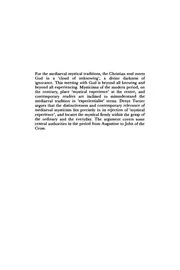
Denys Turner's 'The Darkness Of God: Negativity in Christian Mysticism' is a seminal work for anyone seeking to understand the esoteric depths of Christian mysticism. Turner masterfully navigates the complexities of medieval mystical thought, providing a clear and compelling argument for the relevance of this tradition in today's world. The book is particularly valuable for modern esoteric seekers who may be inclined to view mysticism through an experiential lens. Turner's exploration of the 'cloud of unknowing' and the concept of divine darkness offers a refreshing counterpoint to contemporary notions of spiritual experience. By emphasizing the negativity and unknowing that characterize the medieval mystical encounter, Turner invites readers to reconsider their own spiritual journeys and the role of ignorance in faith. This book is a must-read for those interested in the intersection of theology, mysticism, and esoteric traditions.
📝 Description
83
Denys Turner's 'The Darkness of God' examines the medieval Christian concept of divine unknowability.
Denys Turner's 'The Darkness of God' investigates the concept of divine negativity within Christian mysticism. The book focuses on how medieval mystics understood God not through positive attributes but through absence and unknowing. Turner contrasts this with modern mystical traditions that often prioritize direct personal experience. He highlights the medieval emphasis on apophaticism, the practice of speaking about God by negation, which acknowledges the divine's transcendence beyond human comprehension.
The work revisits the 'cloud of unknowing' and similar ideas, showing how these were central to the spiritual life of the period. Turner argues that this tradition's focus on the ineffable nature of the divine offers a different path to spiritual understanding. It is not about achieving a clear vision of God but about recognizing the limits of human knowledge in the face of the divine mystery. The book calls for an acceptance of this hiddenness as a core aspect of contemplative practice.
This book sits within the esoteric tradition by examining mystical theology, specifically the apophatic path in medieval Christianity. This approach, which defines the divine by what it is not, runs counter to more exoteric or cataphatic methods that rely on positive descriptions and direct experiential claims. The focus on negation and unknowing aligns with mystical traditions across various religions that acknowledge a reality beyond ordinary perception and conceptualization. Turner's work thus interfaces with a long history of contemplative practices that seek union with the divine through detachment from empirical and rational understanding.
💡 Why Read This Book?
Reading 'The Darkness Of God' today offers a unique opportunity to explore the esoteric dimensions of Christian mysticism. In an age where spiritual experiences are often prioritized, Turner's work provides a counter-narrative that emphasizes the value of unknowing and negation. Readers will gain a deeper understanding of medieval mystical traditions and their relevance to contemporary spirituality. This book is essential for those seeking to enrich their spiritual practices with the wisdom of the past.
⭐ Reader Reviews
Honest opinions from readers who have explored this book.
❓ Frequently Asked Questions
What is the main theme of 'The Darkness Of God'?
The main theme of the book is the exploration of the 'cloud of unknowing' and divine darkness in medieval Christian mysticism. Turner argues that this tradition challenges contemporary experientialist interpretations of mysticism.
Who should read this book?
This book is ideal for readers interested in Christian mysticism, esoteric traditions, and the historical development of spiritual thought. It is particularly valuable for those seeking to deepen their understanding of medieval mystical practices.
How does this book differ from other works on Christian mysticism?
Unlike many modern works that focus on 'mystical experience,' 'The Darkness Of God' emphasizes the concept of divine ignorance and negation, offering a unique perspective on the mystical encounter with God.
🔮 Key Themes & Symbolism
Apophaticism
Apophaticism is the theological approach that emphasizes what God is not, rather than what God is. In 'The Darkness of God,' Turner explores how this tradition views God as unknowable and ineffable, encountered in a 'cloud of unknowing.' This theme is central to understanding the mystical dimensions of Christianity and invites readers to embrace the mystery and unknowability of the divine.
Divine Darkness
The concept of divine darkness is a profound mystical symbol representing the unknowable and ineffable nature of God. In medieval Christian mysticism, this darkness is encountered in a 'cloud of unknowing,' where the soul meets God in a state of ignorance and unknowing. This theme challenges modern perceptions of mysticism and invites a deeper, more contemplative approach to understanding the divine.
Contemplative Mysticism
Contemplative mysticism is a practice that emphasizes inner reflection and the cultivation of a deep, personal relationship with the divine. In 'The Darkness of God,' Turner reveals how this tradition views the mystical experience as a journey into the unknown and the hidden, inviting readers to embrace the mystery and unknowability of God. This theme is central to understanding the esoteric dimensions of Christian mysticism.
💬 Memorable Quotes
Direct passages from the work, attributed to the author.
“Medieval mysticism emphasizes the unknowable and ineffable nature of the divine.”
— Turner contrasts this with modern experientialist tendencies, inviting a deeper contemplative approach.
“Embrace the mystery and unknowability of God.”
— Turner's work invites readers to a contemplative journey into the heart of Christian mysticism.
💡 Key Ideas
Editorial paraphrase of the work's core concepts — not direct quotes.
The soul meets God in a 'cloud of unknowing,' where the divine resides in darkness and ignorance.
This quote highlights the apophatic tradition, where God is encountered beyond all knowing and experiencing.
The mystical journey is a path into the unknown and the hidden.
This quote underscores the esoteric dimensions of Christian mysticism, challenging modern perceptions of the mystical experience.
The divine darkness is a symbol of the unknowable and ineffable nature of God.
This quote emphasizes the significance of the 'cloud of unknowing' in medieval Christian mysticism.
🌙 Esoteric Significance
Tradition
This book belongs to the apophatic tradition within Christian mysticism, which emphasizes the unknowable and ineffable nature of God. This tradition is rooted in the medieval mystical practices that view the divine as residing in a 'cloud of unknowing.'
Symbolism
Key symbols in this book include the 'cloud of unknowing,' representing the divine darkness where the soul meets God in a state of ignorance and unknowing. This symbol challenges modern perceptions of mysticism and invites a deeper contemplative approach.
Modern Relevance
This book is relevant today because it challenges modern experientialist tendencies in mysticism and invites a deeper, more contemplative approach to understanding the divine. Modern practitioners who embrace the apophatic tradition find value in Turner's insights into the hidden dimensions of the mystical path.
👥 Who Should Read This Book
Beginners interested in the esoteric dimensions of Christianity will find 'The Darkness of God' an enlightening introduction to the apophatic tradition. Scholars of religious studies will appreciate the depth of Turner's analysis and its historical context. Spiritual seekers and practitioners of contemplative disciplines will benefit from the book's invitation to embrace the mystery and unknowability of God. Those involved in interfaith dialogue will find valuable insights into the mystical traditions of Christianity.
📜 Historical Context
Denys Turner's 'The Darkness of God' was written during a time when modern experientialist tendencies in mysticism were gaining prominence. The book seeks to revive the medieval apophatic tradition, which views God as unknowable and ineffable, encountered in a 'cloud of unknowing.' This tradition was largely overshadowed by modern approaches that emphasize personal mystical experiences. Turner's work is significant because it challenges contemporary perceptions and invites a deeper, more contemplative approach to understanding the divine.
📔 Journal Prompts
Reflect on your understanding of the 'cloud of unknowing' and how it relates to your spiritual practice.
Consider the significance of apophaticism in your mystical journey.
How does the concept of divine darkness challenge your perceptions of the divine?
Explore the differences between medieval and modern approaches to mysticism.
Journal about a personal experience of embracing the mystery and unknowability of God.
🗂️ Glossary
Apophaticism
A theological approach that emphasizes what God is not, rather than what God is, often encountered in a 'cloud of unknowing.'
Cloud of Unknowing
A mystical symbol representing the divine darkness where the soul meets God in a state of ignorance and unknowing.
Contemplative Mysticism
A practice that emphasizes inner reflection and the cultivation of a deep, personal relationship with the divine.
Divine Darkness
The unknowable and ineffable nature of God, encountered in a 'cloud of unknowing' in medieval Christian mysticism.
Mystical Experience
A personal encounter with the divine, often emphasized in modern mysticism but contrasted with the medieval apophatic tradition.
This book appears in 1 collection
🔮 Readers Also Liked
Browse all →







From the “Christian Mysticism” Collection
View all →








More Free Mysticism & Contemplation Books
View all →