Gegenseitige Beeinflussungen von Theosophie und Monte Verità
 76
76

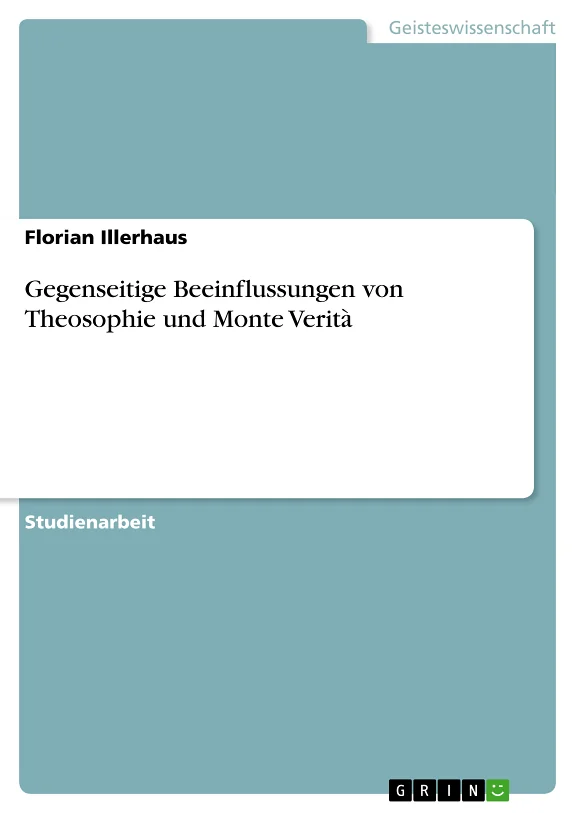
Gegenseitige Beeinflussungen von Theosophie und Monte Verità
Florian Illerhaus’s "Gegenseitige Beeinflussungen von Theosophie und Monte Verità" offers a focused, if somewhat dry, academic account of the interplay between Helena Blavatsky's Theosophical Society and the iconic Monte Verità settlement. The strength of the work lies in its precise charting of intellectual lineages, tracing how specific theosophical concepts likely filtered into the Lebensreform milieu of the Ascona region. A limitation is the work's dense academic prose, which may deter readers seeking a more narrative exploration. The discussion of how theosophical notions of spiritual evolution might have informed the community's pursuit of a "new man" and a "new life" is particularly illuminating, though it remains within the confines of scholarly analysis. It provides a valuable, if specialized, contribution to understanding the roots of modern spiritual movements.
📝 Description
76
Florian Illerhaus's 2009 study traces the mutual influences between Theosophy and the Monte Verità community.
This academic work examines the intellectual and spiritual currents that shaped early 20th-century alternative movements, focusing on the connections between Theosophy and the Monte Verità community. It grew from discussions surrounding the "Monte Verità: Lebensreform, Theosophie und die Anfänge des New Age" event at the University of Münster.
The research analyzes the period leading up to and during Monte Verità's peak influence. It considers societal shifts and a growing interest in spiritual alternatives to mainstream Western thought. The study looks at how Theosophical doctrines, particularly those from Helena Blavatsky, may have affected the commune's ethos, artistic endeavors, and utopian ideals.
The book sits within scholarship on the late 19th and early 20th-century turn towards spiritualism and alternative philosophies. It specifically addresses the interplay between Helena Blavatsky's Theosophical Society and the utopian communities that emerged during this era, like Monte Verità. This period saw a widespread questioning of materialism and a search for new spiritual frameworks, often drawing from Eastern religions and occult traditions.
💡 Why Read This Book?
• Understand the specific impact of Theosophical Society doctrines on the Monte Verità community, particularly in the early 20th century, moving beyond general notions of spiritual influence. • Gain insight into the Lebensreform movement's intellectual landscape by examining how figures associated with it engaged with or were influenced by theosophical ideas as discussed in the text. • Appreciate the academic rigor behind studying the origins of New Age thought, with this work providing a scholarly foundation rooted in the University of Münster's research from 2009.
⭐ Reader Reviews
Honest opinions from readers who have explored this book.
❓ Frequently Asked Questions
What is the primary focus of "Gegenseitige Beeinflussungen von Theosophie und Monte Verità"?
The book investigates the extent to which the Theosophical Society, its members, or its ideas influenced the early development and ethos of the Monte Verità community in Switzerland.
When was this academic study first published?
This academic work by Florian Illerhaus was first published on November 11, 2009, as part of a seminar at the University of Münster.
What academic field does this book belong to?
The book originates from the field of Theology, specifically within the sub-discipline of General Religious Studies, focusing on comparative religion and esoteric movements.
Does the book discuss Helena Blavatsky?
Yes, the abstract indicates the work addresses the influence of the Theosophical Society and its thought, which was founded by Helena Blavatsky, on the Monte Verità community.
What is Monte Verità?
Monte Verità was an early 20th-century utopian colony and artists' retreat in Ascona, Switzerland, known for its association with the Lebensreform (life reform) movement and various alternative spiritual and philosophical ideas.
Is this book available in English?
The original publication is in German. Information about English translations is not provided in the source material.
🔮 Key Themes & Symbolism
Theosophical Doctrine Transmission
The study meticulously traces how core tenets of Theosophy, such as spiritual evolution and hidden wisdom, may have been absorbed and reinterpreted by residents and proponents of Monte Verità. It moves beyond superficial connections to examine the specific conceptual frameworks that could have been shared or adapted between Helena Blavatsky's followers and the Lebensreform community.
Lebensreform Ideals
This theme explores the broader context of the Lebensreform movement, of which Monte Verità was a significant manifestation. The work investigates how the community's pursuit of a "new life"—encompassing vegetarianism, nudism, communal living, and alternative spirituality—intersected with or diverged from theosophical ideals prevalent at the time.
Communal Living and Spirituality
The research looks at the practical application of philosophical and spiritual ideas within a communal setting. It examines how the shared living experiments at Monte Verità might have served as a crucible for testing and embodying theosophical principles or alternative spiritual philosophies.
Academic Religious Studies
Functioning as a "Studienarbeit" (academic paper) from the University of Münster, this theme highlights the work's contribution to the scholarly understanding of esoteric movements. It applies rigorous academic methods to analyze historical interactions between distinct spiritual and philosophical currents.
💬 Memorable Quotes
Direct passages from the work, attributed to the author.
“Theosophy, Monte Verità, Lebensreform, and the beginnings of New Age”
— This phrase highlights the interconnected subject matter, positioning Monte Verità not just as an isolated experiment but as a crucial nexus where various streams of alternative thought, including Theosophy, converged and contributed to nascent New Age philosophies.
“Study paper from 2009, Grade: 1.3, University of Münster”
— This factual annotation underscores the academic rigor and high evaluation of the work, situating it within a specific educational and scholarly context, and indicating its scholarly merit.
“Focus on mutual influences”
— This emphasizes the bidirectional nature of the investigation, suggesting the study doesn't merely assert Theosophy's impact on Monte Verità, but also considers potential reciprocal influences or shared conceptual spaces.
“Exploration of theological and religious science aspects”
— This points to the work's methodological approach, framing the analysis within the discipline of religious studies and theology, thereby ensuring a structured and critical examination of the spiritual and philosophical phenomena involved.
💡 Key Ideas
Editorial paraphrase of the work's core concepts — not direct quotes.
extent to which the Theosophical Society, individual Theosophists, or theosophical ideas influenced the early [Monte Verità]
This paraphrased core research question captures the book's analytical objective: to quantify and qualify the specific intellectual and spiritual borrowings between Theosophy and the Monte Verità community.
🌙 Esoteric Significance
Tradition
This work falls squarely within the academic study of Western Esotericism, specifically focusing on the Theosophical tradition and its influence on secular or pseudo-religious movements like Lebensreform. It examines how esoteric doctrines, originating from Helena Blavatsky's synthesis, were adopted and adapted outside formal Theosophical Society structures, contributing to the lineage of alternative spiritual thought.
Symbolism
While the book's primary focus is intellectual history, its exploration of Theosophy within Monte Verità implicitly touches upon shared symbolic language. Concepts like spiritual evolution, hidden masters, and the quest for a "higher consciousness" function as symbolic frameworks. The communal setting of Monte Verità itself can be seen as a symbol for the practical manifestation of utopian spiritual ideals.
Modern Relevance
Illerhaus's research remains relevant today as scholars and practitioners continue to trace the roots of contemporary New Age spirituality and alternative lifestyles. Understanding the specific interactions between foundational movements like Theosophy and experimental communities like Monte Verità provides critical context for contemporary discussions on spirituality, intentional communities, and the evolution of consciousness.
👥 Who Should Read This Book
• Academic researchers in Religious Studies and Esotericism seeking detailed analysis of the Theosophy-Monte Verità nexus. • Students of the Lebensreform movement interested in the specific spiritual influences shaping early 20th-century alternative communities. • Individuals investigating the historical development of New Age philosophies and their pre-cursors, particularly concerning the transmission of esoteric ideas.
📜 Historical Context
Florian Illerhaus's study emerges from the fertile intellectual ground of early 21st-century scholarship examining alternative spiritual movements. Published in 2009, it engages with the legacy of the Lebensreform movement, particularly the Monte Verità community, which flourished in the early 20th century. This era was marked by a widespread seeking of alternatives to industrialization and conventional religious and social structures. Theosophy, spearheaded by Helena Blavatsky in the late 19th century, offered a complex synthesis of Eastern and Western esoteric traditions, directly influencing many intellectual circles. Illerhaus's work specifically addresses how these theosophical currents interacted with the utopian ideals and experimental living at Monte Verità. The research context is further defined by its origin as an academic paper (Studienarbeit) from the University of Münster, suggesting a critical academic reception rather than widespread popular discourse at the time of its creation.
📔 Journal Prompts
The mutual influences between Theosophy and Monte Verità.
The specific theosophical ideas that may have shaped the Lebensreform movement.
The role of academic institutions like the University of Münster in studying esoteric history.
The significance of the 2009 publication date in the context of New Age studies.
How the concept of "mutual influence" applies to other historical spiritual movements.
🗂️ Glossary
Theosophical Society
An organization founded in 1875 by Helena Blavatsky, William Quan Judge, and others, dedicated to the study of comparative religion, philosophy, and science, and the investigation of unexplained laws of nature and the powers latent in humanity.
Monte Verità
A utopian colony and artists' retreat established in Ascona, Switzerland, in the early 20th century, associated with the Lebensreform movement and attracting figures interested in vegetarianism, nudism, and alternative spiritualities.
Lebensreform
A broad social reform movement that emerged in Germany and Switzerland in the late 19th century, advocating for changes in lifestyle, health, and spirituality, including vegetarianism, natural healing, and communal living.
Studienarbeit
A type of academic paper or thesis typically written by students in German universities as part of their coursework, often indicating rigorous scholarly research.
New Age
A broad range of spiritual or religious beliefs and practices that emerged in Western countries during the 1960s and 1970s, often drawing from Eastern religions, esotericism, and countercultural ideas.
Mutual Influence
The concept of reciprocal impact or effect between two or more entities, ideas, or movements, suggesting a dynamic interplay rather than a one-way causal relationship.
University of Münster
A public research university located in Münster, Germany, where Florian Illerhaus's study was conducted and originally published in 2009.
This book appears in 1 collection
🔮 Readers Also Liked
Browse all →






From the “Western Esotericism” Collection
View all →




More Free Sacred Texts & Gnosticism Books
View all →