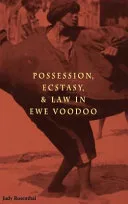
Possession, Ecstasy, and Law in Ewe Voodoo
 81
81

Possession, Ecstasy, and Law in Ewe Voodoo
Rosenthal's "Possession, Ecstasy, and Law in Ewe Voodoo" presents a challenging yet rewarding ethnography by mirroring the very nature of Vodou itself – a dynamic system of meaning requiring active participation from the reader. The strength lies in this methodological ambition, moving beyond passive observation to invite the reader into the interpretive process. Rosenthal meticulously details the intricate relationship between ecstatic possession and the social order, particularly how legal and customary frameworks manage these powerful spiritual experiences. A notable passage details the careful distinction made between different types of spirit possession, a nuance often lost in Western interpretations. However, the text's deliberate opacity, while mirroring Vodou's structure, can occasionally render the ethnographic material dense and less accessible to newcomers to the field. It demands considerable intellectual effort, which may deter some readers seeking a more straightforward introduction. Despite this, the work offers a unique perspective on how spiritual authority is negotiated and maintained within a specific cultural context. Rosenthal's study provides a compelling, albeit demanding, window into Ewe Vodou.
📝 Description
81
Judy Rosenthal's 1998 ethnography examines spirit possession and its legal implications among the Ewe people.
Published in 1998, Judy Rosenthal's "Possession, Ecstasy, and Law in Ewe Voodoo" presents an ethnographic study of the Ewe people in Ghana and Togo. Rosenthal designed the work to mirror the Vodou texts it describes, requiring active reader interpretation rather than passive reception. This method challenges traditional ethnographic writing, asking for a more engaged reading experience from its audience.
The book is for anyone interested in the connections between religion, culture, and social structures in West African Vodou. It will appeal to anthropologists, scholars of religion, and those looking for a look at spirit possession that avoids sensationalism. Students of comparative religion, especially those studying ecstatic religious experiences and their cultural expressions, will find it a useful text. It also suits readers curious about the legal and social systems that shape religious practices in specific cultures.
This work engages with the academic study of African indigenous religions, a field that gained traction in the latter half of the 20th century. It situates Ewe Vodou within its historical and geographical context, moving beyond colonial-era missionary accounts. By focusing on possession and its legal framework, Rosenthal's ethnography addresses how these traditions adapt and persist under external religious and political pressures, offering a view of living religious systems.
💡 Why Read This Book?
• Gain a nuanced understanding of ecstatic possession as a culturally regulated social phenomenon, moving beyond sensationalism, by examining Rosenthal's detailed accounts of Ewe Vodou practices as presented in the 1998 publication. • Appreciate how indigenous legal and customary frameworks interact with spiritual experiences, learning about the specific social mechanisms that govern spirit possession within Ewe society. • Engage with an ethnographic methodology that actively involves the reader in interpreting cultural signs, mirroring Rosenthal's intention for the text to function like Vodou itself, requiring reader interaction.
⭐ Reader Reviews
Honest opinions from readers who have explored this book.
❓ Frequently Asked Questions
What is the primary focus of Judy Rosenthal's "Possession, Ecstasy, and Law in Ewe Voodoo"?
The book is an ethnography examining the intricate relationship between spiritual possession, ecstatic states, and the legal and social regulations within Ewe Vodou traditions in Ghana and Togo, first published in 1998.
What makes the ethnographic approach in this book unique?
Rosenthal designed the ethnography to mirror Vodou texts themselves, requiring the reader to actively interact with signifiers and meanings to achieve comprehension, rather than presenting a purely objective account.
What historical period or context does the book address?
The book, published in 1998, explores Ewe Vodou within its specific socio-cultural and historical landscape in West Africa, analyzing its evolution and adaptation amidst various influences.
Are specific concepts of Ewe Vodou explained in detail?
Yes, the work delves into concepts like spirit possession, ecstatic experiences, and the customary laws that govern these phenomena within the Ewe community.
Who would find this book most beneficial?
Academics in anthropology and religious studies, and individuals interested in comparative religion, ecstatic religious experiences, and the social structures of West African spiritual traditions will find it valuable.
What does the book suggest about the nature of Vodou?
It suggests that Vodou is a complex system of meaning, not just a set of rituals, and that understanding it requires active interpretation and engagement with its symbolic language, much like the Ewe people themselves.
🔮 Key Themes & Symbolism
Possession as Social Performance
The work scrutinizes spirit possession not as a purely internal or pathological event, but as a public performance deeply embedded within the social fabric of Ewe society. Rosenthal illustrates how specific roles, appropriate behaviors, and communal recognition are crucial for possession to be understood and validated within the Vodou framework. This perspective moves beyond simplistic notions of demonic or divine control, highlighting the structured nature of ecstatic states and their function in community life and spiritual authority.
Ecstasy and Spiritual Communication
Ecstatic states are examined as vital channels for communication between the human and spirit worlds in Ewe Vodou. Rosenthal details how these heightened states are cultivated and interpreted, serving as a means for divination, healing, and the reception of spiritual guidance. The book emphasizes that ecstasy is not random but often follows specific patterns and is associated with particular spirits, underscoring its role in maintaining the efficacy and perceived reality of the Vodou cosmology.
The Law of Spirits and Society
This theme addresses how Ewe Vodou operates within and shapes a system of 'law' that governs interactions between humans, spirits, and the community. Rosenthal explores customary practices, judicial processes, and social norms that arise from or are influenced by spiritual phenomena. The book demonstrates how possession and ecstatic experiences can lead to social judgments, resolutions of disputes, and the reinforcement of social order, illustrating a unique synthesis of the spiritual and legal.
Ethnography as Textual Engagement
Rosenthal's methodological innovation is a central theme, proposing that ethnography itself can function as a complex text demanding reader interpretation. By intending her work to mirror Vodou's own sign systems, she challenges readers to become active participants in constructing meaning. This approach highlights the interpretive nature of all cultural understanding and the limitations of purely objective ethnographic reporting, particularly in highly symbolic religious systems.
💬 Memorable Quotes
Direct passages from the work, attributed to the author.
“Possession is a body of signifiers and meanings.”
— This conceptualization frames spirit possession not just as an event, but as a complex semiotic system that requires deciphering, linking the phenomenon directly to language and cultural interpretation.
“Law governs the interactions between humans and the spirit world.”
— This highlights the integration of spiritual beliefs with social order, suggesting that customary laws and social norms provide a framework for managing the powerful and potentially disruptive forces of Vodou.
“Ecstasy functions as a mode of communication.”
— This interpretation emphasizes the pragmatic and functional aspects of ecstatic states within Ewe Vodou, positioning them as essential tools for spiritual dialogue and connection rather than mere emotional outbursts.
“The ethnography intends to mirror the texts of voodoo itself.”
— This statement reveals the core of Rosenthal's project: to create an academic text that embodies the complex, layered, and interactive nature of the Vodou tradition it seeks to describe.
💡 Key Ideas
Editorial paraphrase of the work's core concepts — not direct quotes.
The reader must interact in order to make sense of it.
This quote captures Rosenthal's methodological stance, asserting that her ethnography is not a passive repository of information but an active field for interpretation, requiring reader participation to unlock its meaning.
🌙 Esoteric Significance
Tradition
While Ewe Vodou is primarily an indigenous West African tradition, its study, particularly concerning possession and ecstasy, intersects with broader esoteric interests in altered states of consciousness and spirit communication. These phenomena echo themes found in various esoteric lineages, such as shamanism, spiritualism, and certain branches of Western occultism that explore mediumship and trance. Rosenthal's work provides empirical grounding for understanding these states within a specific, culturally rich context, offering insights relevant to those exploring the mechanics of consciousness and inter-dimensional communication.
Symbolism
Key symbols in Ewe Vodou, as explored in the work, often relate to the natural world and the spirit pantheon. For instance, specific animals might represent certain spirits or embody particular characteristics, serving as conduits for spiritual energy or messages. The use of ritual objects, colors, and even bodily gestures in possession ceremonies are highly symbolic, conveying spiritual status, the identity of the possessing entity, and the intended purpose of the ritual. Understanding these symbols is crucial for deciphering the complex language of Vodou.
Modern Relevance
Contemporary thinkers and practitioners in fields like transpersonal psychology, comparative mysticism, and even certain branches of neuroscience interested in consciousness studies can draw from Rosenthal's detailed ethnography. Her work provides a rigorous, context-specific examination of ecstatic states and spirit possession, offering valuable case material for theories about altered consciousness, the social construction of religious experience, and the cross-cultural phenomenology of the sacred. It serves as a vital reference for understanding the lived reality of these phenomena.
👥 Who Should Read This Book
• Anthropologists and scholars of religion: To gain a rigorous, context-specific understanding of Ewe Vodou, its social structures, and the dynamics of possession and ecstasy. • Students of comparative religious practices: For a detailed case study on ecstatic phenomena and their regulation within a non-Western indigenous tradition. • Readers interested in altered states of consciousness: To explore how trance and possession are culturally mediated, socially integrated, and understood within a specific spiritual system.
📜 Historical Context
Published in 1998, Judy Rosenthal's "Possession, Ecstasy, and Law in Ewe Voodoo" emerged during a period of renewed academic focus on African indigenous religions, moving beyond earlier colonial and missionary perspectives. This era saw scholars increasingly engaging with the complexities of African cosmologies and ritual practices on their own terms. Rosenthal's work can be seen as contributing to a broader anthropological trend that emphasized the social and cultural embeddedness of religious phenomena. While not directly engaging with a single competing school of thought in the way one might compare, say, functionalism versus structuralism, her approach implicitly challenged overly simplistic or universalizing theories of religion by insisting on the specificity of Ewe Vodou. The book's reception by scholars in religious studies and anthropology provided a detailed case study that enriched discussions on possession, altered states of consciousness, and the intersection of religion and law in non-Western societies. Her nuanced portrayal offered a counterpoint to more essentialist or exoticizing accounts that sometimes characterized earlier literature on African religions.
📔 Journal Prompts
The function of spirit possession within Ewe social structures.
The relationship between ecstatic states and spiritual communication in Vodou.
How customary law navigates and regulates possession phenomena.
The reader's role in interpreting ethnographic texts.
The symbolic language of Ewe Vodou spirits and rituals.
🗂️ Glossary
Ewe Vodou
The indigenous religious traditions practiced by the Ewe people of Ghana and Togo, characterized by a complex system of spirits, possession, and ritual practices.
Possession
In Ewe Vodou, the state wherein a spirit is believed to inhabit and manifest through a human host, often involving altered behavior and communication.
Ecstasy
A state of heightened emotion or spiritual fervor, often experienced during possession rituals in Ewe Vodou, believed to facilitate spiritual communication.
Law
Refers to the customary practices, social norms, and judicial processes within Ewe society that govern interactions, resolve disputes, and manage spiritual phenomena.
Ethnography
A descriptive account of a particular society or culture, based on fieldwork and participant observation, as exemplified by Rosenthal's study.
Signifiers
Elements within a system (like language or ritual) that represent or point to something else; in this context, the signs and symbols of Vodou.
Reader Interaction
The active engagement required of the reader to interpret meanings and make sense of the text, a methodological goal set by Rosenthal for her ethnography.