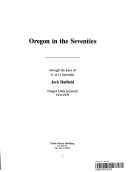
Oregon in the Seventies
 72
72

Oregon in the Seventies
Jock Hatfield's "Oregon in the Seventies" offers a compelling, if somewhat sprawling, look at a pivotal decade. The author excels at capturing the idiosyncratic spirit of the era, particularly the blend of idealism and pragmatism that characterized Oregon's counter-cultural experiments. Hatfield's detailed descriptions of specific communes and the individuals who inhabited them provide a vivid sense of place and personality. However, the book occasionally suffers from a lack of clear thematic focus, at times feeling like a collection of anecdotes rather than a cohesive argument. A particular strength lies in the chapter detailing the growth of the Oregon Country Fair, which vividly illustrates the era's communal ethos. The work is best understood not as a definitive history, but as an evocative series of vignettes from a unique time and place. "Oregon in the Seventies" serves as a valuable, if sometimes untidy, record of a West Coast moment.
📝 Description
72
Jock Hatfield's Oregon in the Seventies examines the Pacific Northwest's counterculture in the 1970s.
This book details the cultural and social shifts in Oregon during the 1970s. Hatfield looks at the undercurrents of counter-culture, environmentalism, and spiritual seeking that characterized the region. It is suited for readers interested in regional history, the evolution of American subcultures, and how place influences consciousness.
The 1970s in Oregon saw growing environmental awareness, influenced by figures like Stewart Brand and ideas from the late 1960s. The state became a center for alternative lifestyles and communal living, mirroring a national trend of questioning established norms. The work touches on intentional communities, the search for spiritual paths outside mainstream religion, and the natural landscape's effect on identity.
The book situates itself within a broader interest in consciousness and alternative spiritualities that gained traction in the 1970s. This era saw a surge in individuals seeking meaning beyond established religious frameworks, often turning to nature, communal living, and self-discovery. Oregon, with its natural beauty and progressive reputation, became a focal point for these pursuits, attracting those interested in forging new social structures and personal identities. Hatfield's work captures this specific regional manifestation of a wider cultural shift toward esoteric exploration.
💡 Why Read This Book?
• Understand the specific socio-spiritual climate of Oregon during the 1970s, including the influence of figures associated with the "Whole Earth Catalog" and its emphasis on self-sufficiency. • Gain insight into the practicalities and philosophies of intentional communities that emerged in response to 1960s idealism, as detailed in specific commune case studies. • Appreciate the unique connection between the natural environment of the Pacific Northwest and the development of alternative lifestyles and spiritual practices prevalent in the 1970s.
⭐ Reader Reviews
Honest opinions from readers who have explored this book.
❓ Frequently Asked Questions
What was the cultural atmosphere in Oregon during the 1970s as depicted in the book?
The book portrays Oregon in the 1970s as a hub for counter-culture, environmental activism, and spiritual exploration, with a strong emphasis on communal living and alternative societal structures.
Does "Oregon in the Seventies" focus on specific locations within Oregon?
Yes, the work references specific areas and communities within Oregon that were significant centers for the counter-culture and intentional living movements of the decade.
Who is Jock Hatfield, and what is his perspective?
Jock Hatfield was a writer and observer of the Pacific Northwest's cultural landscape. His perspective in "Oregon in the Seventies" appears to be that of an engaged chronicler, documenting the era's unique social and spiritual experiments.
What kind of spiritual seeking is discussed in "Oregon in the Seventies"?
The book touches upon a broad spectrum of spiritual seeking, including Eastern philosophies, neopaganism, and the development of unique, homegrown spiritual practices influenced by the region's natural beauty and counter-cultural ethos.
How does the book relate to the broader American counter-culture of the 1960s and 70s?
It illustrates how the ideals and experiments of the 1960s counter-culture evolved and manifested in a distinct regional context throughout the 1970s, focusing on Oregon's specific contributions and adaptations.
What is the significance of the "Whole Earth Catalog" in relation to this book?
The "Whole Earth Catalog," a key influence on self-sufficiency and alternative living, is implicitly relevant as it informed many of the philosophies and practices of the intentional communities and individuals documented in the book.
🔮 Key Themes & Symbolism
Intentional Communities
The work meticulously documents the rise and evolution of intentional communities in Oregon during the 1970s. These communes, often formed around shared ideals of sustainability, communal living, and spiritual exploration, represented a significant departure from traditional societal structures. Hatfield explores the internal dynamics, challenges, and successes of these groups, offering a granular view of how utopian visions were put into practice. The book highlights how the unique geography and ethos of Oregon provided fertile ground for such experiments.
Environmentalism's Roots
Oregon in the Seventies captures a crucial period where environmental consciousness began to solidify into organized movements and lifestyle choices. The book illustrates how the region's natural beauty fostered a deep connection to the land, influencing the back-to-the-land movement and the development of sustainable living practices. It shows how this nascent environmentalism was intertwined with spiritual seeking and a desire for a more harmonious existence with nature.
Counter-Cultural Evolution
This book charts the trajectory of the 1960s counter-culture into the 1970s, focusing on its specific manifestation in Oregon. It moves beyond simplistic portrayals to explore the diverse expressions of this movement, from communal living and alternative economics to the development of local arts and music scenes. Hatfield examines how the idealism of the previous decade was adapted and sometimes challenged by the realities of the 1970s, creating unique regional subcultures.
Spiritual Syncretism
A significant theme is the eclectic nature of spiritual seeking during this period. The work highlights the blending of various traditions—Eastern mysticism, indigenous beliefs, Western esoteric practices, and new age philosophies—as individuals and communities forged their own spiritual paths. This syncretism reflects a broader cultural shift away from rigid religious dogma towards a more personalized and experiential approach to spirituality.
💬 Memorable Quotes
Direct passages from the work, attributed to the author.
“The Oregon Country Fair became a nexus for communal ideals.”
— This statement expresses the fair's role not just as a festival, but as a physical manifestation and incubator for the shared values and experimental lifestyles of the era's counter-culture.
“Many sought refuge and rebirth in Oregon's vast natural spaces.”
— This suggests a deep connection between the region's landscape and the psychological or spiritual needs of individuals seeking escape, transformation, or a new beginning during the 1970s.
“Decisions were often made collectively within the commune structures.”
— This points to the emphasis on consensus and shared governance as a core principle of intentional community living, contrasting with hierarchical decision-making in mainstream society.
“The 'back-to-the-land' movement found a strong foothold in the state.”
— This highlights Oregon's appeal to those intentionally relocating to rural areas to pursue self-sufficient, agrarian lifestyles, driven by disillusionment with urban life and a desire for ecological harmony.
“New forms of social organization emerged from grassroots efforts.”
— This emphasizes the innovative and experimental nature of the social and cultural changes occurring, born from the initiative of ordinary people rather than top-down directives.
🌙 Esoteric Significance
Tradition
While not explicitly tied to a single esoteric lineage like Hermeticism or Kabbalah, "Oregon in the Seventies" documents a period where practitioners of various spiritual paths converged. It reflects the broader New Age milieu, which synthesized elements from Eastern religions, Western esotericism, indigenous traditions, and psychological self-help. The work captures the syncretic and experimental nature of spiritual seeking that characterized this era, moving beyond established doctrines towards personalized experiential religion.
Symbolism
The potent symbolism of the Pacific Northwest's natural landscape—towering forests, rugged coastlines, fertile valleys—serves as a foundational motif. These elements represent purity, primal connection, and a source of spiritual renewal, contrasting sharply with the perceived artificiality of urban industrial society. The "commune" itself functions as a symbol of collective aspiration, a microcosm of an idealized social order based on cooperation and shared consciousness, embodying a search for a new Eden.
Modern Relevance
The work remains relevant for contemporary practitioners of sustainable living, intentional community building, and those exploring decentralized social structures. Thinkers and groups focused on permaculture, ecovillages, and grassroots organizing can find historical precedents and case studies within its pages. Furthermore, scholars of American spirituality and cultural history continue to draw on such accounts to understand the lasting impact of the 1970s counter-culture on modern alternative movements and the ongoing search for meaning beyond consumerism.
👥 Who Should Read This Book
• Students of American counter-culture and alternative lifestyles seeking to understand the practical implementation of 1960s ideals in a specific regional context. • Researchers of communal living and intentional communities interested in the organizational structures, challenges, and successes of these groups during the 1970s. • Individuals drawn to the spiritual and philosophical currents of the 1970s, particularly those interested in the synthesis of Eastern and Western esoteric ideas and the "back-to-the-land" movement.
📜 Historical Context
The 1970s in Oregon unfolded against a backdrop of significant national and global shifts. Following the intense social upheaval of the late 1960s, the nation grappled with economic instability, the Watergate scandal, and a growing environmental consciousness. In Oregon, this translated into a fertile ground for the counter-culture's evolution. Figures like Stewart Brand, with his "Whole Earth Catalog," published in 1971, provided intellectual fuel for the back-to-the-land movement and DIY ethos that flourished in the state. While mainstream society was often skeptical or dismissive, Oregon's unique political climate and natural abundance attracted a diverse array of individuals seeking alternative lifestyles. This era saw the rise of numerous intentional communities and the establishment of influential events like the Oregon Country Fair, which became a significant cultural touchstone. The state's embrace of environmentalism, exemplified by initiatives like the bottle bill passed in 1971, positioned it as a progressive leader, contrasting with more conservative regions.
📔 Journal Prompts
The appeal of communal living structures in the 1970s.
Reflections on the "back-to-the-land" ethos as depicted in the book.
The role of Oregon's natural environment in shaping spiritual seeking.
Personal interpretation of the symbolism of intentional communities.
How the Oregon Country Fair functioned as a cultural nexus.
🗂️ Glossary
Intentional Community
A planned residential community designed from the start to be self-governing, with a high degree of social planning. Often formed around shared social, political, economic, or spiritual values.
Counter-culture
A subculture whose values and norms of behavior differ substantially from those of mainstream society, often in opposition to the established cultural order.
Back-to-the-land movement
A social movement that encouraged people to leave urban life and return to rural settings to pursue self-sufficient, agrarian lifestyles, often with an emphasis on ecological sustainability.
Spiritual Seeking
The active pursuit of spiritual understanding, enlightenment, or connection, often involving exploration of various religious, philosophical, or mystical traditions outside conventional religious frameworks.
Oregon Country Fair
An annual arts, crafts, and music festival held in Veneta, Oregon, which became a significant gathering place for the counter-culture movement in the 1970s.
Syncretism
The combining of different beliefs, cultures, or schools of thought, especially as applied to religious or philosophical systems, evident in the eclectic spiritual practices of the era.
DIY Ethos
A philosophy emphasizing the value of creating, repairing, or modifying things by oneself rather than purchasing or relying on professionals. Prominent in the counter-culture of the period.
This book appears in 1 collection
🔮 Readers Also Liked
Browse all →



From the “Soul Travel” Collection
View all →





More Free Esoteric History & Biography Books
View all →