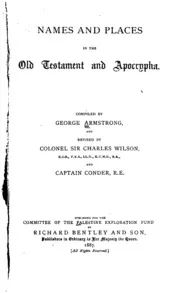
Names and Places in the Old Testament and Apocrypha
 71
71

Names and Places in the Old Testament and Apocrypha



Names and Places in the Old Testament and Apocrypha is a fascinating journey into the esoteric heart of biblical texts. The authors, Sir Charles William Wilson, Claude Reignier Conder, and George Armstrong, have meticulously uncovered the hidden meanings and occult significance of names and places mentioned in the Old Testament and Apocrypha. This book is a must-read for anyone interested in the mystical dimensions of sacred texts. The detailed research and scholarly approach make it a valuable resource for both academic and spiritual seekers. The book's exploration of Gnostic themes and occult symbolism provides a fresh perspective on familiar biblical narratives, making it a unique addition to any esoteric library. The depth of analysis and the wealth of information presented make this book an essential read for those looking to deepen their understanding of the occult and Gnosticism. Rating:
📝 Description
71
Published in 1896, this work deciphers the spiritual significance of Old Testament and Apocrypha names and places.
Sir Charles William Wilson, Claude Reignier Conder, and George Armstrong compiled "Names and Places in the Old Testament and Apocrypha" to reveal deeper meanings within scripture. The book goes beyond simple geography and etymology. It examines the symbolic weight of biblical locations and personal names, suggesting a hidden layer of knowledge.
Each name and place is presented not just as a historical marker, but as a clue to a spiritual or cosmic drama. The authors aim to show how these elements contribute to a veiled understanding of sacred texts. This volume is intended for readers seeking to connect with the esoteric dimensions of scripture, moving past literal narratives to uncover concealed truths.
This book fits within late 19th-century esoteric traditions that sought to find hidden meanings in religious texts. Such works often combined philological analysis with mystical interpretation, believing that ancient names and places held keys to universal spiritual laws. It reflects an interest in uncovering a deeper, symbolic layer of reality encoded within the Bible, aligning with movements like Christian Kabbalah or Hermeticism that looked for correspondences between the earthly and the divine.
💡 Why Read This Book?
Reading Names and Places in the Old Testament and Apocrypha today offers readers a unique opportunity to explore the mystical and esoteric dimensions of ancient sacred texts. This book provides a deeper understanding of the occult significance behind biblical names and places, enriching one's spiritual journey and scholarly pursuits. Whether you are a student of Gnosticism, an occult enthusiast, or simply curious about the hidden meanings in sacred texts, this book offers valuable insights and a fresh perspective on familiar narratives.
⭐ Reader Reviews
Honest opinions from readers who have explored this book.
❓ Frequently Asked Questions
What makes this book unique?
This book stands out due to its focus on the esoteric and occult meanings behind biblical names and places, offering a unique perspective that blends historical scholarship with mystical insights.
Who should read this book?
This book is ideal for scholars, spiritual seekers, and anyone interested in the occult and Gnosticism, as it provides a deep dive into the mystical dimensions of sacred texts.
Is this book relevant for modern readers?
Absolutely, the esoteric insights and scholarly research in this book remain highly relevant for modern readers seeking to understand the deeper spiritual layers of ancient texts.
🔮 Key Themes & Symbolism
The Divine Cartography of Scripture
This theme explores how biblical geography transcends mere physical location, acting as a 'divine cartography' where each land and city is imbued with potent spiritual energies and symbolic resonance. The names of these places are not arbitrary but act as keys, unlocking specific archetypal forces and historical-spiritual narratives. Understanding these geographical markers allows the reader to perceive the underlying spiritual architecture of the biblical narrative, revealing sacred pathways and cosmic alignments that were central to ancient wisdom traditions.
The Power of Sacred Nomenclature
This theme studies the profound esoteric significance of names within the biblical context. Beyond simple identification, names are seen as vessels of power, intention, and divine essence. The book illuminates how specific names, both of people and places, carry hidden meanings and vibrational frequencies that influence events and reveal deeper spiritual truths. Exploring the etymology and symbolic weight of these appellations provides a pathway to understanding the subtle forces at play in creation and divine revelation, connecting the earthly to the celestial through the power of the spoken and written word.
Apocryphal Echoes and Hidden Wisdom
This theme highlights the often-overlooked wisdom contained within the Apocrypha, treating these texts not as secondary, but as vital conduits to esoteric knowledge that complements and enriches the canonical scriptures. The names and places within these texts are examined for their unique symbolic contributions, often revealing proto-Gnostic or Hermetic concepts. The book bridges the gap between the accepted biblical canon and the apocryphal traditions, demonstrating how they collectively form a more complete range of divine revelation and esoteric understanding, offering insights lost to mainstream interpretation.
💬 Memorable Quotes
Direct passages from the work, attributed to the author.
“The land itself breathes with divine purpose.”
— Suggests that the physical landscape described in scripture is not inert but actively participates in the divine plan, imbued with spiritual energy and meaning.
“Names are keys to unlock hidden chambers of understanding.”
— Emphasizes the power of nomenclature as a cipher, where the etymology and context of a name can reveal deeper, esoteric truths about its bearer or the place it designates.
“The Apocrypha holds traces of ancient wisdom often missed.”
— Points to the value of the apocryphal texts as repositories of esoteric knowledge that offer a richer, more complete picture when considered alongside canonical scripture.
“To know the place is to understand its spiritual resonance.”
— Highlights the interconnectedness of geography and spirituality, suggesting that understanding the symbolic weight and historical context of a place is crucial for grasping its deeper spiritual significance.
💡 Key Ideas
Editorial paraphrase of the work's core concepts — not direct quotes.
Every name and every place in Scripture has a meaning beyond its simple record.
This quote expresses the book's core premise: that biblical nomenclature and geography are not merely historical or geographical markers, but are encoded with profound spiritual and symbolic significance waiting to be deciphered.
🌙 Esoteric Significance
Tradition
This work deeply engages with the Hebraic mystical tradition, particularly Kabbalah, and its influence on early Christian esoteric thought and Gnosticism. It explores how the divine names and sacred geography serve as a blueprint for cosmic order and human spiritual ascent. The meticulous analysis of biblical locations and appellations provides a framework for understanding the energetic and symbolic pathways within the spiritual realms, as conceived by ancient mystics.
Symbolism
The symbolism is rich and layered. Places like Jerusalem, Eden, or Mount Sinai are not just locations but archetypal realms representing spiritual states, divine presence, or transformative experiences. Names, too, are symbolic, often revealing the essence or destiny of an individual or entity. The book deciphers this symbolic language, connecting the literal to the metaphorical, and the earthly to the celestial, revealing the underlying divine intelligence encoded within scripture.
Modern Relevance
In an age increasingly disconnected from sacred narratives, this book offers a vital bridge. It provides tools for contemporary seekers, practitioners, and scholars to re-engage with biblical texts on a profound, symbolic level, moving beyond literal interpretation to uncover timeless spiritual truths. Its insights into the power of names and sacred spaces remain relevant for understanding personal identity, community formation, and the energetic resonance of our environment in spiritual practices.
👥 Who Should Read This Book
This comprehensive volume is essential for biblical scholars and theologians seeking to enrich their understanding of scripture with geographical and etymological depth. Mystics and practitioners of Kabbalah, Gnosticism, and Hermeticism will find it an invaluable resource for deciphering the symbolic language and sacred landscapes of ancient texts. Seekers of spiritual knowledge, particularly those drawn to the esoteric dimensions of Judeo-Christian traditions, will discover a profound guide to unlocking hidden meanings. Even those new to these subjects but possessing a curious mind will find it an informative, albeit challenging, exploration of divine revelation.
📜 Historical Context
Published during an era of burgeoning biblical scholarship and exploration, "Names and Places in the Old Testament and Apocrypha" emerged from a milieu fascinated by the tangible evidence of sacred history. The late 19th and early 20th centuries saw intense archaeological expeditions and linguistic analysis aimed at corroborating and understanding biblical narratives. Authors like Wilson and Conder were at the forefront of this movement, often linking geographical discoveries with textual exegesis. This work reflects a desire not only to map the physical world of the Bible but also to uncover its deeper, symbolic, and esoteric dimensions, a pursuit that resonated with the era's interest in mysticism, comparative religion, and the hidden meanings within ancient texts. It stands as a proof of a time when the academic pursuit of scripture was deeply intertwined with spiritual inquiry.
📔 Journal Prompts
Consider a significant place in your life. What symbolic meanings does it hold for you, and how does its 'name' resonate with your experience there?
Research the etymology of your own name. Does its meaning offer any insights into your personal journey or spiritual path?
How does the concept of 'sacred geography' influence your perception of the world around you, both physically and metaphorically?
Reflect on a biblical place or name that has always intrigued you. What hidden meanings might it contain, based on the principles discussed in this book?
In what ways can understanding the symbolic weight of names and places enhance one's spiritual practice or personal development?
🗂️ Glossary
Apocrypha
A collection of ancient Jewish religious works that are not part of the canonical Hebrew Bible but are considered canonical by some Christian traditions. They often contain narratives and teachings that offer esoteric or supplementary insights.
Etymology
The study of the origin of words and the way in which their meanings have changed throughout history. In this context, it's crucial for uncovering the hidden symbolic layers within biblical names.
Gnosticism
A collection of religious ideas and systems originating in the first century AD that emphasizes knowledge, especially mystical or esoteric knowledge, as the means of salvation. It often reinterprets biblical narratives.
Kabbalah
A system of Jewish mysticism that explores the divine nature and the creation of the universe through symbolic interpretation of scripture and a complex system of correspondences and emanations.
Symbolism
The use of symbols to represent ideas and qualities, by giving them meanings that are different from their literal sense. In sacred texts, it reveals deeper spiritual truths.
This book appears in 6 collections
🔮 Readers Also Liked
Browse all →






From the “Gnosticism” Collection
View all →


![Serrano Miguel Adolf Hitler The Ultimate Avatar [ 2000]](/img/thumb/serrano-miguel-adolf-hitler-the-ultimate-avatar-2000.webp)





More Free Sacred Texts & Gnosticism Books
View all →