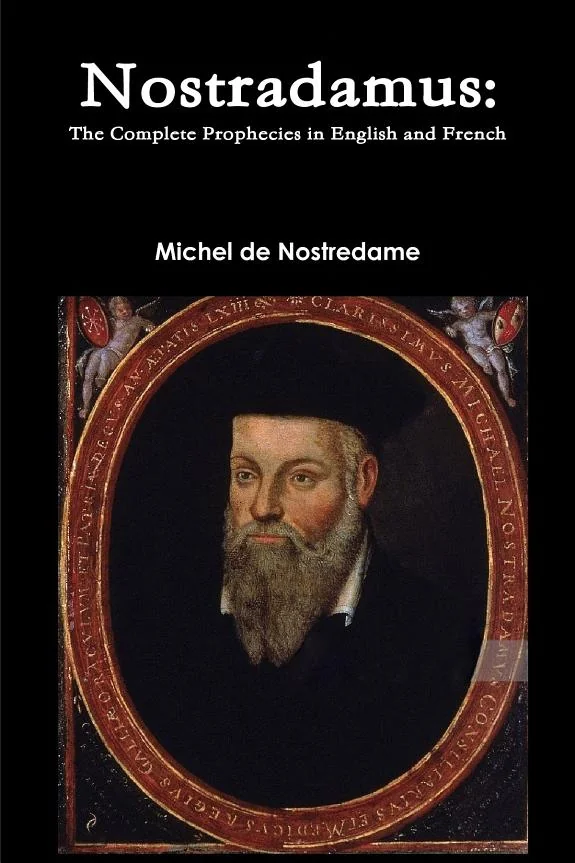
Nostradamus: The Complete Prophecies in English and French
 71
71

Nostradamus: The Complete Prophecies in English and French
The dual-language presentation of Nostradamus's quatrains in this edition is its primary strength, allowing for a direct confrontation with the original French text. This is invaluable for anyone seeking to bypass the filter of translation entirely. However, the volume offers little by way of critical apparatus or scholarly commentary, leaving the reader to navigate the often-obscure verses alone. A particularly striking passage involves the quatrain often interpreted as predicting the Great Fire of London (Centurie 1, Quatrain 31), where the phrase "the blood of the just shall be found / In London, burned by lightning's fire" offers a vivid, albeit ambiguous, image.
While the raw text is presented, the lack of contextualization or analysis makes this edition more of a reference tool than a guide for understanding. It requires significant prior knowledge or supplementary research to unpack the layered meanings and historical debates surrounding these prophecies. Ultimately, this book serves as an unvarnished primary source for those already initiated into the study of Nostradamus.
📝 Description
71
This 2009 volume collects all of Nostradamus's prophecies in their original French and English.
This edition presents the complete quatrains of Michel de Nostredame, also known as Nostradamus, in a dual-language format with original French text alongside a contemporary English translation. It contains the entirety of the prophecies attributed to the 16th-century physician and seer, allowing direct access to his cryptic verses. The work is intended for individuals seeking to engage with Nostradamus's writings directly, bypassing reliance on secondary interpretations.
It is suited for serious students of prophecy, historical occultism, and comparative esotericism. Researchers, practitioners of divination, and those interested in Western prophetic traditions will find it valuable. The edition also appeals to readers interested in the intellectual climate of Renaissance France and its curiosities.
Michel de Nostredame first published his prophecies, *Les Propheties*, in 1555. His work emerged during a time of significant religious and political change in Europe, drawing on Renaissance Neoplatonism and contemporary astrological and divinatory interests. Unlike the more conventional astrological almanacs of his day, Nostradamus utilized a distinct quatrain format. He often employed obscure language and anagrams, which have generated centuries of debate and interpretation.
Nostradamus's quatrains are a significant text within Western esoteric traditions, particularly in the fields of prophecy and divination. Written in the 16th century, his work reflects a blend of Renaissance humanism, Neoplatonic thought, and astrological influences. The use of symbolic language, allegory, and often obscure phrasing has led to a long history of interpretation and application by those seeking to understand or foresee future events. His method, distinct from more systematic astrological charts, relies on poetic verse to convey potential future occurrences, making it a unique entry in the history of Western prophetic literature.
💡 Why Read This Book?
• Gain direct access to the original French quatrains alongside English translations, allowing for nuanced comparison of prophetic language as seen in the 1555 *Les Propheties*. • Examine specific prophecies concerning major historical conflicts and figures, such as those interpreted to refer to World War III or the rise of Hitler, enabling personal analysis. • Understand the historical context of Renaissance divination practices and the unique quatrain format Nostradamus employed, differentiating his work from contemporary astrological almanacs.
⭐ Reader Reviews
Honest opinions from readers who have explored this book.
❓ Frequently Asked Questions
What is the original language of Nostradamus's prophecies?
The original language of Nostradamus's prophecies, first published as *Les Propheties* in 1555, is French. This edition provides both the original French text and an English translation for comparative study.
What kind of events are Nostradamus's prophecies believed to predict?
Nostradamus's prophecies are interpreted by believers to foretell a wide range of events, including wars, natural disasters, political upheavals, and the actions of significant historical figures.
Who was Nostradamus?
Michel de Nostredame (Nostradamus) was a 16th-century French physician and reputed seer, best known for his book of prophecies written in quatrains.
What is a quatrain in the context of Nostradamus's work?
A quatrain is a four-line verse. Nostradamus wrote his prophecies in this poetic form, often using obscure language and symbolism.
When was the first edition of Nostradamus's prophecies published?
The first edition of Nostradamus's prophecies, titled *Les Propheties*, was published in 1555.
Does this book include interpretations of the prophecies?
This book primarily presents the prophecies themselves in French and English. It does not typically include extensive interpretations, focusing instead on the primary text.
🔮 Key Themes & Symbolism
Apocalyptic Foretelling
The work is saturated with pronouncements concerning the end times, often referred to as Armageddon. These quatrains detail celestial signs, divine judgment, and the ultimate confrontation between good and evil. The text invites contemplation on humanity's ultimate fate, aligning with perennial esoteric concerns about cosmic cycles and eschatological events.
Political and Military Upheaval
A significant portion of Nostradamus's predictions focuses on shifts in global power, wars, and the rise and fall of leaders. Quatrains are frequently interpreted to reference specific historical conflicts and figures, from Napoleon to Hitler, suggesting a view of history as a series of predetermined struggles and leadership changes.
Celestial and Natural Disasters
Nostradamus frequently employs astronomical phenomena and natural calamities as symbolic vehicles for prophecy. Eclipses, comets, earthquakes, and floods appear as harbingers of significant change or divine intervention. This reflects a common esoteric belief in the correspondence between cosmic events and terrestrial affairs.
The Antichrist Figure
The concept of the Antichrist, a recurring figure in apocalyptic traditions, is central to many interpretations of Nostradamus's work. The quatrains are often analyzed for clues about the identity, origins, and ultimate impact of this adversarial force in human history, linking to Gnostic and Christian eschatological narratives.
💬 Memorable Quotes
Direct passages from the work, attributed to the author.
“The great kingdom will be inhabited by a people of low birth, coming from the Low Countries.”
— This quatrain is often cited as a prediction relating to Napoleon Bonaparte, whose origins were in Corsica and who rose to power during the French Revolution. It highlights Nostradamus's focus on leadership and political shifts.
“The twin cities will be in great discord, and the secrets revealed. The great man will be struck by lightning.”
— This verse is frequently interpreted as referencing the assassination of John F. Kennedy, with 'twin cities' possibly alluding to Dallas and Fort Worth, and the 'lightning' strike a metaphor for the sudden, fatal event.
“From the human race, children will be born of the three halves more than one.”
— This cryptic quatrain is often debated, with some suggesting it refers to genetic manipulation or unusual births. It exemplifies the ambiguous and symbolic language used by Nostradamus.
“The fire from the sky will make the ground tremble. The great new city will be burned.”
— Often associated with modern interpretations of nuclear war or catastrophic events, this quatrain speaks to large-scale destruction, potentially referencing events like the bombing of cities or widespread natural disasters.
💡 Key Ideas
Editorial paraphrase of the work's core concepts — not direct quotes.
The great king will enter, a wicked and damnable religion will spread. He will conquer the East with a great army.
This passage is frequently linked to interpretations of Islamic expansion or the rise of powerful, religiously motivated leaders, reflecting Nostradamus's concern with religious conflict and conquest.
🌙 Esoteric Significance
Tradition
Nostradamus's work sits at the intersection of Renaissance Hermeticism, Neoplatonism, and folk divination. It draws on a tradition that sees correspondences between the celestial macrocosm and the terrestrial microcosm, a core Hermetic principle. While not strictly Kabbalistic, his use of anagrams and numerical ciphers hints at a mystical approach to language, common in later esoteric traditions seeking hidden meanings within texts.
Symbolism
Key symbols include celestial bodies (stars, eclipses, comets) representing divine influence or harbingers of change, and animals (lions, wolves) often symbolizing powerful rulers or nations. The concept of the 'great king' and the 'Antichrist' are archetypal figures within apocalyptic lore, representing forces of order and chaos, salvation and destruction, respectively.
Modern Relevance
Nostradamus's quatrains continue to be referenced in modern conspiracy theories, geopolitical analyses, and by various New Age and occult practitioners. His work is often cited by futurists, doomsday predictors, and those exploring synchronicity and pattern recognition in historical events, keeping his prophecies relevant in contemporary discussions of fate and foreknowledge.
👥 Who Should Read This Book
• Aspiring prophets and diviners seeking to study historical methods of foretelling future events through cryptic verse and symbolic language. • Scholars of Renaissance history and occultism interested in primary source material concerning 16th-century European beliefs about destiny and cosmic influence. • Enthusiasts of comparative esotericism looking to analyze the structure and themes of one of Western history's most enduring prophetic texts directly.
📜 Historical Context
Michel de Nostredame published the first edition of *Les Propheties* in 1555, during a volatile period in 16th-century Europe marked by religious schism and political intrigue. The work emerged amidst a flourishing of occult and divinatory practices, including astrology, alchemy, and Kabbalah, which were not necessarily segregated from scholarly pursuits. Nostradamus, a trained physician, operated within this intellectual milieu, drawing upon classical sources and contemporary astrological knowledge. His unique approach, employing cryptic quatrains and obscure language, distinguished him from contemporaries who favored more direct astrological forecasts. While figures like Paracelsus explored similar alchemical and mystical themes, Nostradamus's prophetic focus garnered significant attention. His work faced scrutiny and was later placed on the Catholic Church's Index of Forbidden Books, reflecting the tension between prophetic claims and religious orthodoxy.
📔 Journal Prompts
The quatrain concerning the 'Great Fire' in London, Centurie 1, Quatrain 31, and its symbolic implications for destruction and renewal.
Analyze the recurring motif of the 'Antichrist' across different quatrains and its potential archetypal meanings.
Consider the role of celestial events (eclipses, comets) as predictive markers in Nostradamus's prophecies.
Reflect on the challenges of translating and interpreting the ambiguous language used in the quatrains.
Examine the concept of historical cycles as presented through the sequence of prophecies concerning political upheaval.
🗂️ Glossary
Quatrain
A verse or stanza consisting of four lines. Nostradamus wrote his prophecies exclusively in this four-line poetic format.
Les Propheties
The title of Nostradamus's primary work containing his prophecies, first published in 1555. It was later expanded in subsequent editions.
Seer of Provence
A common epithet for Nostradamus, referring to his origin from the Provence region of France.
Armageddon
In eschatological contexts, the site of the final battle between good and evil, often symbolizing the end of the world or a great cosmic conflict.
Antichrist
A figure in Christian eschatology who opposes Christ and is believed to appear before the end of the world, often associated with deception and destruction.
Centurie
A collection or 'century' of ten quatrains within Nostradamus's *Les Propheties*. The prophecies are organized into these groups.
Occult Powers
Abilities or knowledge considered supernatural or secret, beyond the scope of ordinary understanding, often associated with divination or magic.
This book appears in 1 collection
🔮 Readers Also Liked
Browse all →








From the “Nostradamus” Collection
View all →





More Free Sacred Texts & Gnosticism Books
View all →