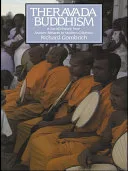
Theravada Buddhism
 72
72

Theravada Buddhism
Richard Gombrich's "Theravada Buddhism" offers a rigorous, if sometimes dense, academic perspective on this major Buddhist tradition. Gombrich's strength lies in his meticulous attention to textual history and his willingness to challenge common assumptions about the immutability of Buddhist doctrine. He effectively demonstrates how Theravada, far from being a monolithic entity, has undergone significant historical and social transformations. A particularly illuminating section discusses the complex relationship between monastic rules and the lived experience of the Sangha. However, the book’s academic rigor can sometimes be a barrier for the casual reader, with extensive scholarly apparatus that might detract from the narrative flow for those not deeply versed in Buddhist studies. For scholars, it provides a valuable, detailed analysis of a tradition often presented in simplified terms. Gombrich’s work is an essential reference for serious students of Buddhist history.
📝 Description
72
Richard Gombrich's 1988 study examines Theravada Buddhism's doctrines, practices, and history.
Richard Gombrich's 1988 book offers a scholarly look at Theravada Buddhism, one of the oldest surviving Buddhist traditions. He traces its doctrines, monastic practices, and social history, focusing on South and Southeast Asia. The book moves beyond simple ideas to show how this tradition changed and adapted over time. It is written for academics, students of religion, and scholars of Buddhism. However, anyone seriously interested in the beginnings and growth of Buddhist ideas and practices, who can handle detailed historical and textual arguments, will find it useful.
Gombrich's work places Theravada Buddhism in the context of scholarship from its 1988 publication date. At that time, scholars debated the accuracy of early Buddhist texts and the original teachings of the historical Buddha versus later changes. This book helps explain Theravada not as a fixed, pure form, but as a tradition shaped by historical interactions and reinterpretation. It also considers how the tradition adapted to different cultures and interacted with other schools of thought.
Theravada Buddhism, grounded in the Pali Canon, represents a lineage that emphasizes the Buddha's original teachings as preserved by the Sangha. Its contemplative practices aim at liberation from suffering (*dukkha*) through disciplined adherence to the Noble Eightfold Path. This tradition's historical development, as detailed by Gombrich, shows its capacity for adaptation while maintaining a core focus on monasticism and the Vinaya codes. Understanding Theravada requires engaging with its scriptural authority and the historical processes that shaped its transmission and practice across South and Southeast Asia.
💡 Why Read This Book?
• Gain a precise understanding of the Pali Canon's role, as Gombrich details its compilation and significance for Theravada orthodoxy, offering insights unavailable in general introductions. • Grasp the historical development of the Sangha, learning how monastic institutions evolved from the time of the Buddha to their present forms, a perspective crucial for understanding contemporary practice. • Comprehend the nuanced interpretation of *dukkha* within the Theravada framework, moving beyond superficial definitions to explore its philosophical depth as presented in the text.
⭐ Reader Reviews
Honest opinions from readers who have explored this book.
❓ Frequently Asked Questions
When was Richard Gombrich's "Theravada Buddhism" first published?
Richard Gombrich's "Theravada Buddhism" was first published in 1988, with a later edition released on April 14, 2006, by Routledge, an imprint of Taylor & Francis.
What is the primary focus of Gombrich's "Theravada Buddhism"?
The book focuses on the historical development, doctrines, and monastic practices of Theravada Buddhism, emphasizing its evolution within South and Southeast Asia.
Is "Theravada Buddhism" by Gombrich suitable for beginners?
While comprehensive, the book's academic style and detailed textual analysis are best suited for students of religious studies or those with a pre-existing, serious interest in Buddhism.
What is the significance of the Pali Canon discussed in the book?
Gombrich examines the Pali Canon as the authoritative scripture for Theravada Buddhism, exploring its compilation and how it has shaped the tradition's doctrines and practices over time.
Does the book cover meditation practices in Theravada Buddhism?
While the book focuses more on historical and doctrinal aspects, it addresses the philosophical underpinnings of practices like the Noble Eightfold Path, which are central to Theravada meditation.
What makes Gombrich's approach to Theravada Buddhism distinct?
Gombrich's approach is distinctive for its rigorous historical scholarship, textual criticism, and its examination of Theravada not as static but as a dynamically evolving tradition.
🔮 Key Themes & Symbolism
Doctrine and History
Gombrich meticulously traces the historical trajectory of Theravada Buddhism, demonstrating how its doctrines, such as the Four Noble Truths and the Noble Eightfold Path, have been shaped and reinterpreted through centuries of practice and textual transmission. The work emphasizes that Theravada is not a static relic but a living tradition that has adapted to diverse cultural and political landscapes across Asia, particularly in Sri Lanka and Southeast Asia.
The Sangha and Vinaya
A significant focus is placed on the role and evolution of the Sangha, the monastic community. Gombrich examines the Vinaya, the code of monastic discipline, and its practical implications. He explores the historical tensions and accommodations between the ideal monastic life and the realities of its social integration, offering a grounded perspective on the institutional aspects of Theravada.
Pali Canon Authority
The book scrutinizes the authority and interpretation of the Pali Canon, the collection of scriptures considered foundational to Theravada Buddhism. Gombrich discusses the process of canonization and how specific texts have been used to define orthodoxy, regulate practice, and understand Buddhist cosmology and ethics, providing critical insights into the textual basis of the tradition.
Theravada's Identity
Gombrich addresses the construction of Theravada's identity, particularly in relation to other Buddhist schools and its colonial encounters. The work explores how Theravada has historically defined itself and been perceived, moving beyond simplistic notions of "original Buddhism" to reveal a complex and evolving religious system deeply embedded in its historical contexts.
💬 Memorable Quotes
Direct passages from the work, attributed to the author.
“Theravada Buddhism is not a static entity, but a tradition that has undergone significant historical development and adaptation.”
— This statement underscores Gombrich's historical approach, challenging the idea of an unchanging, pristine Buddhism. It highlights the dynamic nature of religious traditions and their responsiveness to changing social and cultural environments.
“The interpretation of the Pali Canon has been central to defining Theravada orthodoxy.”
— This highlights the importance of scripture in establishing and maintaining the identity of Theravada Buddhism. It suggests that understanding the tradition requires examining how its foundational texts have been understood and applied over time.
“The Sangha's relationship with lay society has always been a complex negotiation.”
— This interpretation points to the practical realities of monastic life within broader society. It suggests that the ideal of renunciation is constantly interacting with social, economic, and political factors, shaping the evolution of the monastic order.
“Concepts like dukkha are understood through a lens of historical and philosophical discourse.”
— This emphasizes that core Buddhist concepts are not mere platitudes but subjects of deep intellectual engagement. It implies that grasping these ideas requires exploring their nuanced development within Theravada's specific intellectual tradition.
“The adaptation of Buddhist practices reflects the ongoing interplay between tradition and context.”
— This idea suggests that Theravada Buddhism, like any living tradition, continually adapts its forms and expressions to remain relevant and effective within varying societal and historical circumstances.
🌙 Esoteric Significance
Tradition
While Theravada Buddhism is typically classified as orthodox Buddhism rather than esoteric in the Western sense (like Hermeticism or Kabbalah), its deep philosophical inquiries into the nature of reality, consciousness, and liberation align with esoteric pursuits. Its emphasis on rigorous self-discipline and direct experiential realization through meditation can be seen as a form of esoteric practice, focusing on inner transformation and attainment of higher states of awareness, akin to certain contemplative traditions.
Symbolism
Key symbols in Theravada, as explored in Gombrich's work, include the stupa, representing the Buddha's enlightened mind and cosmic order; the Dharma wheel (Dharmachakra), symbolizing the Buddha's teachings and the path to enlightenment; and the Bodhi tree, representing awakening and the potential for enlightenment inherent in all beings. These symbols serve not just as visual representations but as focal points for contemplation and understanding of profound philosophical concepts.
Modern Relevance
Contemporary Western Buddhist practitioners, particularly those drawn to mindfulness and Vipassana meditation, often engage with Theravada texts and concepts. Teachers and scholars influenced by Gombrich's historical and critical approach continue to shape modern understandings of Theravada, moving away from simplistic devotional models towards a more integrated view of doctrine, practice, and historical context in global Buddhism.
👥 Who Should Read This Book
• Academic researchers in religious studies and Buddhist history seeking a rigorous, textually grounded analysis of Theravada's development. • Students of comparative religion needing to understand the historical and doctrinal foundations of one of Buddhism's major branches. • Dedicated practitioners of Buddhist meditation interested in the historical and philosophical underpinnings of Theravada principles, such as the Four Noble Truths.
📜 Historical Context
Published in 1988, Richard Gombrich's "Theravada Buddhism" emerged during a period of intense scholarly re-evaluation of Buddhist history and doctrine. The mid-to-late 20th century saw critical engagement with colonial-era scholarship, which had often presented Theravada as the "pure" or "original" form of Buddhism. Gombrich's work contributed to a more nuanced understanding, positioning Theravada within its specific historical and geographical development, particularly in Sri Lanka and Southeast Asia. This contrasted with some earlier scholarship that might have focused more on comparative doctrine or idealized monasticism. At the time, scholars like Gananath Obeyesekere were also critically examining the relationship between Buddhism and society in Sri Lanka, contributing to a broader intellectual current questioning essentialist views of religious traditions. Gombrich's meticulous textual analysis and historical contextualization were vital in challenging prevailing narratives and establishing a more robust academic framework for studying Theravada.
📔 Journal Prompts
The historical evolution of the Sangha's role in Theravada society.
The Pali Canon's influence on Theravada orthodoxy.
The concept of *dukkha* as presented in Theravada doctrine.
The relationship between monastic discipline (Vinaya) and lay practice.
The adaptation of Theravada teachings across different cultural contexts.
🗂️ Glossary
Theravada
The "Doctrine of the Elders," one of the two major branches of Buddhism, considered the more conservative and orthodox, primarily based on the Pali Canon.
Pali Canon
The standard collection of scriptures in the Theravada Buddhist tradition, believed to contain the teachings of the Buddha and his disciples.
Sangha
The monastic community of monks and nuns, and sometimes extended to include the wider community of Buddhist disciples.
Vinaya
The code of discipline governing Buddhist monks and nuns, forming a fundamental part of the Buddhist scriptures.
Dukkha
A fundamental concept in Buddhism, often translated as 'suffering,' 'pain,' or 'dissatisfaction,' referring to the inherent unsatisfactoriness of conditioned existence.
Noble Eightfold Path
The path to the cessation of suffering, advocated by the Buddha, comprising Right Understanding, Right Thought, Right Speech, Right Action, Right Livelihood, Right Effort, Right Mindfulness, and Right Concentration.
Dharma
In Buddhism, refers to the teachings of the Buddha, cosmic law, or the ultimate truth.