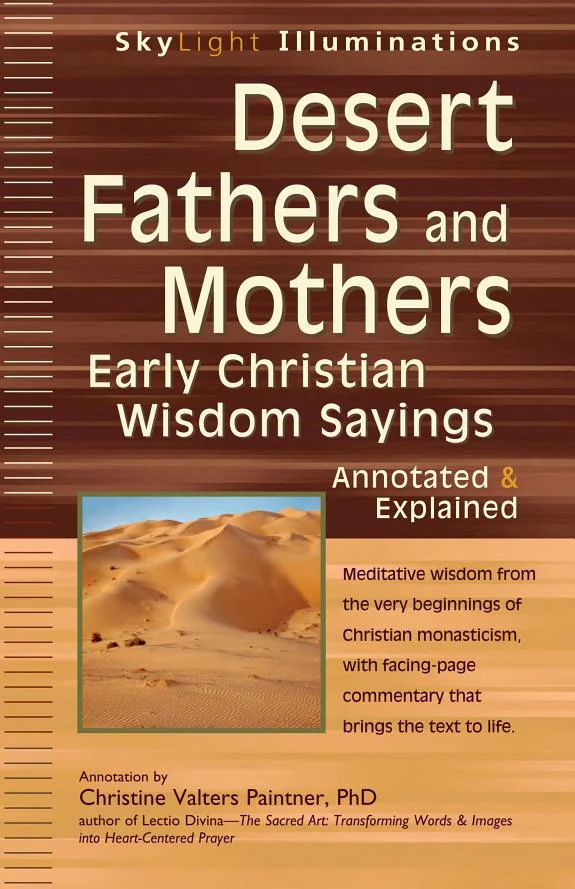
Desert Fathers and Mothers
 79
79

Desert Fathers and Mothers
Christine Valters Paintner’s collection, *Desert Fathers and Mothers*, presents the stark, compelling voices of early Christian ascetics. The strength lies in its straightforward presentation of their aphorisms and anecdotes, allowing the raw power of their renunciate lives to speak for itself. A particularly striking concept is the emphasis on *apatheia*, not as emotional numbness, but as a state of inner stillness free from the disturbance of passions. The limitation, however, is the occasional lack of deep historical or theological contextualization for readers unfamiliar with the period; the book sometimes assumes a prior understanding of early Christian monasticism.
Paintner offers a valuable window into a foundational ascetic tradition.
📝 Description
79
Christine Valters Paintner's book gathers the sayings of early Christian ascetics from the 3rd to 5th centuries.
This book collects the teachings of the Desert Fathers and Mothers, early Christian ascetics who pursued God through radical renunciation in the deserts of Egypt, Palestine, Syria, and Arabia. Active from approximately the 3rd to 5th centuries CE, these figures withdrew from society to live solitary lives, dedicating themselves to prayer and spiritual discipline. Their collected sayings and stories provide practical guidance for those on a personal path of devotion. The text is relevant for readers interested in the origins of Christian contemplative practices, asceticism, monasticism, and the history of Christian mysticism. It speaks to individuals seeking a deeper prayer life, enhanced self-discipline, and a more direct experience of the divine, especially those inspired by lives of solitude and simplicity. The figures discussed emerged in a significant period for Christianity, following its legalization and subsequent establishment as the Roman Empire's state religion. This era saw a backlash against what some perceived as growing worldliness within the Church, leading many to seek authenticity in the desert.
Antony the Great, often cited as the first desert father, set a precedent for ascetic living that profoundly shaped monastic traditions in both the East and West. The wisdom shared emphasizes spiritual disciplines such as constant prayer, fasting, manual labor, and obedience. It also addresses the internal struggle against negative thoughts, known as logismoi. The desert itself is presented not merely as a harsh physical environment but as a place for spiritual refinement and direct encounter with God. Key elements of their teachings include the cultivation of humility, the value of silence, and the careful discernment of one's thoughts as central to spiritual progress.
The Desert Fathers and Mothers represent an early phase of Christian asceticism, a movement focused on rigorous self-discipline and withdrawal from worldly distractions to achieve spiritual union. Their practices, such as prolonged prayer, fasting, and solitude, became foundational for later monasticism. This tradition emphasizes the inner life, viewing the physical world and the self as arenas for spiritual combat and transformation. Their emphasis on direct experience of God, often mediated through silence and the struggle against inner distractions, places them within a broader esoteric current that seeks immediate spiritual insight beyond institutional dogma.
💡 Why Read This Book?
• Gain practical wisdom on prayer and self-discipline directly from the 3rd-5th century Desert Fathers and Mothers, learning their methods for cultivating inner peace. • Understand the spiritual significance of the desert as a place of encounter with God, a concept central to their ascetic practice. • Explore the concept of *logismoi* (thoughts or inner demons) and the ascetics' strategies for discerning and overcoming them, as detailed in their sayings.
⭐ Reader Reviews
Honest opinions from readers who have explored this book.
❓ Frequently Asked Questions
Who were the Desert Fathers and Mothers?
They were early Christian monks and ascetics, primarily active from the 3rd to 5th centuries CE. They lived in the deserts of Egypt, Palestine, and Syria, seeking God through solitude, prayer, fasting, and renunciation of worldly possessions.
What is the main message of the Desert Fathers and Mothers?
Their core message emphasizes a radical commitment to God through asceticism, constant prayer, inner vigilance against negative thoughts, and the pursuit of humility and stillness in solitude.
What is 'apatheia' in the context of the Desert Fathers?
Apatheia refers to a state of inner tranquility and freedom from disordered passions and disturbances, achieved through disciplined spiritual practice, allowing for a clearer perception of God.
Where did the Desert Fathers and Mothers live?
They lived primarily in the deserts of Egypt (like the Scetis region), Palestine, Syria, and Arabia, seeking remote locations away from urban centers and societal distractions.
When were the Desert Fathers and Mothers most active?
Their period of greatest influence and activity is generally considered to be from the late 3rd century CE through the 5th century CE, with their teachings continuing to shape monasticism thereafter.
What does 'logismoi' mean in this spiritual tradition?
Logismoi are distracting or harmful thoughts, temptations, or passions that arise in the mind. The Desert Fathers taught rigorous methods for discerning and overcoming these internal disturbances.
🔮 Key Themes & Symbolism
Ascetic Discipline
The Desert Fathers and Mothers embraced rigorous ascetic practices as a means of purification and drawing closer to God. This included intense fasting, manual labor, celibacy, and renunciation of material possessions. Their lives demonstrate a profound belief that the body, through discipline, could become a vessel for divine encounter, stripping away worldly attachments to focus solely on spiritual realities. This theme highlights the transformative power of self-denial in achieving inner freedom and spiritual clarity.
The Desert as Spiritual Crucible
The arid landscapes were not merely a physical location but a symbolic and functional space for spiritual transformation. In the desert, away from the distractions and comforts of settled society, individuals confronted their inner demons and the raw realities of their spiritual path. It was seen as a place where God's presence could be encountered more directly, unmediated by social structures or worldly concerns, fostering a deep, personal relationship with the divine.
Discernment of Thoughts
A central focus of the Desert Fathers' teachings is the struggle against 'logismoi' – intrusive thoughts, temptations, or passions that disturb the mind and hinder prayer. They developed sophisticated methods for recognizing these thoughts, understanding their origins, and rejecting them through constant prayer, vigilance, and humility. This theme emphasizes the importance of inner work and mental discipline in achieving spiritual progress and maintaining peace.
The Practice of Silence and Stillness
Silence ('hesychia') was highly valued by the Desert Fathers and Mothers as essential for deep prayer and encountering God. They understood that external quietude facilitates internal stillness, creating the space for listening to God's voice. This theme underscores the contemplative dimension of their spirituality, where active doing is balanced by receptive being, allowing for direct spiritual experience beyond mere intellectual understanding.
💬 Memorable Quotes
Direct passages from the work, attributed to the author.
“The desert is the place where the heart finds God.”
— This expresses the belief that by removing worldly distractions and comforts, the individual's heart becomes more receptive to divine presence. The harshness of the desert environment mirrors the internal struggles necessary for spiritual purification.
“A monk carries his cell with him wherever he goes.”
— This aphorism speaks to the internal nature of monastic discipline. True spiritual practice is not dependent on external location but on the inner state of mind and heart, maintained through consistent practice.
“We must fight the battle of the heart.”
— This refers to the constant inner struggle against negative thoughts, temptations, and passions (logismoi). The Desert Fathers emphasized that true spiritual warfare occurs within one's own mind and heart.
“Humility is the foundation of all virtues.”
— This statement highlights the paramount importance of humility in the ascetics' spiritual path. Without it, other spiritual efforts are seen as hollow or prone to pride, hindering genuine connection with God.
“Even in sleep, do not cease to pray.”
— This illustrates the ideal of 'unceasing prayer' sought by the Desert Fathers. It suggests a state of prayerfulness so ingrained that it permeates even the subconscious, reflecting a complete dedication to God.
🌙 Esoteric Significance
Tradition
The Desert Fathers and Mothers represent a foundational stream within Christian mysticism and early ascetic spirituality. While not typically categorized under modern esoteric labels like Hermeticism or Gnosticism, their emphasis on direct, experiential knowledge of God, inner transformation through rigorous practice, and the symbolic field of the desert aligns with broader esoteric principles of spiritual alchemy and interior purification found across various traditions.
Symbolism
The primary symbol is the **desert** itself, representing a place of stripping away the superfluous, confronting the self, and encountering the divine in stark purity. **Fasting** symbolizes the subjugation of the physical to the spiritual, a voluntary emptying to be filled with divine grace. **Silence** is the receptive state necessary for hearing the divine voice, a space cleared of internal and external noise.
Modern Relevance
Contemporary contemplative practices, mindfulness movements, and even certain strands of psychological self-help draw implicitly or explicitly on the wisdom of the Desert Fathers. Thinkers like Thomas Merton, and contemporary authors like Christine Valters Paintner herself, have revitalized interest in their teachings for modern seekers. Their emphasis on inner stillness, discernment of thoughts, and finding the sacred in simplicity continues to offer a counter-narrative to the noise and speed of contemporary life.
👥 Who Should Read This Book
• Aspiring contemplatives and ascetics seeking historical models for radical spiritual commitment and disciplined prayer. • Students of Christian history and comparative religion interested in the origins of monasticism and mystical traditions. • Individuals wrestling with inner distractions and seeking practical methods for cultivating mental quietude and spiritual focus.
📜 Historical Context
The teachings of the Desert Fathers and Mothers emerged in the 4th and 5th centuries CE, a period of significant transition for Christianity following Emperor Constantine's Edict of Milan in 313 CE. As Christianity moved from persecution to establishment, many felt a spiritual vacuum and reacted against the perceived worldliness entering the Church. Figures like Antony the Great (c. 251–356 CE) pioneered the eremitic (solitary) life, withdrawing to the Egyptian desert. This movement offered an alternative to institutionalized religion, emphasizing direct experience of God through asceticism and contemplation. It stood in contrast to the developing scholastic and theological debates within the urban centers of the Roman Empire. While not facing direct censorship, this ascetic movement was sometimes viewed with suspicion by Church hierarchy concerned about extremism, yet its influence on monasticism, particularly through figures like John Cassian who documented their practices for Western audiences, was profound.
📔 Journal Prompts
The desert as a metaphor for inner stillness, and its role in encountering the divine.
Reflecting on the practice of *logismoi* and personal strategies for discernment.
The meaning of renunciation in contemporary life, inspired by the Desert Fathers' examples.
Analyzing the virtue of humility as presented in the sayings of the Desert Mothers and Fathers.
The significance of silence in spiritual practice, drawing parallels to the desert environment.
🗂️ Glossary
Asceticism
A spiritual discipline involving self-denial and rigorous practices (like fasting, celibacy, prayer) undertaken to achieve spiritual purification and closer union with God.
Logismoi
Greek term for thoughts, impulses, or temptations that disturb the mind. The Desert Fathers taught methods for recognizing, resisting, and overcoming these inner disturbances.
Apatheia
A state of inner stillness and freedom from disordered passions or emotional disturbances, achieved through spiritual discipline. It is not apathy, but a balanced, unperturbed state of the soul.
Eremitic Life
A form of monasticism characterized by solitude and withdrawal from society, exemplified by the Desert Fathers living alone in the wilderness.
Contemplation
A form of prayer or meditation focused on silent, attentive presence to God, often involving stillness and direct experience rather than discursive thought.
Discernment
The spiritual practice of distinguishing between different spiritual influences, particularly recognizing the origin and nature of thoughts and impulses to follow God's will.
Hesychia
Greek term for stillness or quietude, central to Eastern Orthodox spirituality and the practice of the Desert Fathers, emphasizing inner peace achieved through prayer and silence.
This book appears in 1 collection
🔮 Readers Also Liked
Browse all →









From the “Desert Fathers” Collection
View all →







More Free Sacred Texts & Gnosticism Books
View all →