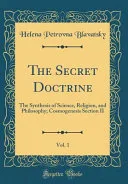
The Secret Doctrine, Vol. 1: The Synthesis of Science, Religion, and Philosophy; Cosmogenesis Section II (Classic Reprint)
 81
81

The Secret Doctrine, Vol. 1: The Synthesis of Science, Religion, and Philosophy; Cosmogenesis Section II (Classic Reprint)
Helena Petrovna Blavatsky’s *The Secret Doctrine*, Volume 1, remains a formidable, if often inscrutable, pillar of modern occult thought. This reprint of the Cosmogenesis Section II offers a stark encounter with her ambitious attempt to reconcile ancient mythos with nascent scientific understanding. Blavatsky's prose, particularly in this section, can be labyrinthine, demanding considerable readerly patience. Yet, her audacity in positing a universe governed by cyclical epochs and cosmic intelligences is undeniable. A particularly striking passage details the differentiation of the 'Mula-Prakriti' or primordial substance, illustrating the generative forces at play before manifest existence. However, the text’s reliance on obscure terminology and its often-assertive tone, without extensive empirical backing, can present significant barriers to comprehension. Despite these challenges, the sheer scope of Blavatsky's synthesis—attempting to unify science, religion, and philosophy from an esoteric standpoint—is its signal strength. It stands as a crucial, if demanding, document for understanding the roots of 20th-century esotericism.
📝 Description
81
Helena Petrovna Blavatsky published "The Secret Doctrine, Vol. 1" in 1888, detailing cosmogenesis.
This volume, the first of a monumental work, focuses on the cosmogenesis section of Helena Petrovna Blavatsky's "The Secret Doctrine." Section II specifically addresses the processes of cosmic creation, aiming to unify scientific, religious, and philosophical viewpoints. Blavatsky drew upon diverse ancient scriptures and philosophical traditions to outline a view of existence as cyclical, with the universe expanding and contracting over vast epochs. It is not a simple story but a philosophical argument intended to establish the basis for later discussions on human origins and spiritual development.
This text is for students of esoteric philosophy and comparative religion ready for complex reasoning. It explains the Theosophical perspective on cosmology as it developed in the late 19th century. Readers interested in the connections between ancient thought, early scientific ideas, and occultism will find relevant material. It requires a commitment to engaging with abstract concepts and questioning standard frameworks, rather than seeking easy answers.
Published in 1888, "The Secret Doctrine" emerged during a time of significant intellectual change. As Darwinism questioned religious beliefs and spiritualism grew, Blavatsky sought to blend Eastern and Western esoteric traditions. Her work presented a comprehensive cosmology that she argued predated and surpassed contemporary scientific and religious explanations. It positioned itself as the rediscovery of universal, ancient truths. The Theosophical Society, which Blavatsky co-founded, played a role in spreading these concepts.
💡 Why Read This Book?
• Gain insight into the Theosophical model of cosmic creation, understanding concepts like the Seven Planes of Existence as presented by Blavatsky, offering a unique cosmological framework distinct from Western scientific or religious doctrines. • Explore Blavatsky's integration of ancient Eastern philosophies, such as her interpretation of cyclical time and universal evolution found in the Cosmogenesis Section II, providing a comparative religious perspective. • Examine the historical significance of the 1888 publication, understanding its impact on the esoteric movements of the late 19th century and its engagement with contemporary scientific debates of that era.
⭐ Reader Reviews
Honest opinions from readers who have explored this book.
❓ Frequently Asked Questions
What is the primary focus of The Secret Doctrine, Vol. 1: Cosmogenesis Section II?
This section primarily details Helena Petrovna Blavatsky's theory of cosmic creation, outlining the universe's evolutionary stages from primordial substance through complex manifestations across vast cycles.
What makes this 'Classic Reprint' different from the original 1888 publication?
A 'Classic Reprint' like this one, published by Forgotten Books, aims to preserve the original text's content and layout, making it accessible again, though it may not include modern scholarly annotations.
Who was Helena Petrovna Blavatsky and what was Theosophy?
Blavatsky was a Russian occultist and founder of the Theosophical Society in 1875. Theosophy is a spiritual philosophy that seeks to understand the underlying unity of all religions and sciences, emphasizing esoteric wisdom.
What is the 'Mula-Prakriti' mentioned in The Secret Doctrine?
Mula-Prakriti, a Sanskrit term, refers to the undifferentiated, primordial substance or root-matter from which all the manifested universes arise according to Blavatsky's cosmology.
How does this book relate to modern science?
Blavatsky attempted to synthesize ancient esoteric teachings with the scientific understanding of her time (late 19th century). While many scientific theories have evolved, her work presents a philosophical challenge and alternative perspective.
Is this book suitable for beginners in esotericism?
Due to its dense philosophical arguments and specialized terminology, it is generally recommended for readers with some background in esoteric or comparative religious studies, rather than absolute beginners.
🔮 Key Themes & Symbolism
Cyclical Cosmology
The work posits a universe operating in vast cycles of manifestation and dissolution, far exceeding human comprehension of time. This cyclical view, often termed 'Manvantaras' and 'Pralayas', suggests that creation is not a singular event but an eternal rhythm. Blavatsky draws parallels between these cosmic cycles and the evolutionary processes of planets and humanity, proposing a grand, interconnected unfolding of existence governed by immutable laws. This contrasts sharply with linear creation narratives found in many Western religions.
Primordial Substance and Evolution
Central to Blavatsky's cosmogenesis is the concept of Mula-Prakriti, the unmanifested, undifferentiated root-stuff of the cosmos. From this primordial essence, through a process of differentiation and condensation, the various planes of existence and material forms emerge. The text details the stages of this evolutionary unfolding, guided by cosmic intelligences (Dhyan Chohans), presenting a hierarchical system where consciousness permeates all levels of reality, from the most subtle to the most material.
Root Races and Human Evolution
Volume 1 introduces the doctrine of Root Races, a framework for understanding humanity's evolutionary trajectory across cosmic cycles. Blavatsky outlines seven Root Races, each with distinct physical and spiritual characteristics, evolving sequentially on Earth. This concept provides a framework for interpreting ancient myths and legends as records of past evolutionary stages and foreshadows the development of future human forms and consciousness.
Cosmic Hierarchies
Blavatsky describes a complex hierarchy of cosmic beings, often referred to as Dhyan Chohans or 'Builders', who are responsible for the organization and evolution of the universe. These entities operate on various planes and guide the manifestation of form and consciousness according to divine law. They are presented as intermediaries between the Absolute and the manifested world, embodying different aspects of the universal intelligence.
💬 Memorable Quotes
Direct passages from the work, attributed to the author.
“The Law of Cycles... reigns over all the phenomena of the universe.”
— This statement underscores Blavatsky's belief in a universe governed by predictable, recurring patterns. It suggests that understanding these cosmic cycles is key to comprehending both universal and human evolution, moving away from notions of random chance.
“From the manifested Sound, Light, and Heat, the differentiation of the Kosmos is effected.”
— This highlights the fundamental energetic principles Blavatsky believed initiated and sustained cosmic creation. Sound, Light, and Heat are presented not merely as physical phenomena but as active, creative forces emerging from the primordial state.
“The Seven are the key to everything.”
— A recurring motif in esoteric traditions, Blavatsky emphasizes the number seven as a fundamental organizing principle. This applies to the seven planes of existence, seven principles of man, and seven Root Races, representing a foundational structure of reality.
“The universe is the playground of the Great Law.”
— This conveys the idea that all cosmic events and evolutionary processes are governed by an overarching, intelligent, and impartial principle or law, emphasizing order and purpose within the manifested world.
“Spirit, the Breath of Life, is the first and the last.”
— This points to the primacy of consciousness or spirit as the ultimate source and end of all existence. It asserts that life-breath is the fundamental reality from which all phenomena arise and to which they ultimately return.
🌙 Esoteric Significance
Tradition
The Secret Doctrine is a cornerstone text of the Theosophical tradition, which Blavatsky herself founded. It attempts to synthesize elements from Hermeticism, Kabbalah, Neoplatonism, Buddhism, and Hinduism, presenting them as fragments of a single, ancient universal doctrine. It departs from many Western esoteric systems by prioritizing Eastern concepts of cyclic time, karma, and reincarnation on a cosmic scale, viewing them as integral to a complete understanding of existence.
Symbolism
The work is rich with symbolism, notably the 'Ouroboros', representing cyclical eternity and the self-devouring nature of the cosmos. The 'Serpent' often symbolizes divine wisdom, primordial life, or Kundalini energy. Another key symbol is the 'Triangle', representing the Trinity in various traditions, but here often elaborated into a septenary system reflecting the seven planes or principles of manifestation and consciousness.
Modern Relevance
Contemporary esoteric thinkers and practitioners continue to draw from Blavatsky's cosmological frameworks. New Age movements, certain branches of Western esotericism, and students of comparative religion often reference her ideas on cyclic evolution, karma, and the interconnectedness of all life. Her synthesis has influenced subsequent occult authors and provided a foundational vocabulary for discussing spiritual evolution beyond conventional religious or scientific paradigms.
👥 Who Should Read This Book
• Students of comparative religion and mythology seeking to understand how ancient cosmologies are interpreted through an esoteric lens. • Researchers into the history of Western esotericism interested in the Theosophical movement and its foundational texts from the late 19th century. • Aspiring occultists and philosophers looking to engage with complex cosmological models that attempt to bridge science, religion, and ancient wisdom.
📜 Historical Context
When *The Secret Doctrine* was published in 1888, the intellectual landscape was dramatically shaped by Darwinian evolution and the burgeoning interest in spiritualism and Eastern philosophies. Helena Petrovna Blavatsky, a co-founder of the Theosophical Society in 1875, sought to present a 'UniversalCosmogony' that synthesized these disparate currents. Her work offered a sophisticated esoteric alternative to both orthodox religion and scientific materialism, drawing heavily on Hindu scriptures like the Stanzas of Dzyan (a text whose authenticity remains debated) and Buddhist cosmology. Blavatsky's ambitious synthesis aimed to reveal the 'ancient wisdom' underlying all traditions. The book was received with intense interest and controversy; while lauded by Theosophists, it faced skepticism and criticism from mainstream academics and religious figures. Contemporaries like Annie Besant became fervent proponents, while critics like the SPR’s Richard Hodgson questioned its originality and Blavatsky's claims.
📔 Journal Prompts
The differentiation of Mula-Prakriti and its subsequent evolution.
The role of the Dhyan Chohans in cosmic creation.
Humanity's place within the seven Root Races.
The significance of the number seven in cosmic structure.
The concept of cyclical time versus linear progression.
🗂️ Glossary
Mula-Prakriti
Sanskrit term for the primordial, undifferentiated substance or root-matter, the unmanifest source from which all cosmic manifestations arise in Blavatsky's cosmology.
Dhyan Chohans
Cosmic intelligences or 'Builders' described by Blavatsky, responsible for organizing and guiding the evolutionary processes of the universe across different planes of existence.
Manvantara
A Sanskrit term referring to a period of cosmic manifestation, a 'day of Brahma', representing a grand cycle of creation and evolution within the larger cosmic rhythm.
Pralaya
Sanskrit for a period of cosmic dissolution or rest, a 'night of Brahma', following a Manvantara, during which the universe withdraws into potentiality before the next cycle.
Root Races
Blavatsky's concept of seven successive stages of human evolution on Earth, each characterized by distinct physical, mental, and spiritual attributes, unfolding across vast geological and cosmic timescales.
Seven Planes
The hierarchical levels of existence described in Theosophy, ranging from the most material to the most spiritual, through which consciousness and matter evolve.
Stanzas of Dzyan
Ancient esoteric texts, purportedly the source material for Blavatsky's cosmogenesis, claimed to contain the fundamental principles of universal creation and evolution.