Mesmerism and Christian Science
 78
78

Mesmerism and Christian Science
Frank Podmore's 1909 examination, Mesmerism and Christian Science, offers a valuable, if somewhat dry, comparative study of two powerful currents in late Victorian spiritual thought. Its signal strength lies in its meticulous tracing of intellectual lineage, demonstrating how seemingly disparate movements could draw from a shared cultural wellspring of belief in unseen forces and the mind's dominion over matter. Podmore’s detailed exposition of mesmerism’s early practitioners and theories provides a solid foundation for understanding the groundwork upon which later spiritualist and healing movements were built. A notable limitation, however, is the author's somewhat detached, almost clinical, tone, which can obscure the passionate conviction that animated adherents of both mesmerism and Christian Science. The extended analysis of early mesmeric phenomena, particularly the debates surrounding 'passes' and induced trances, is particularly illuminating, though it might leave the reader wishing for a more direct engagement with the lived experience of these practices. Ultimately, the work serves as an important scholarly bridge between the study of mesmerism and the history of Christian Science, anchoring both within their historical moment.
📝 Description
78
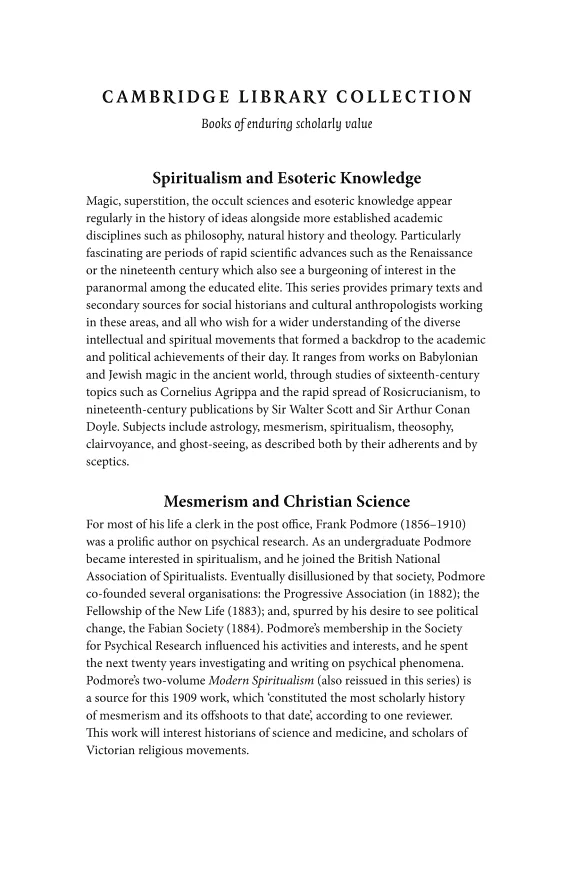
Frank Podmore's 1909 book connects mesmerism and Christian Science.
First published in 1909, Frank Podmore's work investigates the connections between 19th-century mesmerism and the rise of Christian Science healing. The book traces how ideas about psychic energy, faith, and consciousness developed, showing how these movements responded to a world questioning pure materialism.
Podmore examines concepts like animal magnetism and divine healing, contrasting the observational approach of mesmerism with Christian Science's theological basis. Both, he argues, offered solace and a sense of control by emphasizing non-physical forces over material reality. The text is suited for those interested in the intellectual currents of the late Victorian era that fueled spiritualist and mind-body healing movements.
This book sits within the study of late 19th and early 20th-century spiritualism and alternative healing. It examines how societal shifts, driven by scientific advancements and a questioning of materialism, led to the popularization of movements like Spiritualism and the development of unique healing systems such as Christian Science. Podmore's work bridges the gap between direct psychic phenomena like mesmerism and religiously framed healing, illustrating a broader interest in forces beyond the purely physical.
💡 Why Read This Book?
• Understand the historical roots of spiritual healing by examining Frank Podmore's analysis of mesmerism's influence, a key concept discussed in the book, which predates and informs later movements. • Grasp the intellectual climate of the late 19th century by exploring how phenomena like animal magnetism were scientifically and philosophically debated alongside the rise of Christian Science. • Gain insight into the distinct yet related approaches to mind-body connection as Podmore contrasts the methods and philosophies of mesmerism with Mary Baker Eddy's Christian Science.
⭐ Reader Reviews
Honest opinions from readers who have explored this book.
❓ Frequently Asked Questions
When was Mesmerism and Christian Science originally published?
Mesmerism and Christian Science by Frank Podmore was originally published in 1909, offering a contemporary analysis of these movements during their active periods.
What is the main focus of Frank Podmore's book?
The book focuses on the historical relationship between mesmerism, a practice involving hypnotic suggestion and alleged psychic energy, and the spiritual healing doctrines of Christian Science.
How does Podmore compare mesmerism and Christian Science?
Podmore compares them by tracing their shared interest in non-physical healing and the power of the mind, while also highlighting their distinct theoretical frameworks and methods of practice.
Is this book a primary source for Christian Science?
No, it is a secondary analysis written in 1909 by an observer of both movements. It provides historical and comparative context rather than being a foundational text of Christian Science itself.
What historical period does Mesmerism and Christian Science cover?
The book primarily covers the late 18th century with the origins of mesmerism and the late 19th century, the period of peak influence for both mesmerism and the early development of Christian Science.
What does the term 'animal magnetism' refer to in this context?
'Animal magnetism' is the term used by Franz Mesmer to describe a supposed universal vital fluid that could be manipulated, forming the basis of mesmerism and early hypnotic practices.
🔮 Key Themes & Symbolism
The Power of Suggestion
Podmore meticulously details how suggestion operates within mesmerism, inducing altered states and influencing behavior. He then draws parallels to how belief and suggestion function within Christian Science's framework of spiritual healing, positing that the mind's conviction, amplified by faith, can override perceived physical limitations. The work explores how both phenomena leverage psychological mechanisms, albeit through different conceptual lenses, to achieve therapeutic outcomes.
Spiritual vs. Material Explanations
This book positions mesmerism and Christian Science as significant responses to the perceived limitations of 19th-century materialism. Podmore illustrates how both movements offered alternative explanations for healing and consciousness, appealing to spiritual forces or the inherent power of the mind. He examines the societal fascination with these non-physical modalities, contrasting them with the scientific rationalism prevalent at the time and highlighting the enduring human quest for meaning beyond the purely physical.
Evolution of Healing Practices
Mesmerism and Christian Science charts the historical progression from early explorations of psychic energy and hypnotic states to the more systematized theological approach of Christian Science. Podmore analyzes how concepts like 'divine healing' and 'mind over matter' were articulated and practiced differently across these movements. The work provides a critical look at how these beliefs were disseminated and received, offering a glimpse into the evolving range of alternative healing and spiritual belief systems.
The Role of Faith and Belief
Central to Podmore's analysis is the pervasive role of faith and belief in both mesmerism and Christian Science. He investigates how conviction—whether in the mesmeric healer, the spiritual energy, or divine intervention—was presented as a crucial component for achieving desired results. The book explores the psychological and societal implications of relying on faith as a primary modality for well-being, demonstrating its powerful influence in shaping individual and collective experiences.
💬 Memorable Quotes
Direct passages from the work, attributed to the author.
“The phenomena of Christian Science are, in fact, a direct challenge to the current beliefs concerning the nature of disease and the efficacy of medical treatment.”
— This statement highlights the revolutionary aspect of Christian Science as perceived by observers like Podmore, positioning it as a radical departure from established medical and scientific understanding of the late 19th century.
“Mesmerism, or 'animal magnetism,' proposed a subtle fluidic force capable of inducing sleep and therapeutic effects through the will of the operator.”
— This succinctly defines the core concept of mesmerism as understood in the era, emphasizing the practitioner's role and the idea of an invisible energy exchange central to its practice.
“Both movements tapped into a widespread societal yearning for explanations beyond the purely materialistic worldview gaining dominance.”
— This interpretation suggests that the popularity of both mesmerism and Christian Science stemmed from their ability to offer comfort and meaning in an era increasingly defined by scientific rationalism and industrial change.
💡 Key Ideas
Editorial paraphrase of the work's core concepts — not direct quotes.
The reliance on spiritual interpretation rather than direct psychic manipulation distinguishes Christian Science from earlier mesmeric traditions.
This paraphrase points to a key divergence Podmore identifies: while both systems address healing, Christian Science grounds its efficacy in theology and divine principle, unlike the more direct, energetic manipulation associated with mesmerism.
The effectiveness attributed to Christian Science healing often hinges on the patient's absolute faith in its doctrines and the power of God.
This paraphrased concept underscores the critical role of belief and faith within the Christian Science healing paradigm, as observed by Podmore, suggesting it is foundational to its perceived success.
🌙 Esoteric Significance
Tradition
Podmore's work sits at the intersection of late 19th-century psychical research and the burgeoning study of religious movements. While not strictly belonging to a single esoteric lineage like Hermeticism or Kabbalah, it engages with the broader Hermetic principle of 'as above, so below' and the Gnostic emphasis on spiritual knowledge over material reality. The book analyzes how both mesmerism and Christian Science, in their own ways, sought to access or manifest a higher, spiritual order to influence the material world, particularly concerning health.
Symbolism
Key motifs include the concept of 'animal magnetism' itself, representing a subtle, pervasive life force or energy akin to vitalism. Another significant element is the idea of 'divine Mind' within Christian Science, symbolizing a perfect, incorporeal reality that supersedes material illusion. Podmore also implicitly engages with the symbolism of light and darkness, or knowledge versus ignorance, in contrasting the rationalistic, materialistic worldview with the spiritual insights offered by these alternative systems.
Modern Relevance
Podmore's analysis remains relevant for understanding the historical trajectory of mind-body medicine, New Thought movements, and the enduring appeal of spiritual healing. Contemporary practices in energy healing, consciousness studies, and even certain therapeutic applications of hypnosis echo themes explored in his work. Thinkers and practitioners interested in the philosophical underpinnings of placebo effects, the power of intention, and the historical development of non-traditional wellness approaches can find valuable context in this study.
👥 Who Should Read This Book
• Students of 19th-century social and intellectual history seeking to understand the cultural forces that gave rise to spiritualist and New Thought movements. • Researchers in the history of religion and parapsychology interested in the comparative development of mesmerism and Christian Science. • Practitioners of alternative healing modalities who wish to explore the historical precedents and philosophical underpinnings of mind-body therapeutics.
📜 Historical Context
Published in 1909, Frank Podmore's *Mesmerism and Christian Science* emerged from a fertile period of spiritual and intellectual ferment in Britain and America. The late Victorian and Edwardian eras were marked by intense public and academic interest in psychical research, Spiritualism, and alternative healing modalities. Movements like the Theosophical Society, founded by Helena Blavatsky in 1875, explored Eastern philosophies and esoteric traditions, contributing to a broader climate receptive to non-material explanations for reality. Podmore himself was a prominent member of the Society for Psychical Research, established in 1882, which investigated phenomena ranging from telepathy to hauntings. In this milieu, Christian Science, formally established by Mary Baker Eddy in the 1870s, represented a distinct but related spiritual impulse. While Spiritualism often focused on communication with the departed and phenomena like mediumship, Christian Science centered on a theological interpretation of healing through divine Mind. Podmore's work sought to contextualize both, exploring their roots and relationships within this complex intellectual landscape, a landscape also being charted by contemporaries like William James, whose *The Varieties of Religious Experience* (1902) explored similar themes of belief and healing.
📔 Journal Prompts
The concept of animal magnetism as a universal fluid.
Mary Baker Eddy's doctrine of divine Mind versus physical reality.
The role of the practitioner in mesmerism compared to faith in Christian Science.
Societal responses to spiritual healing in the late 19th century.
The tension between materialistic science and spiritual explanations for phenomena.
🗂️ Glossary
Mesmerism
A pseudoscientific theory and practice developed by Franz Mesmer in the late 18th century, involving the manipulation of a supposed vital fluid ('animal magnetism') to induce a trance-like state and effect healing.
Animal Magnetism
The invisible, natural force or fluid proposed by Franz Mesmer, believed to permeate the universe and be capable of influencing living beings, particularly through the will of a 'magnetizer'.
Christian Science
A religious movement founded by Mary Baker Eddy in the late 19th century, teaching that reality is purely spiritual and that physical disease is an illusion of mortal mind, curable through prayer and spiritual understanding.
Spiritualism
A religious movement prominent in the 19th century, based on the belief that the spirits of the dead can communicate with the living, often through mediums.
Psychical Research
The interdisciplinary study of purported psychic phenomena, such as telepathy, clairvoyance, precognition, and psychokinesis, often employing scientific methods.
Suggestion
In the context of mesmerism, the process by which a hypnotist or healer influences the thoughts, feelings, or actions of a subject, often leading to psychosomatic effects or altered states of consciousness.
Divine Mind
A central concept in Christian Science, referring to the allness and perfection of God, understood as the only true reality, from which all good emanates and which corrects the illusion of material existence.
This book appears in 1 collection
🔮 Readers Also Liked
Browse all →








From the “Mesmerism” Collection
View all →



More Free Esoteric History & Biography Books
View all →