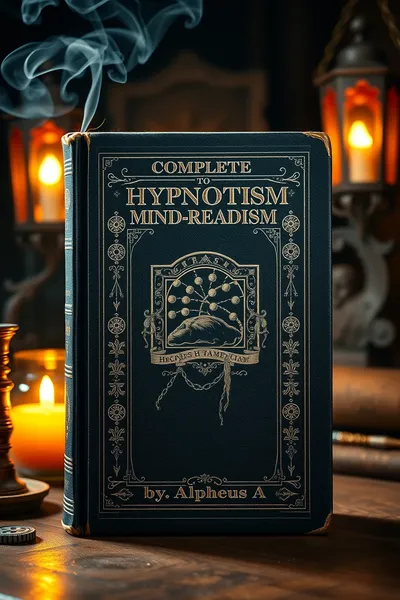
How to Hypnotize
 71
71

How to Hypnotize
A. Alpheus's "How to Hypnotize" approaches its subject with a straightforward, almost instructional tone, eschewing flowery prose for direct guidance. Its strength lies in its thoroughness, touching upon hypnotism, mesmerism, mind-reading, and spiritualism within a single volume. The clarity of its early sections on establishing rapport and inducing trance is commendable for beginners. However, the latter sections, particularly those on "mind-reading" and "spiritualism," feel less substantiated, blending speculative claims with practical advice in a way that might confuse less experienced readers. The work's assertion that "hypnotism is simply the art of controlling the subconscious mind through suggestion" is a useful, albeit simplified, starting point. Ultimately, "How to Hypnotize" serves as a functional primer, best suited for those with a specific, practical interest in the mechanics of suggestion and trance induction.
📝 Description
71
A. Alpheus published 'How to Hypnotize' in 2012, detailing hypnotic techniques for influencing perception and consciousness.
This 2012 manual by A. Alpheus details the principles and practices of hypnosis. It covers how to influence perception, enhance persuasion, and achieve altered states of consciousness. The book combines theoretical explanations with practical exercises, offering a thorough introduction to the mechanics of hypnosis and related esoteric disciplines. It is written for individuals interested in mental discipline, esoteric arts, or the history of mesmerism. Readers will find discussions on suggestion, altered states, and the potential for mental communication.
The work draws on the historical interest in mesmerism and spiritualism, movements prominent in the 19th century. It acknowledges figures like Franz Mesmer and the early 20th century's continued study of psychic phenomena. Central concepts include suggestion, concentration, and rapport, explaining how focused attention can induce trance. Alpheus discusses hypnotic communication and phenomena such as "mind-reading" as outcomes of focused mental energy and suggestibility.
This book is situated within the historical currents of mesmerism and spiritualism, traditions that gained traction in the 19th century and continued into the early 20th. These movements investigated phenomena like animal magnetism and psychic abilities, seeking to understand consciousness and influence beyond conventional scientific understanding. Alpheus's work connects these historical explorations to practical techniques for inducing altered states, focusing on concentration, suggestion, and the development of rapport. It reflects a lineage of esoteric thought concerned with the untapped potential of the human mind and subtle energies.
💡 Why Read This Book?
• You will learn specific techniques for inducing trance states and utilizing suggestion, a core skill detailed in the early chapters concerning "hypnotism" and "mesmerism." • You can explore the historical connections between hypnosis and spiritualism, as presented in the text's integration of these practices, offering a unique perspective from its 2012 publication. • You will gain an understanding of the principles of "mind-reading" as described by Alpheus, which focuses on heightened suggestibility and focused observation, distinct from paranormal claims.
⭐ Reader Reviews
Honest opinions from readers who have explored this book.
❓ Frequently Asked Questions
What is mesmerism according to A. Alpheus?
According to A. Alpheus in "How to Hypnotize," mesmerism refers to a practice involving the manipulation of a hypothetical "animal magnetism" to induce a trance state, closely related to early forms of hypnotism and suggestion.
Does "How to Hypnotize" teach actual mind-reading?
The book presents "mind-reading" as a potential outcome of advanced hypnotic techniques, emphasizing heightened intuition and subtle cues rather than literal psychic ability, framed within the context of suggestion and psychological influence.
Is this book suitable for absolute beginners in hypnosis?
Yes, the book is designed as a comprehensive guide, offering foundational knowledge and practical steps that make it accessible for those entirely new to the study and practice of hypnotism and mesmerism.
What is the historical significance of this book's publication year, 2012?
Published in 2012, "How to Hypnotize" reflects a modern compilation of historical esoteric practices, placing classic techniques within a contemporary publishing context, distinct from their original 19th-century prevalence.
How does Alpheus connect spiritualism and hypnotism?
Alpheus connects spiritualism and hypnotism by suggesting that the heightened suggestibility and altered states achieved through hypnosis can facilitate experiences often attributed to spiritual communication or mediumship.
Are there specific exercises for developing hypnotic skills in the book?
Yes, "How to Hypnotize" includes numerous practical exercises designed to help readers develop skills in suggestion, concentration, and rapport building, essential for effective hypnotic practice.
🔮 Key Themes & Symbolism
The Art of Suggestion
The work posits suggestion as the fundamental tool of hypnosis and mesmerism. It details how carefully crafted verbal and non-verbal cues can influence a subject's thoughts, feelings, and perceptions. Alpheus emphasizes the importance of clear intent and confident delivery, presenting suggestion not as manipulation but as a directed form of communication aimed at unlocking the subject's potential or guiding their focus.
Altered States of Consciousness
A central theme is the exploration and induction of altered states, commonly referred to as trance. The book guides readers through various methods to achieve these states, distinguishing between light, medium, and deep hypnotic conditions. It examines the subjective experience of trance and its potential applications, from therapeutic suggestion to heightened sensory perception.
Mind-Reading and Spiritualism
Alpheus approaches "mind-reading" and "spiritualism" as phenomena that can be understood through the lens of advanced hypnotic principles. This includes the cultivation of intuition, the interpretation of subtle cues, and the potential for telepathic-like communication through deep rapport and suggestion, linking these esoteric pursuits to psychological influence rather than purely supernatural origins.
Esoteric Practice and Self-Mastery
Beyond specific techniques, the book promotes a broader philosophy of self-mastery and personal development through the disciplined application of mental faculties. It frames the study of hypnotism and mesmerism as a path toward understanding one's own mind and enhancing personal influence, aligning with broader esoteric traditions focused on inner work and potential.
💬 Memorable Quotes
Direct passages from the work, attributed to the author.
“Hypnotism is simply the art of controlling the subconscious mind through suggestion.”
— This statement expresses the book's pragmatic approach, reducing complex hypnotic phenomena to the core mechanism of directed influence via suggestion. It highlights the power and accessibility of the subconscious for those who understand how to communicate with it effectively.
“The operator must first establish a rapport with the subject.”
— This emphasizes the foundational importance of trust and connection between the hypnotist and the subject. Without this established link, the effectiveness of any suggestion or hypnotic technique is significantly diminished, making rapport a prerequisite for success.
“Concentration is the key to unlocking the mind's latent powers.”
— Alpheus suggests that focused mental effort, whether by the operator or the subject, is crucial for accessing deeper levels of consciousness and potential. This principle underpins various exercises and techniques described throughout the manual.
“Mesmerism paved the way for modern hypnotism.”
— This highlights the historical lineage of hypnotic practices, tracing modern techniques back to the earlier work of figures like Franz Mesmer and the concept of animal magnetism.
“Spiritualism can be understood as an extension of hypnotic suggestion.”
— This controversial interpretation reframes spiritualistic phenomena through a psychological lens, suggesting that many reported mediumistic or telepathic experiences might stem from the principles of suggestion and altered states.
🌙 Esoteric Significance
Tradition
This work fits within the broad Western Esoteric tradition, particularly its branches concerned with psychical research and mental sciences, which flourished in the late 19th and early 20th centuries. It bridges the gap between practical occultism focused on will and influence, and the more speculative investigations into consciousness and the subconscious mind characteristic of movements like Theosophy or early parapsychology.
Symbolism
The book's symbolism is less about overt mystical icons and more about the symbolic power of suggestion and focused intent. The 'operator' can be seen as a symbolic figure of control and guidance, while the 'trance state' symbolizes access to deeper, often hidden, potentials of the human mind. The concept of 'rapport' itself symbolizes the energetic and psychological connection between individuals.
Modern Relevance
Contemporary practices in areas like hypnotherapy, neurolinguistic programming (NLP), and certain forms of mindfulness and consciousness exploration can trace conceptual lineage back to the principles outlined in texts like Alpheus's. Thinkers exploring the power of belief, placebo effects, and the subconscious mind continue to find relevance in the foundational techniques of suggestion and altered states.
👥 Who Should Read This Book
• Aspiring practitioners of esoteric arts interested in the mechanics of mental influence and consciousness alteration, seeking a foundational text. • Students of Western Esotericism curious about the historical development and practical application of hypnotism, mesmerism, and related phenomena. • Individuals interested in self-improvement and psychology looking to understand the power of suggestion and the subconscious mind from a non-clinical, esoteric perspective.
📜 Historical Context
A. Alpheus's "How to Hypnotize," published in 2012, draws heavily from the intellectual currents of the 19th century, a period marked by intense fascination with mesmerism, spiritualism, and psychic phenomena. Figures like Franz Mesmer had earlier popularized concepts of "animal magnetism," which evolved into the practices of hypnotism studied by researchers like Jean-Martin Charcot and Hippolyte Bernheim in the late 19th century. While Alpheus's work is a modern compilation, it engages with this historical legacy. The book implicitly contrasts with the more clinical, scientific approaches to hypnosis that gained traction in the mid-20th century, such as those developed by Milton H. Erickson. It also exists in a landscape where spiritualism, though less mainstream than in its Victorian heyday, continues to be explored within esoteric and New Age communities, often intersecting with alternative psychology and consciousness studies.
📔 Journal Prompts
Reflect on the core principle of suggestion as described by Alpheus.
How does the concept of rapport, as detailed in the book, relate to your personal interactions?
Consider the historical links between mesmerism and modern hypnotism explored in the text.
Analyze the author's interpretation of "mind-reading" through the lens of suggestion.
Explore the potential applications of induced trance states beyond the scope presented.
🗂️ Glossary
Hypnotism
The practice of inducing a trance-like state in a subject, characterized by heightened suggestibility and focused attention, often used for therapeutic or experimental purposes.
Mesmerism
An early form of hypnotism, named after Franz Mesmer, based on the theory of 'animal magnetism,' involving passes and manipulation to induce a trance state.
Suggestion
A specific idea or instruction presented to a subject, which they are influenced to accept and act upon, especially within a hypnotic state.
Trance
An altered state of consciousness characterized by deep relaxation, focused attention, and increased receptivity to suggestion, distinct from normal waking consciousness.
Mind-Reading
As presented in the book, the ability to perceive another person's thoughts or intentions, often framed as a result of enhanced intuition and subtle cue interpretation within a hypnotic context.
Spiritualism
A belief system centered on the idea that the spirits of the dead can communicate with the living, often through mediums; the book discusses its connection to hypnotic states.
Rapport
A harmonious relationship or connection between two individuals, considered essential for effective hypnotic induction and communication.