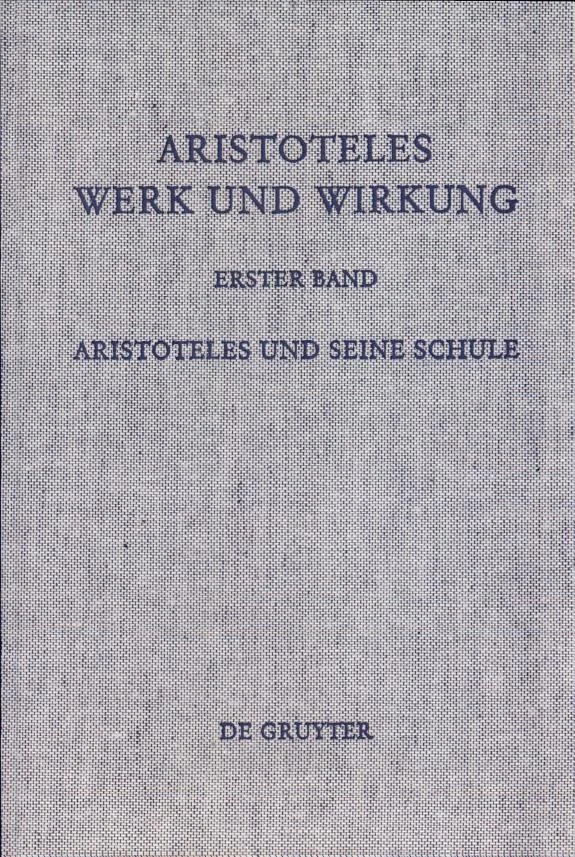
Aristoteles, Werk und Wirkung: Aristoteles und seine Schule
 71
71

Aristoteles, Werk und Wirkung: Aristoteles und seine Schule
Wiesner's dense study, "Aristoteles, Werk und Wirkung: Aristoteles und seine Schule," offers a rigorously academic look at the philosopher and his immediate intellectual descendants. The strength lies in its detailed exposition of the Lyceum's internal workings and the subtle shifts in doctrine introduced by figures like Theophrastus. However, the work's academic density, while a virtue for specialists, presents a significant barrier for general readers. A particularly illuminating section details the Peripatetic approach to ethics, emphasizing virtue as a mean, a concept Wiesner elucidates with careful attention to its early interpretations. The book is a valuable, if specialized, contribution to understanding the transmission of ancient thought. It provides a clear, if demanding, account of Aristotelian influence.
📝 Description
71
Jürgen Wiesner's 1985 study examines Aristotle's philosophy and his school.
Published in 1985, Jürgen Wiesner's "Aristoteles, Werk und Wirkung: Aristoteles und seine Schule" offers a detailed academic analysis of Aristotle's philosophical works and the early Peripatetic school. This is not a general introduction; rather, it is a rigorous academic text for those with prior knowledge of classical philosophy. Wiesner focuses on the intellectual lineage stemming directly from Aristotle, examining how his immediate disciples preserved and developed his thought.
The book delves into specific Aristotelian doctrines, including the concept of the unmoved mover, the four causes, and the soul as the form of the body. It also considers the structure and teaching methods of Aristotle's Lyceum and how figures like Theophrastus adapted his philosophy. The work prioritizes Aristotle's empirical and logical foundations, distinguishing its approach from later interpretations.
While this work primarily engages with classical philosophy, its detailed examination of Aristotle's systematic thought, particularly his metaphysics and cosmology (like the unmoved mover), touches upon themes that have been reinterpreted within esoteric traditions for centuries. The meticulous analysis of logical structures and the nature of reality, as understood by Aristotle and his immediate successors, forms a basis for later mystical and philosophical explorations that sought universal principles. The focus on the transmission of knowledge from a central figure to his students also echoes patterns found in various esoteric lineages.
💡 Why Read This Book?
• Gain a precise understanding of Aristotle's doctrine of the four causes, as analyzed through the lens of his earliest followers, providing a foundational grasp of causation in Western thought. • Explore the organizational structure and pedagogical methods of Aristotle's Lyceum, offering insight into ancient academic institutions and the practical dissemination of philosophical ideas. • Examine the specific contributions of Theophrastus, Aristotle's successor, to the Peripatetic school, highlighting how core Aristotelian concepts were adapted and expanded in the late 4th century BCE.
⭐ Reader Reviews
Honest opinions from readers who have explored this book.
❓ Frequently Asked Questions
What is the primary focus of Jürgen Wiesner's "Aristoteles, Werk und Wirkung: Aristoteles und seine Schule"?
The book's primary focus is a scholarly examination of Aristotle's philosophical works and the intellectual legacy of his school, the Lyceum, particularly the ideas transmitted by his immediate disciples.
Who was Theophrastus in relation to Aristotle?
Theophrastus was Aristotle's successor as head of the Lyceum. He played a crucial role in preserving, interpreting, and further developing Aristotelian philosophy after his teacher's death.
What are the 'four causes' discussed in Aristotelian philosophy?
The four causes are material, formal, efficient, and final. Wiesner's work explores how Aristotle and his school understood these causes as fundamental to explaining any phenomenon.
Is "Aristoteles, Werk und Wirkung" suitable for beginners in philosophy?
No, the book is written for advanced students and scholars due to its dense, academic style and specialized terminology, requiring prior familiarity with classical philosophy.
When was "Aristoteles, Werk und Wirkung: Aristoteles und seine Schule" first published?
The work was first published in 1985, positioning it within a later 20th-century scholarly engagement with classical antiquity.
What is the 'Lyceum' in the context of Aristotle?
The Lyceum was the school founded by Aristotle in Athens around 335 BCE. It served as a center for philosophical teaching and research, and its members formed the Peripatetic school.
🔮 Key Themes & Symbolism
Peripatetic School Doctrine
This volume meticulously traces the philosophical doctrines that emanated from Aristotle's Lyceum. It focuses on how his students, particularly Theophrastus, interpreted and expanded upon foundational concepts like the prime mover and the classification of virtues. The work highlights the school's commitment to empirical observation and logical analysis as primary tools for understanding the cosmos and human existence, differentiating it from more speculative traditions.
The Four Causes
A central tenet explored is Aristotle's theory of the four causes: material, formal, efficient, and final. Wiesner's analysis demonstrates how the Peripatetic school grappled with these explanatory principles, applying them to diverse fields from physics to ethics. The book illustrates the intellectual framework Aristotle provided for understanding causality, emphasizing the interconnectedness of a thing's matter, form, origin, and purpose.
Aristotle's Lyceum
The book provides a detailed look into the structure and intellectual life of Aristotle's school, the Lyceum. It examines its role as a center for advanced philosophical study and research in the late 4th century BCE. Understanding the Lyceum's organization sheds light on the methods of philosophical inquiry and pedagogy that shaped Western thought for centuries.
Transmission of Knowledge
Central to Wiesner's study is the concept of how knowledge was transmitted and evolved within Aristotle's immediate circle. It examines the process by which disciples preserved, systematized, and sometimes subtly altered Aristotle's teachings, creating a lineage of thought. This focus on intellectual inheritance is crucial for understanding the long-term impact of Aristotelianism.
💬 Memorable Quotes
Direct passages from the work, attributed to the author.
“Theophrastus's elaboration on Aristotelian ethics.”
— This refers to the work's exploration of how Aristotle's successor, Theophrastus, built upon his master's ethical frameworks, likely refining or extending discussions on virtue and the good life within the Peripatetic school.
“The four causes as explanatory tools.”
— This captures the essence of how the book presents Aristotle's framework for understanding phenomena, emphasizing the material, formal, efficient, and final aspects as integral to a complete explanation.
“Aristotle's focus on immanent causality.”
— This interpretation suggests the book underscores Aristotle's tendency to seek explanations within the natural world itself, rather than relying on transcendent principles, a key aspect of his philosophical method.
“The Peripatetic school's empirical orientation.”
— This points to the book's portrayal of Aristotle and his followers prioritizing observation and empirical evidence as the basis for philosophical understanding, a hallmark of their approach.
💡 Key Ideas
Editorial paraphrase of the work's core concepts — not direct quotes.
The Lyceum as a center of systematic inquiry.
This paraphrased concept highlights the book's emphasis on Aristotle's school not merely as a place of lecture, but as an active research institution dedicated to methodical investigation and knowledge accumulation.
🌙 Esoteric Significance
Tradition
While Aristotle himself predates many formalized esoteric traditions, his emphasis on logic, the prime mover, and the soul's nature has been foundational for later Hermetic and Neoplatonic thinkers. Wiesner's work, by detailing the systematic, rational approach of the Peripatetic school, provides the bedrock upon which later mystical interpretations were built. It offers a crucial lens for understanding the intellectual architecture that esoteric traditions later engaged with, adapted, or reacted against.
Symbolism
Key symbolic motifs explored implicitly include the 'prime mover' as a concept of ultimate, unmoved origin—a theme echoed in various mystical cosmologies. The concept of 'form' (eidos) as the essence or blueprint of matter also carries symbolic weight, representing structure and divine order. The methodical categorization and analysis inherent in the Peripatetic method itself can be seen as a symbolic pursuit of cosmic intelligibility.
Modern Relevance
Contemporary esoteric practitioners and scholars of Western esotericism often engage with Aristotelian thought as a foundational element of the philosophical tradition they inherit. Philosophers exploring virtue ethics, thinkers analyzing consciousness, and those studying the history of metaphysics frequently draw upon the rigorous frameworks established by Aristotle and his school, as detailed in works like Wiesner's, to ground their own inquiries.
👥 Who Should Read This Book
• Advanced students of classical philosophy: Gain a deeper, textually grounded understanding of Aristotle's core ideas and their immediate transmission beyond introductory surveys. • Scholars of ancient Greek intellectual history: Access detailed analysis of the Lyceum's structure and the philosophical contributions of Aristotle's early disciples, particularly Theophrastus. • Comparative religion researchers: Understand the philosophical underpinnings that later esoteric traditions engaged with, providing context for the development of Western metaphysical thought.
📜 Historical Context
Published in 1985, Jürgen Wiesner's work emerges from a robust tradition of Aristotelian scholarship that intensified in the late 20th century. This period saw critical re-evaluations of ancient texts and philosophical systems. Wiesner's focus on the immediate Aristotelian school, particularly figures like Theophrastus, distinguishes his work from broader historical surveys or those emphasizing later Neoplatonic interpretations. The intellectual currents of the time encouraged detailed philological analysis and close readings of primary sources. While not a direct engagement with a specific contemporary debate, the book contributes to the ongoing scholarly project of accurately reconstructing and understanding the foundational thinkers of Western philosophy, placing Aristotle's school in dialogue with the wider Hellenistic philosophical landscape that would soon feature Stoicism and Epicureanism.
📔 Journal Prompts
The Lyceum's systematic approach to knowledge.
Aristotle's concept of the unmoved mover.
Theophrastus's role in Peripatetic doctrine.
The application of the four causes.
Aristotelian ethics as presented by his school.
🗂️ Glossary
Peripatetic School
The philosophical school founded by Aristotle, named after the colonnade (peripatos) at the Lyceum where Aristotle taught. Its members focused on empirical observation and logical analysis.
Lyceum
The ancient Greek gymnasium and later philosophical school in Athens established by Aristotle around 335 BCE, serving as the center for the Peripatetic school.
Theophrastus
Aristotle's successor as head of the Lyceum. He was a significant philosopher in his own right, known for his work in botany and for developing Aristotelian thought.
Unmoved Mover
Aristotle's concept of a prime cause of all motion and change in the universe, which itself is unmoved and unchanging. It is pure actuality.
Four Causes
Aristotle's framework for explaining phenomena: material cause (what it's made of), formal cause (its essence or form), efficient cause (what brought it into being), and final cause (its purpose or telos).
Psyche
Greek for 'soul' or 'mind'. In Aristotelian philosophy, it is understood as the form or essence of a living being, the principle of life and activity.
Doctrine
A belief or set of beliefs held and taught by a church, political party, or other group; in philosophy, a tenet or system of beliefs.
This book appears in 1 collection
🔮 Readers Also Liked
Browse all →







From the “Neoplatonism” Collection
View all →








More Free Esoteric History & Biography Books
View all →