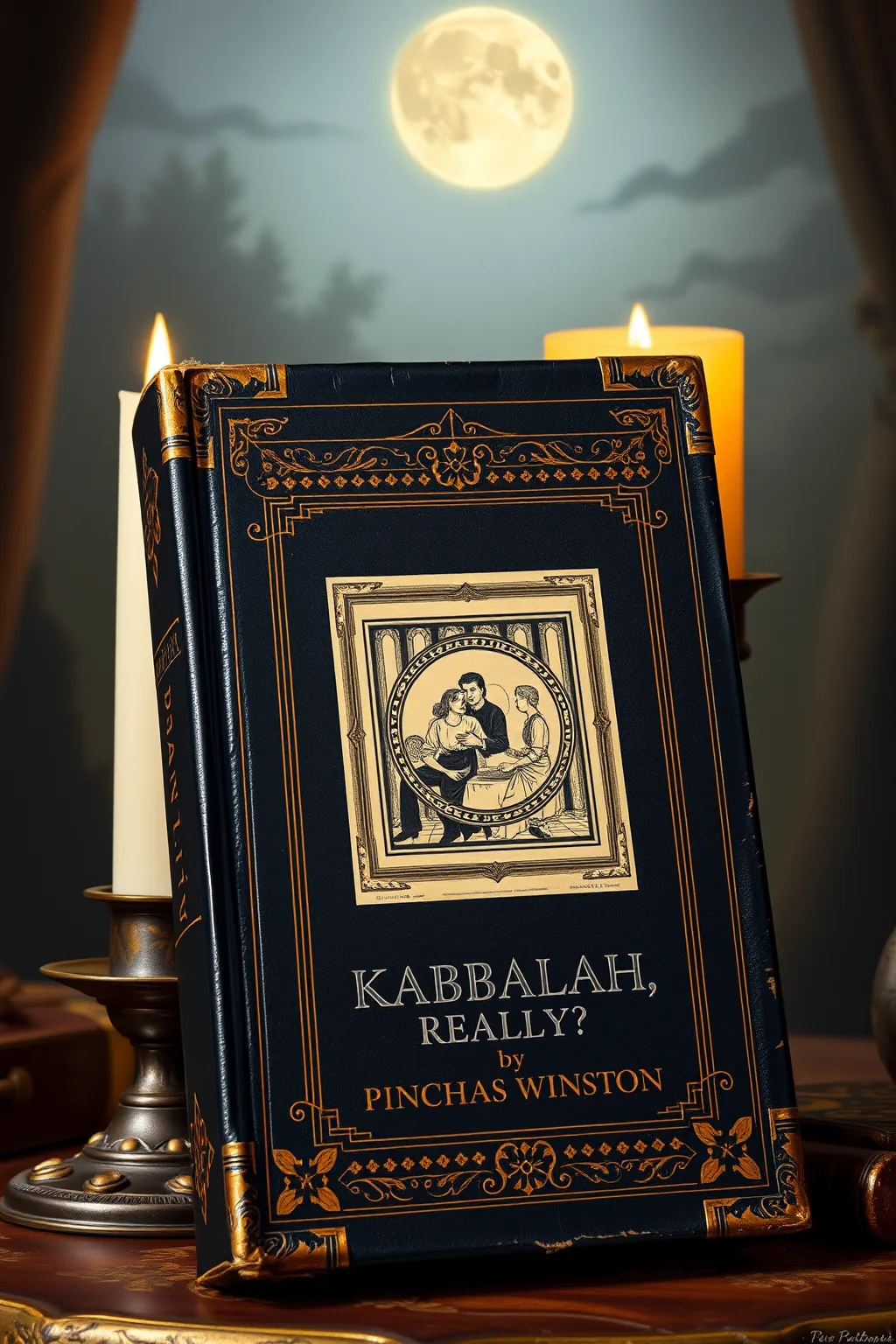
Kabbalah, Really?
 61
61

Kabbalah, Really?


Ophelia Vance, Mystical Literature Reviewer — Pinchas Winston's "Kabbalah, Really?" is a compelling exploration that demystifies the profound depths of Jewish mysticism. Winston possesses a rare gift for translating complex esoteric concepts into accessible yet profoundly insightful prose. He skillfully navigates the intricate tapestry of Kabbalistic thought, revealing its hidden order and spiritual architecture. This work is particularly valuable for its ability to connect ancient wisdom to contemporary spiritual yearning, offering genuine esoteric insights without resorting to sensationalism. It is an essential read for anyone seriously interested in understanding the true essence of Kabbalah and its enduring relevance.
📝 Description
61
Pinchas Winston's 2007 book, "Kabbalah, Really?", questions common understandings of Jewish mysticism.
Pinchas Winston's "Kabbalah, Really?" approaches Jewish mysticism with a critical eye. The book seeks to clarify what Kabbalah is by examining its core concepts and distinguishing them from popular or misconstrued notions. Winston addresses the symbolic language and narrative structures that have long informed spiritual thought within Judaism. He aims to make these complex ideas accessible, showing how they connect to broader philosophical inquiries. The work invites readers to consider the deeper layers of Jewish tradition and its mystical aspects. It is written for anyone interested in understanding the esoteric dimensions of Jewish belief, potentially shifting their perspective on established ideas. The author's goal is to illuminate the specific teachings of Kabbalah for a contemporary audience.
This book fits within the broader study of esoteric traditions, specifically focusing on the Kabbalistic stream of Jewish mysticism. Kabbalah, originating in medieval Jewish circles, developed a complex system of cosmology, theology, and contemplative practice. It often employs symbolic interpretations of the Torah and Hebrew alphabet to understand the divine and the structure of reality. Winston's work engages with this tradition, aiming to present its authentic teachings while distinguishing them from later or external influences that may have diluted or altered its original meaning within the esoteric field.
💡 Why Read This Book?
Uncover the hidden architecture of the cosmos and the divine blueprint of existence. "Kabbalah, Really?" offers a clear yet profound entry point into the esoteric traditions of Jewish mysticism, ideal for spiritual seekers, academic scholars, and those practicing contemplative disciplines. If you crave a deeper understanding of G-d, creation, and the soul's journey, this book provides the keys.
⭐ Reader Reviews
Honest opinions from readers who have explored this book.
❓ Frequently Asked Questions
Is this book suitable for beginners?
Absolutely. Pinchas Winston has a remarkable ability to present complex Kabbalistic concepts in an accessible manner, making "Kabbalah, Really?" an excellent starting point for those new to Jewish mysticism.
What are the core principles discussed?
The book delves into central Kabbalistic ideas such as the Sefirot, the nature of divine emanation, the Tree of Life, and the interconnectedness of all creation, offering a comprehensive overview of its foundational tenets.
Does the book require prior knowledge of Judaism?
While prior knowledge enhances the experience, it is not strictly necessary. Winston provides sufficient context and explanation to guide readers, even those unfamiliar with Jewish religious practice.
What is the practical application of Kabbalah presented here?
The book emphasizes the practical application of Kabbalistic wisdom in daily life, focusing on spiritual growth, ethical development, and cultivating a deeper connection with the divine through understanding its underlying principles.
How does this book differ from other Kabbalah introductions?
Winston's approach is distinguished by its intellectual rigor, spiritual depth, and avoidance of superficial interpretations, offering a genuinely esoteric and philosophical perspective that resonates with serious students of mysticism.
🔮 Key Themes & Symbolism
The Divine Emanation and the Sefirot
This theme explores the Kabbalistic concept of divine emanation, detailing the ten Sefirot as divine attributes and vessels through which the infinite Ein Sof manifests in the finite world. Winston illuminates how these Sephirotic energies form the structure of both the cosmos and the human soul, offering a profound understanding of the interconnectedness of all existence and the divine blueprint that underpins reality. The intricate relationships between these divine attributes are presented as a map for spiritual ascent and a framework for comprehending the very essence of creation.
The Tree of Life as a Cosmic Map
Central to Kabbalistic cosmology, the Tree of Life is presented not merely as a diagram but as a dynamic, living map of spiritual reality. Winston dissects its structure, revealing the pathways and connections between the Sefirot, illustrating how they represent stages of divine revelation and human consciousness. This theme studies the symbolic language of the Tree, explaining its significance as a tool for meditation, self-discovery, and understanding the cyclical nature of creation, destruction, and renewal.
Kabbalah and the Nature of Reality
This theme examines how Kabbalah offers a radical redefinition of reality, moving beyond purely material perceptions to a vision of existence as a multidimensional spiritual phenomenon. Winston explores the Kabbalistic understanding of divine immanence, the illusion of separation, and the potential for human consciousness to perceive the underlying unity of all things. It studies concepts like Tzimtzum (divine contraction) and Shevirat HaKelim (shattering of the vessels) to explain the origins of perceived imperfection and the path toward cosmic rectification (Tikkun).
💬 Memorable Quotes
Direct passages from the work, attributed to the author.
“Every symbol is a key, unlocking a hidden door within the soul.”
— This emphasizes the symbolic language of Kabbalah as a profound tool for self-discovery and spiritual awakening, where each metaphor points towards deeper inner truths.
“To truly know, one must first unlearn.”
— This speaks to the necessity of shedding preconceived notions and intellectual barriers to achieve genuine spiritual insight and access deeper levels of understanding.
“The path of Kabbalah is a journey inward, mirroring the outward creation.”
— This illustrates the fundamental principle of correspondence in Kabbalah, where the internal spiritual range of an individual reflects the grander cosmic order.
“Wisdom is not found, but revealed through diligent seeking.”
— This underscores the active and participatory nature of spiritual pursuit in Kabbalah, where knowledge is gained through dedicated effort and openness to divine revelation.
💡 Key Ideas
Editorial paraphrase of the work's core concepts — not direct quotes.
The divine is not a distant king, but the very fabric of existence.
This quote highlights the immanent nature of G-d in Kabbalah, suggesting that the divine is not an external entity but is intrinsically woven into the very essence of the universe.
🌙 Esoteric Significance
Tradition
This work is deeply rooted in the Western Esoteric tradition, specifically within the framework of Jewish Mysticism, or Kabbalah. It engages with ancient texts and concepts that have been transmitted through generations of mystics, offering a sophisticated exploration of divine emanations, cosmic structures, and the spiritual journey of the soul. It represents a significant contribution to the continued evolution and dissemination of Kabbalistic knowledge within contemporary esoteric discourse.
Symbolism
The book meticulously deciphers the rich symbolic language of Kabbalah, with a particular focus on the Tree of Life, the Hebrew alphabet, and archetypal figures. Each symbol is presented not as mere decoration, but as a profound key to understanding divine principles, cosmic processes, and the hidden architecture of reality. Winston illustrates how these symbols serve as conduits for spiritual insight, enabling the reader to perceive the underlying unity and divine intelligence woven into the fabric of existence.
Modern Relevance
In an age often characterized by materialism and spiritual disconnect, "Kabbalah, Really?" offers a vital bridge to ancient wisdom, demonstrating the profound relevance of Kabbalistic thought for contemporary life. It provides a framework for understanding the human condition, fostering personal growth, and cultivating a sense of interconnectedness with the divine and the universe. The book empowers readers to find deeper meaning, purpose, and spiritual fulfillment amidst the complexities of modern existence.
👥 Who Should Read This Book
This book is a valuable collection for a diverse audience. **Beginners** will find it an accessible yet profound introduction to the core concepts of Jewish mysticism, explaining complex ideas. **Scholars** will appreciate Winston's rigorous scholarship and insightful interpretations, which offer new perspectives on ancient texts. **Spiritual Seekers** yearning for a deeper connection to the divine and a richer understanding of the universe will find inspiration and practical guidance. **Practitioners** of contemplative disciplines can integrate its wisdom to deepen their meditation, ethical development, and spiritual practice.
📜 Historical Context
Pinchas Winston's "Kabbalah, Really?" emerges from a rich and complex historical lineage, tracing its roots back to the esoteric traditions of Judaism that flourished in medieval Spain and the Land of Israel. Emerging in the 12th and 13th centuries, Kabbalah offered a mystical interpretation of the Torah, seeking to understand the divine nature and the mechanics of creation through symbolic language and intricate cosmologies. The Zohar, the foundational text of Kabbalah, revolutionized Jewish thought, providing a dense collection of allegories, meditations, and theological insights. Following periods of persecution and diaspora, Kabbalistic thought continued to evolve, influencing figures like Isaac Luria in the 16th century, whose teachings on Tikkun Olam (world rectification) profoundly shaped subsequent mystical movements. Winston's work stands as a modern proof of this enduring tradition, bridging ancient wisdom with contemporary seekers.
📔 Journal Prompts
Reflect on a time you felt a profound sense of interconnectedness with the universe. How might Kabbalistic concepts explain this experience?
Consider the Sefirot as aspects of your own personality. Which Sefirah do you most identify with, and why?
Meditate on the concept of divine emanation. How does the idea of the divine flowing into creation change your perception of everyday objects?
Explore a personal challenge through the lens of Tikkun Olam. What spiritual 'repairs' can you contribute to your own life and the world around you?
How does the symbolic language of the Tree of Life resonate with your own life journey and aspirations?
🗂️ Glossary
Ein Sof
The Kabbalistic term for the Infinite or Without End, representing the unknowable, transcendent aspect of God before any manifestation or emanation.
Sefirot
The ten divine attributes or emanations through which the Infinite God reveals Himself and interacts with creation, forming the structure of the Kabbalistic Tree of Life.
Tree of Life
A central diagram in Kabbalah, depicting the ten Sefirot and their interconnections, symbolizing the structure of the universe, divine revelation, and the pathways of spiritual ascent.
Tzimtzum
The Kabbalistic concept of divine contraction or withdrawal, creating a space for creation to exist and allowing for the manifestation of the divine within a finite reality.
Tikkun Olam
The concept of 'world rectification' or 'repair,' referring to the process of restoring cosmic harmony and spiritual wholeness, often seen as a shared responsibility between God and humanity.
This book appears in 1 collection
🔮 Readers Also Liked
Browse all →







More by Pinchas Winston
All books →
From the “Kabbalah” Collection
View all →








More Free Kabbalah & Jewish Mysticism Books
View all →