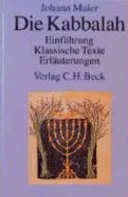
Die Kabbalah
 79
79

Die Kabbalah
Maier’s "Die Kabbalah" presents a formidable, if occasionally dry, exposition of its subject. The strength lies in its methodical breakdown of complex ideas, particularly the intricate relationships between the Sefirot. For instance, the explanation of the Sefirah Malkuth’s role as the final manifestation of divine will is rendered with commendable clarity. However, the work’s academic tone, while accurate, can sometimes obscure the experiential dimension that many readers associate with Kabbalah. The absence of direct engagement with 20th-century Kabbalistic revivalists is a notable limitation for those interested in contemporary practice. Maier’s contribution is a solid academic foundation, not a spiritual guide.
Verdict: A rigorously researched academic overview for the serious student.
📝 Description
79
Johann Maier's Die Kabbalah, published in 1995, examines Kabbalistic thought beyond superficial interpretations.
This 1995 book by Johann Maier provides a scholarly yet accessible overview of Kabbalistic thought. It aims to demystify this complex mystical tradition for a contemporary audience, moving beyond surface-level readings. The work is intended for serious students of comparative mysticism, religious studies scholars, and those with a dedicated interest in Jewish esoteric traditions.
Readers should expect to engage with dense philosophical and theological concepts; it is not a light introduction. The book emerged during a period of renewed academic and popular interest in esoteric subjects. Maier situates his work within ongoing scholarly discourse on Kabbalah, engaging with foundational texts and later interpretations. Its publication offered a comprehensive German-language resource.
Kabbalah, a Jewish mystical tradition, centers on understanding the divine and its relationship to the created world. Its core texts, such as the Zohar, interpret scripture through esoteric allegories and symbolic systems. Central to Kabbalah are concepts like Ein Sof (the Infinite) and the Sefirot, divine attributes or emanations that bridge the gap between God and creation. Maier's study addresses these fundamental elements, tracing their development and theological significance within Jewish mysticism.
💡 Why Read This Book?
• Learn the specific structure of the Sefirot, as detailed in Maier's analysis, to understand their hierarchical and interconnected divine emanations. • Grasp the historical development of Kabbalistic thought from its early stages through to the medieval period, as presented by Maier's scholarship. • Understand the theological significance of the Zohar, a foundational Kabbalistic text, through Maier's exposition of its core narratives and mystical concepts.
⭐ Reader Reviews
Honest opinions from readers who have explored this book.
❓ Frequently Asked Questions
What is the primary focus of Johann Maier's "Die Kabbalah"?
The book's primary focus is a scholarly examination of Kabbalistic thought, detailing its core doctrines, historical development, and key texts like the Zohar.
Is "Die Kabbalah" suitable for beginners interested in mysticism?
While comprehensive, the book's academic rigor makes it more suitable for those with some background in religious studies or esoteric traditions, rather than absolute beginners.
When was "Die Kabbalah" first published?
Johann Maier's "Die Kabbalah" was first published in 1995, offering a structured look at Jewish mysticism during a period of renewed academic interest.
Does the book discuss the practical application of Kabbalah?
The book primarily focuses on the theoretical and theological aspects of Kabbalah, with less emphasis on practical meditative or ritualistic applications.
What is the significance of the Sefirot in Kabbalah according to Maier?
Maier explains the Sefirot as divine emanations, describing their structure and interconnectedness as central to understanding God's manifestation in the world.
Does the book cover the influence of Kabbalah on other traditions?
While focusing on Jewish Kabbalah, Maier's work provides the foundational knowledge necessary to understand its later influences on Western esotericism.
🔮 Key Themes & Symbolism
The Sefirot as Divine Emanations
Maier meticulously details the ten Sefirot, the divine attributes or emanations through which God, the Ein Sof, interacts with creation. The work explores their complex relationships, their progression from the highest spiritual realms to the material world, and their symbolic representation in various Kabbalistic texts. Understanding the Sefirotic tree is presented as crucial for comprehending the Kabbalistic cosmology and the divine flow of energy.
The Zohar's Centrality
This book emphasizes the central role of the Zohar, the foundational text of Kabbalah. Maier analyzes its allegorical narratives, mystical interpretations of the Torah, and its contribution to developing concepts like the Sefirot and the divine union. The work positions the Zohar not just as a text, but as a living source of Kabbalistic doctrine and spiritual insight that profoundly shaped subsequent mystical thought.
Ein Sof and Divine Immanence
A core theme is the Kabbalistic concept of Ein Sof, the Infinite and Unknowable Divine Essence. Maier explores how Kabbalists grappled with the paradox of an infinite God creating and interacting with a finite universe. The Sefirot are presented as the bridge between Ein Sof and creation, illustrating the Kabbalistic understanding of divine immanence – God's presence within all aspects of existence.
Cosmological Structure
Maier outlines the Kabbalistic worldview, which often involves multiple spiritual worlds or realms. The book explains how these realms are structured and how divine influence flows through them, culminating in the physical world. This cosmological framework is essential for understanding the Kabbalistic view of the soul's journey, the nature of angels, and the interplay between the spiritual and material planes.
💬 Memorable Quotes
Direct passages from the work, attributed to the author.
“The Zohar offers allegorical interpretations of scripture to unveil hidden mystical meanings.”
— This interpretation emphasizes the Zohar's method of biblical exegesis, suggesting that its narratives and symbolism serve as keys to understanding deeper, spiritual truths about God and existence.
“Ein Sof is the absolute, undifferentiated divine unity beyond all comprehension.”
— This concept captures the Kabbalistic understanding of God in God's ultimate essence – an infinite, boundless, and transcendent reality that human intellect cannot fully grasp.
“Malkuth is the final Sefirah, representing the field of earthly manifestation.”
— This statement points to the Sefirah of Kingship, illustrating its position at the bottom of the Sefirotic tree and its role as the point where divine energy enters and is expressed in the physical world.
💡 Key Ideas
Editorial paraphrase of the work's core concepts — not direct quotes.
The Sefirot represent the divine attributes through which the Infinite reveals itself.
This paraphrased concept highlights the fundamental Kabbalistic idea that the Sefirot are not separate deities but channels or aspects of the singular, unknowable God (Ein Sof) that allow for interaction with the created world.
Kabbalah seeks to understand the relationship between the divine and the created universe.
This paraphrased idea frames Kabbalah as a system of thought concerned with cosmology and theology, aiming to elucidate the intricate connections and emanations linking God to all of existence.
🌙 Esoteric Significance
Tradition
This work is firmly rooted in the Kabbalistic tradition, a lineage of Jewish mysticism. It meticulously examines the development and core doctrines of Kabbalah, particularly as codified in medieval texts. Maier's approach adheres to a scholarly interpretation, tracing the evolution of concepts from early mystical movements through to the influential Lurianic Kabbalah and the widely disseminated Zohar, providing a historical and theological framework.
Symbolism
Central to the book's exploration of symbolism is the Sefirot, often depicted as a ten-runged tree. Maier details how each Sefirah (e.g., Keter, Chokmah, Binah) represents a distinct divine attribute or emanation, forming a map of divine consciousness and creation. Another key symbol is the divine name (e.g., YHWH), which Kabbalists believed held profound cosmic power and was intricately linked to the Sefirotic structure.
Modern Relevance
While Maier's work is primarily historical and academic, it serves as a crucial resource for contemporary scholars and practitioners of Western esotericism who seek a rigorous understanding of Kabbalah's origins. Thinkers and groups exploring Hermeticism, Rosicrucianism, and ceremonial magic often draw upon Maier's foundational exposition to contextualize Kabbalistic elements within their own systems.
👥 Who Should Read This Book
• Academic researchers in Jewish studies or comparative religion seeking a comprehensive overview of Kabbalistic thought and its textual history. • Students of Western Esotericism looking to understand the foundational Kabbalistic concepts that influenced later mystical and magical traditions. • Serious practitioners of Jewish mysticism who desire a scholarly text to deepen their theoretical knowledge of the Sefirot, Ein Sof, and the Zohar.
📜 Historical Context
Johann Maier's "Die Kabbalah," published in 1995, entered a landscape where academic study of Jewish mysticism was well-established, yet accessible syntheses in German remained less common than in English. The late 20th century saw a resurgence of interest in esoteric traditions, partly fueled by the New Age movement and a broader academic re-evaluation of non-Western philosophies. Maier's work positions itself within this scholarly tradition, engaging with established scholarship on texts like the Zohar and the writings of scholars such as Gershom Scholem, who had revolutionized Kabbalah studies in the mid-20th century. Unlike more popular, often syncretic interpretations of Kabbalah that emerged in the 1990s, Maier's approach is strictly academic, focusing on historical development and textual analysis rather than contemporary practical application or spiritual interpretation.
📔 Journal Prompts
The structure of the Sefirot as divine emanations.
The role of the Zohar in shaping Kabbalistic doctrine.
The concept of Ein Sof and its relation to the manifest world.
Maier's explanation of the cosmological realms.
The historical context of Kabbalah's development as presented in the text.
🗂️ Glossary
Ein Sof
The Kabbalistic term for the Infinite, Unknowable Godhead, understood as the ultimate divine essence beyond all description or comprehension.
Sefirot
The ten divine emanations or attributes through which Ein Sof manifests and interacts with creation, often depicted as a symbolic tree.
Zohar
The foundational text of Kabbalah, a collection of mystical commentaries on the Torah, written primarily in Aramaic, attributed to Rabbi Shimon bar Yochai.
Malkuth
The tenth and final Sefirah, representing the Kingdom or Realm, often associated with the physical world and the culmination of divine manifestation.
Gematria
A system of Jewish numerology that assigns numerical values to Hebrew letters, used in Kabbalah for mystical interpretation of texts.
Tzimtzum
The Kabbalistic concept of divine contraction or withdrawal, understood as the necessary act by Ein Sof to create a space for the universe.
Shekhinah
The feminine aspect of the divine presence, often associated with the Sefirah Malkuth, representing God's immanence and dwelling among creation.