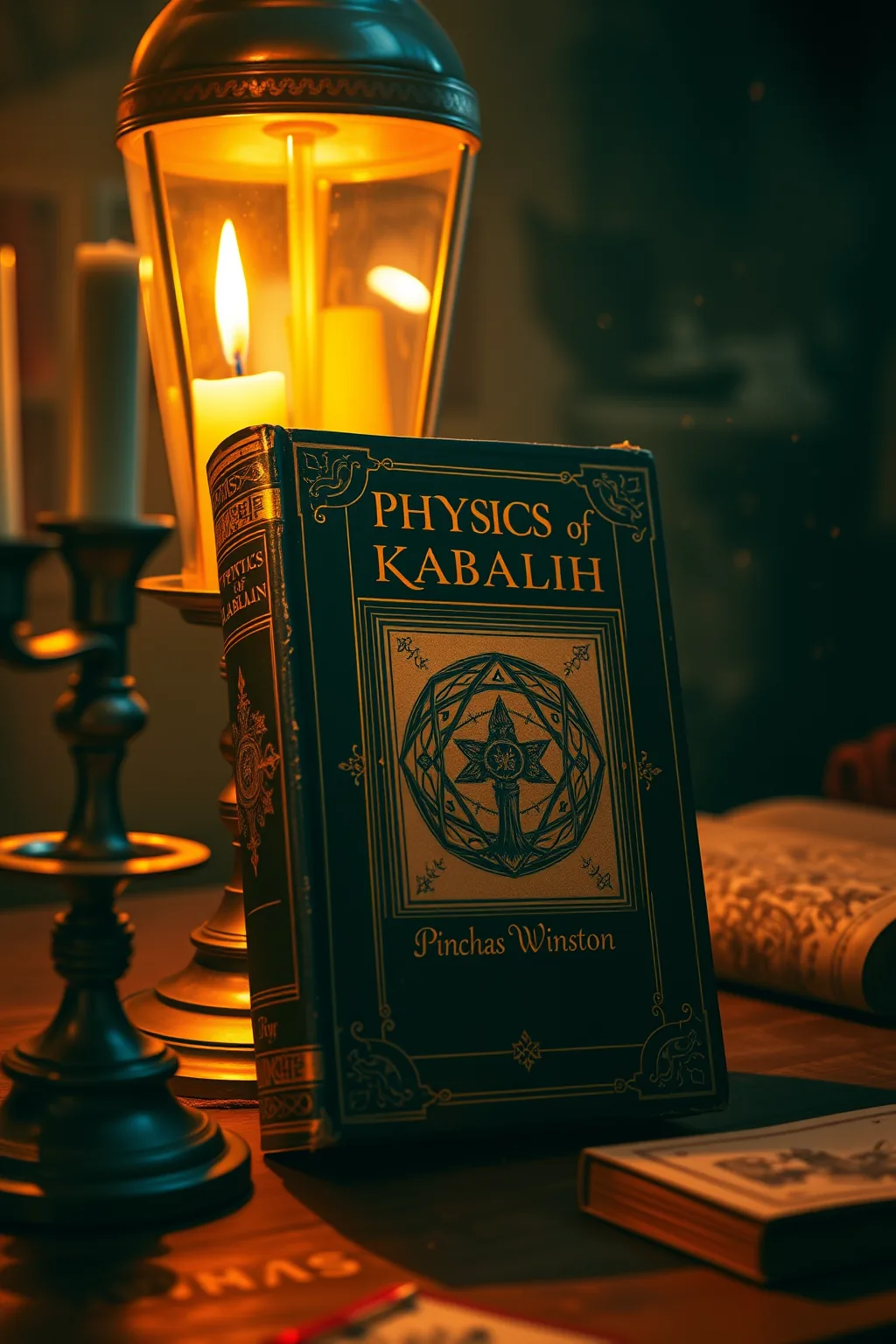
Physics of Kabbalah
 61
61

Physics of Kabbalah



Sophia Crane (Associate Editor) — Pinchas Winston's "Physics of Kabbalah" is a monumental achievement in esoteric scholarship, offering a potent synthesis of ancient Kabbalistic principles and modern scientific inquiry. Winston's unique ability to translate abstract mystical concepts into tangible, relatable frameworks is nothing short of brilliant. He meticulously unravels the intricate symbolism of the Sefirot and their interplay, presenting them as fundamental forces akin to those studied in physics. This work is indispensable for anyone seeking a deeper, more structured understanding of Jewish mysticism, moving beyond mere interpretation to uncover the underlying operational mechanics of the divine. Highly recommended for serious students and practitioners of Kabbalah.
📝 Description
61
Pinchas Winston's 2007 "Physics of Kabbalah" argues Kabbalah is a science describing cosmic forces.
This book examines Kabbalistic teachings not as a system of belief, but as a scientific framework for understanding reality. Pinchas Winston interprets the symbolism of the Tree of Life as a map of fundamental cosmic forces. He connects these ancient Hebrew mystical concepts to the structure of the universe.
The author uses rigorous scholarship to bridge the gap between empirical observation and spiritual understanding. The book discusses causality, consciousness, and the interconnectedness of all things. It presents Kabbalah as a sophisticated method for grasping the nature of creation, linking the material world with the spiritual or unseen dimensions.
This work situates Kabbalah within a tradition that seeks to understand divine principles and cosmic order through symbolic interpretation and mystical experience. It draws parallels between Kabbalistic concepts, such as the Sefirot, and the underlying structure of the physical universe. The book engages with the idea of a unified field or blueprint that governs all existence, a theme found in various esoteric traditions that explore the relationship between the microcosm and the macrocosm.
💡 Why Read This Book?
Unlock the universe's hidden blueprint. "Physics of Kabbalah" offers a unique lens through which to perceive the interconnectedness of all existence, revealing the profound, almost scientific, structure within ancient Jewish mystical thought. Ideal for seekers of deeper meaning, scholars of comparative mysticism, and practitioners looking to ground their spiritual work in a robust, conceptual framework. This book transforms abstract concepts into an accessible, yet profound, exploration of reality's fundamental laws.
⭐ Reader Reviews
Honest opinions from readers who have explored this book.
❓ Frequently Asked Questions
Is this book suitable for beginners in Kabbalah?
While "Physics of Kabbalah" delves into complex themes, Pinchas Winston's clear prose and structured approach make it accessible to dedicated beginners eager to grasp the foundational principles and underlying 'physics' of this ancient wisdom tradition.
What is the primary focus of the 'Physics' aspect?
The 'Physics' refers to Kabbalah's intricate system of spiritual forces, divine emanations (Sefirot), and their interconnectedness, presented as a framework for understanding the mechanics of creation and spiritual law, not as literal scientific physics.
Does the book require prior knowledge of Hebrew?
Prior knowledge of Hebrew is not strictly required, as the book primarily focuses on conceptual understanding and symbolic interpretation. However, an appreciation for Hebrew terms and their mystical significance will enhance the reading experience.
How does this book relate to traditional Kabbalistic texts?
It offers a unique interpretative framework for traditional Kabbalistic texts, presenting their esoteric teachings through a lens that emphasizes their inherent structure and operational principles, bridging ancient wisdom with a modern conceptual approach.
What are the main benefits of studying the 'physics' of Kabbalah?
Studying the 'physics' of Kabbalah provides a deeper understanding of spiritual causality, the dynamics of divine influence, and the interconnectedness of the material and spiritual realms, fostering a more comprehensive and integrated spiritual practice.
🔮 Key Themes & Symbolism
The Sefirotic Matrix
This book elucidates the Sefirot not as abstract divine attributes, but as dynamic, interconnected forces forming the fundamental architecture of reality. Winston explores their interplay as the 'physics' that governs creation, influencing everything from cosmic order to individual consciousness. Understanding this matrix reveals the underlying energetic currents and causal relationships that shape existence, providing a profound framework for comprehending the divine mechanics of the universe.
Symbolism as Universal Language
"Physics of Kabbalah" posits that the detailed symbolism within Jewish mysticism serves as a universal language, encoding profound truths about the cosmos and the divine. Winston deciphers these symbols, from the Hebrew alphabet to the Tree of Life, revealing them as keys to unlocking the hidden laws of existence. This perspective treats sacred imagery as a scientific notation, a means to articulate the ineffable and understand the fundamental principles that govern spiritual and material phenomena.
Kabbalah as Applied Metaphysics
Pinchas Winston presents Kabbalah not just as a theoretical system, but as a practical science of applied metaphysics. The 'physics' of Kabbalah refers to the operational understanding of how divine energies manifest and interact within creation. This book guides the reader to perceive these dynamics, offering insights into the causal chains that link intention, manifestation, and spiritual evolution, thereby empowering individuals to engage with the universe on a more conscious and profound level.
💬 Memorable Quotes
Direct passages from the work, attributed to the author.
“Symbolism is the language of the soul, speaking truths the mind cannot grasp.”
— This highlights the esoteric power of symbols in Kabbalah, positing them as direct conduits to higher understanding, bypassing the limitations of rational thought.
“Every letter holds a universe, every name a divine force.”
— This profound statement underscores the intricate power embedded within the Hebrew alphabet and divine names in Kabbalistic tradition, suggesting immense cosmic potential within each element.
“The Tree of Life is not a map, but the blueprint of consciousness itself.”
— This redefines the Tree of Life from a mere diagram to the very structure and operational system of spiritual awareness and the cosmos, emphasizing its dynamic and functional nature.
“To know the physics of Kabbalah is to understand the mechanics of miracles.”
— This suggests that by comprehending the underlying principles of Kabbalistic emanation and interaction, one can begin to understand how seemingly miraculous events align with divine laws.
💡 Key Ideas
Editorial paraphrase of the work's core concepts — not direct quotes.
The universe is not random; it is built upon divine principles.
This quote emphasizes the ordered, structured nature of creation according to Kabbalistic thought, suggesting that underlying the apparent chaos lies a profound, divinely ordained system.
🌙 Esoteric Significance
Tradition
This work is deeply rooted in the tradition of Lurianic Kabbalah, which emphasizes the dynamic interplay of divine forces, cosmic repair (Tikkun), and the intricate structure of spiritual worlds. It draws heavily on the symbolic language and hermeneutic methods developed over centuries, reinterpreting these concepts through a lens that highlights their inherent 'physics' – the underlying principles and mechanics of spiritual emanation and interaction.
Symbolism
The core symbolism revolves around the Tree of Life (Etz Chaim), the ten Sefirot (divine emanations), and the Hebrew letters. Winston interprets these not as static representations but as active energetic principles. The Sefirot are presented as fundamental forces governing creation, akin to scientific constants, while the letters represent the building blocks of reality. The intricate relationships and pathways between these symbols form the 'physics' of the Kabbalistic cosmos.
Modern Relevance
In an era often characterized by materialism and spiritual fragmentation, "Physics of Kabbalah" offers a profound synthesis. It demonstrates that ancient mystical traditions hold sophisticated frameworks for understanding existence that can resonate with modern scientific inquiry. The book's relevance lies in its ability to provide seekers with a structured, meaningful cosmology, offering insights into consciousness, causality, and the interconnectedness of all things, thereby fostering a more integrated and holistic approach to life and spirituality.
👥 Who Should Read This Book
This useful text is essential for serious students and practitioners of Kabbalah, offering a unique conceptual framework to deepen their understanding of its intricate systems. Scholars of comparative religion and mysticism will find its interdisciplinary approach useful for exploring the universal principles underlying spiritual traditions. For the spiritual seeker yearning for a profound, structured understanding of the cosmos and their place within it, "Physics of Kabbalah" provides a roadmap to the hidden architecture of reality, moving beyond mere philosophy to reveal the very mechanics of creation.
📜 Historical Context
The study of Kabbalah, with its roots stretching back to ancient Israel, flourished significantly in medieval Europe, particularly in Spain and Provence during the 13th century with the emergence of the Zohar. The Renaissance saw a resurgence of interest, often intertwined with Neoplatonism and Hermeticism, leading to interpretations that sought universal spiritual laws. Pinchas Winston's "Physics of Kabbalah" emerges within this lineage, building upon centuries of esoteric exploration. It responds to a modern spiritual hunger for structured, rational frameworks that can accommodate both scientific understanding and profound mystical experience. The book reflects a contemporary desire to reintegrate ancient wisdom into a holistic worldview, demonstrating Kabbalah's enduring relevance as a sophisticated system for understanding the universe's fundamental workings.
📔 Journal Prompts
Reflect on a time you perceived a hidden order or connection in an seemingly chaotic event. How might the Sefirotic model offer insight?
Consider the Hebrew alphabet as building blocks of reality. What 'words' or 'concepts' do you feel are foundational to your own existence?
How does understanding Kabbalah as a 'physics' of creation change your perception of miracles or divine intervention?
Explore the symbolic language you use in your daily life. How does it shape your thoughts and actions, akin to Kabbalistic symbolism?
Contemplate the interconnectedness of all things. How can a deeper understanding of this connection influence your personal spiritual practice and interactions with the world?
🗂️ Glossary
Sefirot
The ten divine emanations or attributes through which God reveals Himself and creates the universe. They form the structure of the Tree of Life and represent distinct energetic forces.
Tree of Life (Etz Chaim)
A central symbolic diagram in Kabbalah, representing the totality of creation and the pathways of divine emanation. It consists of ten Sefirot connected by 22 pathways, often seen as the blueprint of the cosmos and consciousness.
Ein Sof
The Kabbalistic concept of God as infinite, boundless, and unknowable. It represents the divine essence before any manifestation or emanation into creation.
Tzimtzum
The act of divine 'contraction' or withdrawal by Ein Sof to create a 'space' for creation to exist. It is the primordial act that allows for multiplicity and distinctness in the universe.
Kavanah
Intent or concentration, particularly in prayer and ritual. In Kabbalah, Kavanah refers to the focused intention required to direct spiritual energy and connect with divine realms.
This book appears in 1 collection
🔮 Readers Also Liked
Browse all →







More by Pinchas Winston
All books →
From the “Kabbalah” Collection
View all →







More Free Kabbalah & Jewish Mysticism Books
View all →