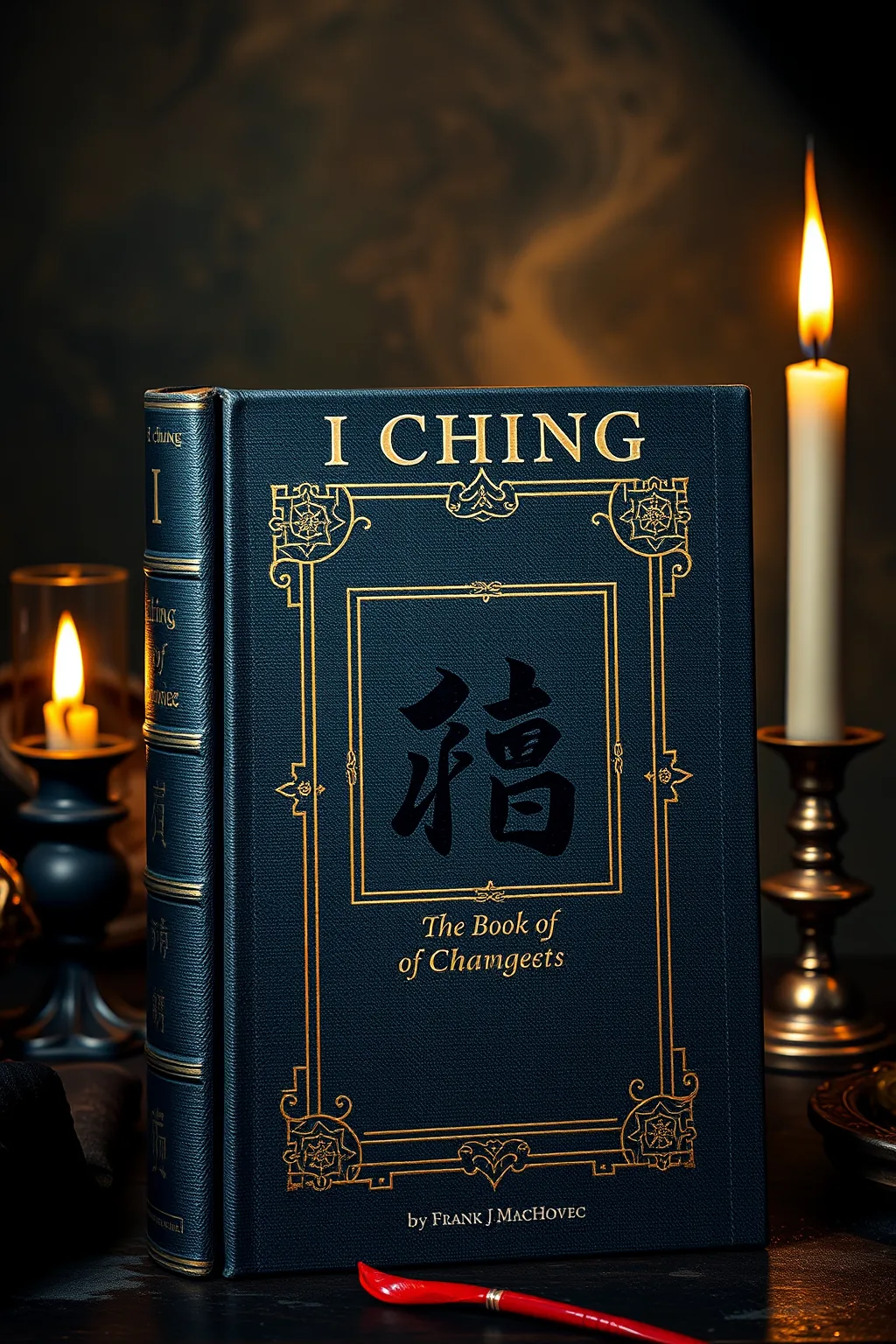
I ching; the book of changes
 61
61

I ching; the book of changes



Frank J. MacHovec's rendition of the *I Ching* is a monumental contribution to esoteric literature. This edition doesn't just translate; it illuminates, offering profound clarity on the ancient hexagrams and their intricate symbolism. MacHovec's scholarship shines, revealing the deep philosophical underpinnings and the sophisticated divination techniques embedded within this sacred text. It is an indispensable resource for seasoned practitioners of the Taoist arts and a compelling entry point for serious students of Eastern mysticism. The work's strength lies in its ability to distill complex cosmic principles into accessible, yet deeply resonant, guidance. A truly essential acquisition for any serious library of the arcane.
📝 Description
61
Frank J. MacHovec's 1995 edition of the I Ching unlocks its symbolic language and philosophical inquiry.
Frank J. MacHovec's edition of the I Ching, the Book of Changes, presents a significant Chinese classic. This version aims to clarify the text's symbolic language and philosophical underpinnings. The I Ching functions as more than a divination tool; it describes cosmic forces and the interplay of Yin and Yang.
MacHovec's work illuminates the hexagrams, showing the archetypes they represent and the insights they offer on human experience and reality. It is intended for those interested in esoteric traditions, seeking a deeper understanding of forces influencing destiny. The book connects ancient thought to contemporary guidance and a sense of cosmic order, promoting self-discovery and balanced living.
The I Ching is a cornerstone of Chinese esoteric thought, predating many Taoist and Confucian concepts. Its hexagram system, derived from combinations of broken and unbroken lines, maps patterns of change in the universe. This edition by MacHovec makes these complex patterns accessible to a modern audience. It connects the I Ching to broader esoteric traditions that seek to understand universal laws and human participation within them.
💡 Why Read This Book?
Unravel the ancient secrets of cosmic harmony and personal destiny. This edition offers a profound gateway into the philosophical and divinatory power of the *I Ching*. Ideal for spiritual seekers, philosophy enthusiasts, and practitioners of ancient wisdom who wish to deepen their understanding of universal patterns and navigate life's complexities with profound insight.
⭐ Reader Reviews
Honest opinions from readers who have explored this book.
❓ Frequently Asked Questions
What is the primary purpose of the I Ching?
The I Ching serves as both a profound philosophical text and a sophisticated divinatory tool, offering insights into the nature of change, balance, and the cosmic forces that shape existence. It provides guidance for decision-making and self-understanding.
Who was Frank J. MacHovec?
Frank J. MacHovec was a dedicated scholar and translator specializing in Eastern philosophies and esoteric traditions, known for his insightful renditions of classical texts.
How is the I Ching used for divination?
Divination involves casting yarrow stalks or coins to generate a hexagram, which is then interpreted using the text's commentary to understand the current situation and potential future developments.
What are the core concepts of the I Ching?
Key concepts include Yin and Yang (complementary opposites), the Eight Trigrams (Ba Gua), the Sixty-four Hexagrams, and the dynamic principles of constant change and transformation.
Is this book suitable for beginners?
Yes, while the I Ching is profound, MacHovec's edition aims for clarity, making it accessible for dedicated beginners eager to explore its wisdom alongside seasoned practitioners.
🔮 Key Themes & Symbolism
The Dynamics of Change
The *I Ching* is fundamentally a philosophy of constant flux. It teaches that nothing remains static and that understanding the principles of change is key to navigating life's challenges and opportunities. The text illustrates how seemingly opposite forces, like Yin and Yang, are in perpetual interaction, creating the conditions for transformation and evolution. This theme encourages adaptability, foresight, and a graceful acceptance of life's inherent impermanence.
Cosmic Harmony and Balance
Central to the *I Ching*'s wisdom is the concept of maintaining equilibrium within oneself and in relation to the external world. Through its hexagrams and their associated commentaries, the text provides guidance on how to align one's actions with the natural order of the universe. Achieving balance prevents stagnation and conflict, fostering a state of flowing harmony that leads to well-being and auspicious outcomes, reflecting the interconnectedness of all things.
Symbolic Language of the Universe
The *I Ching* employs a wide range of symbols, most notably the trigrams and hexagrams, to represent the fundamental archetypes and forces at play in creation. Each symbol is a condensed expression of complex phenomena, offering a profound language through which to understand the subtle workings of the cosmos and the human psyche. Deciphering this symbolic lexicon unlocks deeper layers of meaning and intuitive understanding.
💬 Memorable Quotes
Direct passages from the work, attributed to the author.
“The superior man acts before he speaks, and then speaks according to his action.”
— This highlights the principle of integrity and authenticity, where actions are the foundation of one's truth, and words naturally follow and confirm them. It emphasizes living in alignment with one's true nature.
“The wise man finds joy in his own virtue.”
— True contentment arises not from external validation or material possessions, but from the internal cultivation of one's moral character and ethical principles. It is the reward of living a virtuous life.
“What is done in the world is done by the man who is not afraid of doing.”
— This emphasizes the courage and decisiveness required to enact change and achieve one's goals. Overcoming fear is essential to manifest intentions and contribute meaningfully to the world.
“The superior man understands the signs of the times.”
— This underscores the importance of discernment and awareness, recognizing the subtle indications and trends that signal opportune moments for action or periods of caution.
💡 Key Ideas
Editorial paraphrase of the work's core concepts — not direct quotes.
When the wise man is born, he becomes the whole world.
This quote speaks to the expansive consciousness achieved through enlightenment, where the individual transcends ego and identifies with the universal, realizing their oneness with all existence.
🌙 Esoteric Significance
Tradition
The *I Ching* is a core part of Taoist and Chinese esoteric philosophy, deeply intertwined with concepts of cosmic order, natural law, and the balance of Yin and Yang. It serves as a primary text for understanding the principles of the Tao, the subtle energies (Qi) that govern the universe, and the art of aligning oneself with these forces for optimal living and spiritual growth.
Symbolism
Its core symbolism lies in the sixty-four hexagrams, each formed by six lines, either solid (Yang) or broken (Yin). These hexagrams represent archetypal situations and transformations in nature and human life. The trigrams (Ba Gua) are foundational, symbolizing elemental forces and fundamental aspects of existence, such as Heaven, Earth, Thunder, and Water, providing a rich symbolic language for cosmic understanding.
Modern Relevance
In the modern era, the *I Ching* offers a powerful antidote to the chaos and uncertainty of contemporary life. Its emphasis on adaptability, mindful action, and understanding cyclical patterns provides practical guidance for navigating complex challenges. Esoterically, it remains a vital tool for introspection, self-awareness, and developing intuition, allowing individuals to connect with deeper wisdom and foster a sense of equilibrium in a rapidly changing world.
👥 Who Should Read This Book
This edition of the *I Ching* is an invaluable resource for a diverse audience. **Beginners** seeking an accessible yet profound introduction to ancient Chinese wisdom and divination will find MacHovec's clarity useful. **Scholars of Eastern philosophy and mysticism** will appreciate the depth and scholarly rigor. **Spiritual seekers** looking for guidance on personal growth, decision-making, and understanding life's subtle currents will discover a powerful oracle. **Practitioners of various esoteric arts**, including Taoism and geomancy, will find it an essential text for deepening their practice and expanding their understanding of cosmic principles.
📜 Historical Context
Originating in ancient China, the *I Ching* (Book of Changes) boasts a history spanning over three millennia, making it one of the oldest and most influential texts in human civilization. Its roots are deeply embedded in shamanistic practices and early philosophical inquiries into the nature of reality and the cosmos. Over centuries, it evolved from a divinatory manual to a profound philosophical and ethical treatise, influencing Taoism, Confucianism, and countless aspects of Chinese culture, art, and governance. During the Zhou Dynasty (c. 1046–256 BCE), its systematization and philosophical interpretation, particularly by scholars like King Wen and the Duke of Zhou, solidified its canonical status. Its enduring legacy lies in its ability to provide a framework for understanding universal principles of change, balance, and cyclical patterns, resonating across diverse eras and cultures.
📔 Journal Prompts
Reflect on a recent 'change' in your life. How did the principles of the I Ching apply?
Consider the balance of Yin and Yang in your daily routine. Where can you find greater harmony?
What archetypal situation does a frequently occurring hexagram represent for you?
How can you better 'understand the signs of the times' in your personal or professional life?
If the I Ching were to offer you one piece of advice today, what would it be based on your current circumstances?
🗂️ Glossary
Hexagram
A symbol composed of six stacked lines, each either solid (Yang) or broken (Yin). There are sixty-four unique hexagrams in the I Ching, representing complex situations and transformations.
Trigram (Ba Gua)
A symbol composed of three stacked lines (Yang or Yin). There are eight trigrams, representing fundamental elements and forces of nature such as Heaven, Earth, and Water.
Yin
The principle of receptivity, darkness, passivity, femininity, and the moon. It is often represented by a broken line in the I Ching.
Yang
The principle of activity, light, assertiveness, masculinity, and the sun. It is often represented by a solid line in the I Ching.
Tao
The fundamental, ineffable principle underlying all existence in Taoist philosophy; the 'Way' or the natural order of the universe.
This book appears in 3 collections
🔮 Readers Also Liked
Browse all →







More by Frank J. MacHovec
All books →
From the “Tarot” Collection
View all →







More Free Divination & Tarot Books
View all →