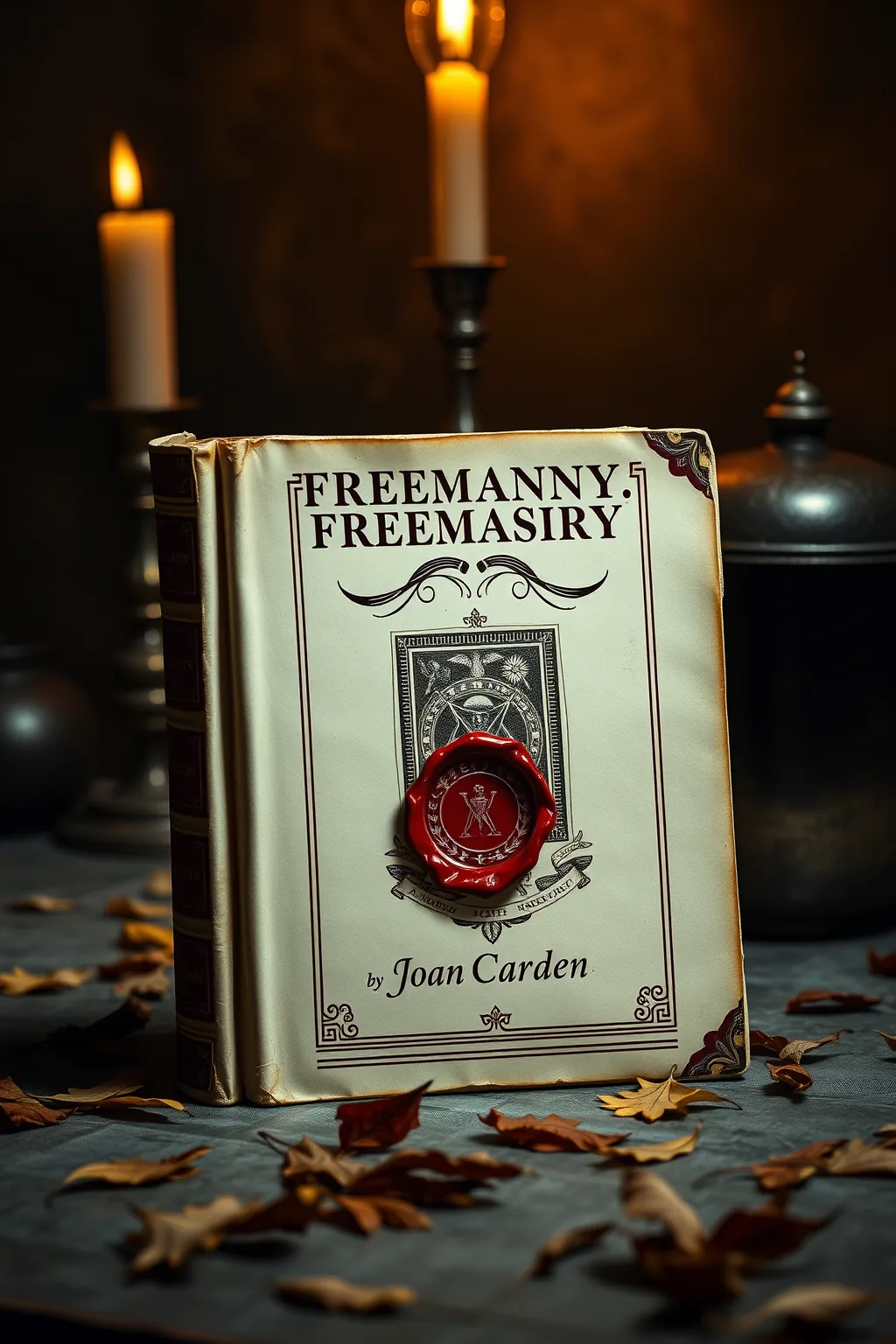
Freemasonry and the ancient wisdom, Qabalah
 61
61

Freemasonry and the ancient wisdom, Qabalah


Cassian Rothmann, Senior Critic, Ancient Wisdom — Joan Carden's 'Freemasonry and the Ancient Wisdom: Qabalah' is a seminal work for anyone seeking to understand the deep esoteric connections between these two powerful traditions. Carden's scholarship is evident as she navigates the complex symbology and philosophical underpinnings, revealing how Qabalistic principles have permeated Masonic thought and practice. The book offers crucial insights into the spiritual architecture of both disciplines, making it an indispensable resource for serious students of Western esotericism. Its strength lies in its clarity and its ability to illuminate previously obscure links, providing a comprehensive guide for practitioners and scholars alike who wish to deepen their understanding of mystical pathways.
📝 Description
61
Joan Carden's 1979 book connects Freemasonry's symbols with Qabalistic teachings.
Joan Carden's 'Freemasonry and the Ancient Wisdom: Qabalah' examines the relationship between Masonic symbolism and Qabalistic philosophy. The author details how elements within Freemasonry, such as its rituals and allegorical teachings, mirror the structure and concepts found in the Qabalah, particularly the Tree of Life. Carden analyzes the symbolic language common to both traditions, focusing on areas like sacred geometry, numerology, and celestial correspondences.
The book aims to show how these seemingly distinct systems share a common root in ancient esoteric thought. It deciphers specific symbols and philosophical ideas, suggesting they contribute to a broader understanding of spiritual development. Carden's work invites readers to see connections that illuminate a path toward self-knowledge and a perception of underlying universal principles. The text bridges Eastern and Western esoteric legacies, offering a unified perspective on spiritual inquiry.
This book is situated within the Western esoteric tradition, specifically focusing on the intersection of two prominent streams: Freemasonry and Kabbalah. It operates on the premise that both systems, despite their historical and structural differences, draw from a common reservoir of ancient wisdom concerning cosmology, human nature, and spiritual transformation. Carden's work engages with the symbolic language and philosophical frameworks that have historically been used to map the divine order and humanity's place within it, often referencing concepts like the divine emanations and the path of initiation.
💡 Why Read This Book?
Uncover the profound, often hidden, connections between Freemasonry and the ancient Qabalistic system. This book offers a unique lens through which to understand the symbolic language and philosophical depth of both traditions. Ideal for seekers of esoteric truth, practitioners looking to enrich their understanding of ritual and symbolism, and scholars interested in the cross-pollination of mystical ideas across cultures and epochs.
⭐ Reader Reviews
Honest opinions from readers who have explored this book.
❓ Frequently Asked Questions
What is the primary focus of this book?
The book's primary focus is to explore and illuminate the intricate connections and shared esoteric principles between Freemasonry and the ancient wisdom of the Qabalah, revealing how one has influenced and informed the other throughout history.
Is prior knowledge of Freemasonry or Qabalah required?
While prior knowledge can enhance the reading experience, the book is written in a way that makes it accessible to those new to these subjects, offering clear explanations of core concepts and symbolism.
What kind of symbolism is discussed?
The book delves into a rich array of symbolism, including the Tree of Life, divine emanations, Hebrew letters, geometric patterns, alchemical principles, and the allegorical narratives found within both Masonic rituals and Qabalistic lore.
Who is the intended audience for this book?
The intended audience includes Freemasons seeking deeper meaning in their craft, students of Kabbalah, practitioners of Western esotericism, philosophers, and anyone interested in the mystical and spiritual dimensions of ancient traditions.
Does the book offer practical applications of Qabalistic or Masonic principles?
While primarily an exploration of theory and symbolism, the insights gained can profoundly inform and enrich the personal spiritual practices and understanding of those engaged with these traditions.
🔮 Key Themes & Symbolism
The Tree of Life and Masonic Degrees
This theme meticulously charts the correlation between the ten Sephiroth on the Qabalistic Tree of Life and the progressive stages or degrees within Freemasonry. Carden demonstrates how the ascent through the Masonic initiations mirrors the journey through the divine emanations, offering a symbolic blueprint for spiritual growth and understanding the nature of the cosmos and the divine.
Hebrew Alphabet as Sacred Geometry
The profound significance of the Hebrew alphabet within Qabalistic thought is explored, highlighting its role not merely as letters but as sacred geometric forms and carriers of cosmic vibration. The book illustrates how these principles are subtly integrated into Masonic symbolism, revealing a deeper layer of meaning in sacred geometry and the power of divine language.
Universal Principles of Esoteric Initiation
This theme focuses on the shared essence of initiation as a transformative process across different spiritual disciplines. Carden argues that both Freemasonry and Qabalah offer distinct yet convergent pathways for the aspirant to achieve self-knowledge, connect with higher consciousness, and understand their place within the divine order of the universe.
💬 Memorable Quotes
Direct passages from the work, attributed to the author.
“Wisdom is not found, but built.”
— This suggests that true spiritual understanding is not passively received but actively constructed through diligent study, practice, and inner work, mirroring the 'building' metaphor in Freemasonry.
“The microcosm reflects the macrocosm.”
— A fundamental esoteric principle highlighting the interconnectedness of the individual human being (microcosm) with the universe (macrocosm), a concept central to both Qabalistic and Masonic philosophies.
“The veiled truths await the discerning eye.”
— This points to the hidden nature of esoteric knowledge, accessible only to those who cultivate perception and dedicate themselves to unraveling the deeper meanings behind apparent realities.
“Ascent is a journey through light and shadow.”
— This metaphor describes the spiritual path as one involving both illumination and the confrontation of one's own inner darkness, a process integral to transformative initiations.
💡 Key Ideas
Editorial paraphrase of the work's core concepts — not direct quotes.
The symbols are keys, not locks.
This quote emphasizes that the strong symbolism within Freemasonry and Qabalah is intended to unlock understanding and consciousness, rather than to obscure or restrict knowledge.
🌙 Esoteric Significance
Tradition
This work is deeply rooted in Western Esotericism, specifically exploring the intersection of Kabbalah (Jewish Mysticism) and Freemasonry. It examines how Qabalistic concepts, such as the Tree of Life, divine emanations, and gematria, have been assimilated and reinterpreted within the symbolic language and ritualistic structure of Masonic orders, offering a bridge between ancient Hebrew mysticism and Western initiatory traditions.
Symbolism
The book's esoteric significance lies in its profound decoding of the symbolic language shared by both disciplines. It illuminates how the Tree of Life acts as a cosmic map, how Hebrew letters are imbued with divine power, and how geometric principles and allegorical narratives within Freemasonry echo Qabalistic teachings on creation, consciousness, and spiritual evolution. The symbolism serves as a vehicle for understanding divine order and the path of human transformation.
Modern Relevance
In contemporary times, 'Freemasonry and the Ancient Wisdom: Qabalah' remains highly relevant for individuals seeking to understand the perennial philosophy and the underlying unity of spiritual traditions. It offers practitioners of both Freemasonry and Kabbalah a deeper appreciation of their respective systems, revealing how ancient wisdom can inform modern spiritual seeking, personal development, and the pursuit of higher consciousness in an increasingly complex world.
👥 Who Should Read This Book
This book is an invaluable resource for a diverse audience. Freemasons, particularly those in higher degrees, will find it offers useful insights into the symbolic underpinnings of their rituals and teachings. Students of Kabbalah will discover how its principles have been adopted and adapted in a Western initiatory context. Seekers of esoteric knowledge and practitioners of Western mysticism will benefit from its clear exposition of interconnected spiritual philosophies. Scholars of comparative religion and philosophy will find it a compelling study in the transmission and transformation of mystical ideas across cultural and historical divides.
📜 Historical Context
Published in an era of renewed interest in esoteric traditions and their historical connections, 'Freemasonry and the Ancient Wisdom: Qabalah' emerged at a time when scholars and practitioners were actively seeking to bridge perceived divides between various mystical systems. The late 19th and early 20th centuries saw a surge in the study of Hermeticism, Kabbalah, and Rosicrucianism, often intertwined with Masonic lore. This period was marked by a desire to uncover a universal spiritual science underlying diverse religious and philosophical expressions. Joan Carden's work contributes to this intellectual current by offering a systematic exploration of how Qabalistic thought, with its roots in Jewish mysticism, found fertile ground and expression within the symbolic framework of Freemasonry, particularly in its higher degrees. The book reflects a broader trend of seeking ancient wisdom in a modernizing world, aiming to reveal the enduring spiritual truths that transcend time and cultural boundaries.
📔 Journal Prompts
Reflect on a Masonic symbol that speaks to you. How might its meaning be amplified by a Qabalistic interpretation?
Consider the concept of divine emanation. How does this idea manifest in your own spiritual understanding or practices?
What does the idea of 'building' oneself spiritually mean to you? Connect this to Masonic and Qabalistic concepts of creation and transformation.
Explore the relationship between 'microcosm' and 'macrocosm' in your daily life. Where do you see the universal reflected in the personal?
How can the pursuit of hidden knowledge, as discussed in the book, contribute to personal growth and a deeper connection with the divine?
🗂️ Glossary
Qabalah
A complex system of Jewish mysticism that explores the nature of God, creation, and the spiritual universe through symbolic interpretation of scripture and esoteric teachings, often centered around the Tree of Life.
Tree of Life (Etz Chaim)
A central diagram in Kabbalah, representing the ten Sephiroth (divine emanations) and the paths connecting them, symbolizing the structure of the universe and the pathway of spiritual ascent.
Sephiroth
The ten divine attributes or emanations emanating from God in Qabalistic cosmology, each representing a distinct aspect of the divine and a stage in creation.
Gematria
A method of interpreting scripture by calculating the numerical value of Hebrew letters and words, revealing hidden connections and meanings.
Esotericism
Belief systems and practices concerned with hidden knowledge, inner spiritual truths, and mystical experiences, often communicated through symbolism and allegory rather than literal interpretation.
This book appears in 1 collection
🔮 Readers Also Liked
Browse all →







From the “Kabbalah” Collection
View all →









More Free Kabbalah & Jewish Mysticism Books
View all →